On this page
How to identify it
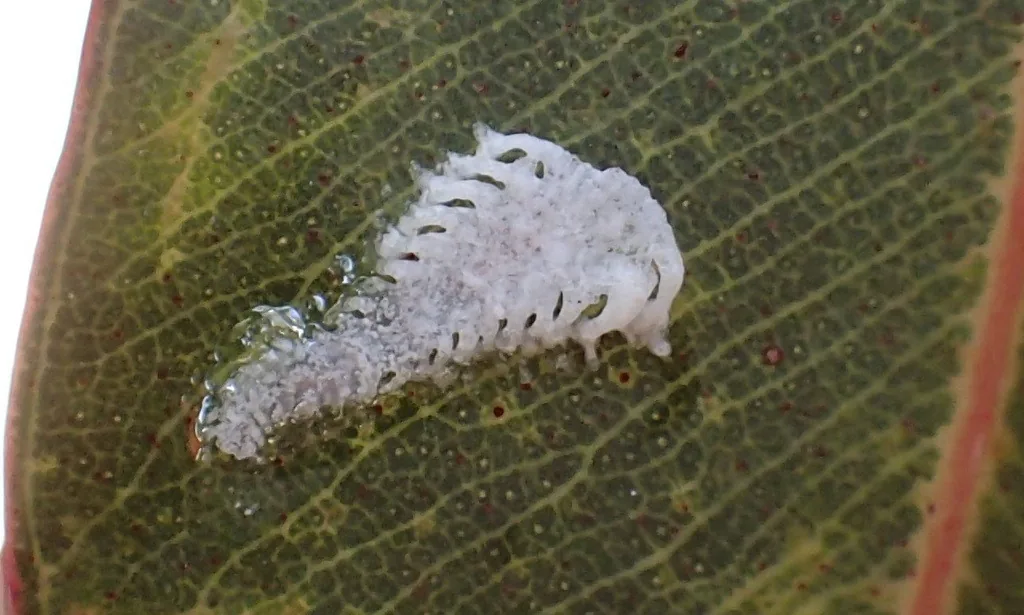
- Nymphs build a lerp, a protective cover made mostly of crystallized honeydew. It is flattened, roughly triangular and funnel shaped, with rib-like ridges that resemble a small skeletal backbone. Lerps grow larger as the nymph ages.[1][3]
- Nymphs are yellow, or yellow and brown. Unlike redgum lerp psyllid nymphs, they move freely in and out of their lerps, several can share one lerp, and a nymph crawls away if its lerp is disturbed.[1]
- Adults are slender, green and about 3 mm long, slightly smaller than redgum lerp psyllid adults.[1][2]
- Eggs are yellow when first laid and darken to slate gray. They stand upright on the leaf, mostly on the lower half.[1]
Look-alikes
| Look-alike | How to tell them apart |
|---|---|
| Redgum lerp psyllid | Its nymphs look similar, but they do not move freely in and out of their lerps the way spotted gum lerp psyllid nymphs do, and its adults are slightly larger.[1] |
| Lemongum psyllid (Cryptoneossa triangula) | Found alongside it on lemon-scented and spotted gums in the Anaheim area in 2000. It lives free on the leaves and also shelters under spotted gum lerp psyllid lerps.[2][3] |
| Bluegum psyllid | Another eucalyptus psyllid in California, but it feeds on baby blue gum and juvenile blue gum foliage and covers leaves and tips with fluffy wax instead of building ribbed lerps.[3] |
Where it lives
Native to Australia. In California it was first found in Los Angeles in 2000 and soon after in Anaheim, Orange County, and by 2001 it was in Oceanside and Encinitas in San Diego County, which the county then described as generally infested. In 2002 researchers described it as restricted to California and Australia.[1][2][4]
Biology and life cycle
In California it attacks lemon-scented gum (Eucalyptus citriodora) and spotted gum (E. maculata). It attacks only certain eucalyptus species, and on some others its eggs cannot complete development.[1][3]
In southern California, populations generally peak twice a year, in late spring to early summer and again in fall.[2]
In Australia it has three generations a year around Adelaide, prefers fully mature leaves, and ants tend the nymphs for their honeydew. Eggs hatch in 10 to 20 days in spring and summer but can take months in winter.[1]
Stressed eucalyptus trees can carry more nitrogen in their leaves, which increases psyllid reproduction and survival, and egg-laying females and nymphs favor soft new shoots pushed out by quick-release fertilizer.[1]
Damage and signs
- The psyllids produce large amounts of honeydew that drips onto cars and sidewalks and stains the ground beneath trees, where black sooty mold grows on it.[1][2]
- Heavy infestations cause leaf drop and may weaken trees, making them more vulnerable to drought and to fatal attack by other insects. There is concern that feeding may eventually kill host trees.[1][2]
Health risk
The sources describe it only as a tree pest and a honeydew nuisance; none mentions bites or any risk to people or pets.[1][2]
Control
Prevention
Keep eucalyptus unstressed. During long dry periods, water infrequently but deeply, applying it slowly beneath the outer canopy rather than near the trunk, and avoid frequent shallow lawn-style watering.[1][2]
Avoid fertilizing eucalyptus, and use slow-release fertilizer on other plants growing under the drip line.[1][2]
Biological control
A parasitic wasp collected near Brisbane, Australia, was found in UC trials to control the psyllid without harming other beneficial insects, and UC's Pest Notes list the psyllid as partly controlled, especially near the coast, by the parasitoid Psyllaephagus parvus. Lady beetles and minute pirate bugs eat it but have not proved effective.[2][3][1]
Introduced parasites have reduced spotted gum lerp psyllid numbers, and in some coastal areas they may keep it from becoming an intolerable problem. In most situations UC says it needs no management beyond conserving natural enemies.[3]
Pesticides
No insecticide kills only psyllids, large trees are hard to spray without drift, and the lerp may shield nymphs. If honeydew is intolerable, a mix of insecticidal soap and horticultural oil with thorough coverage can give temporary control on smaller trees, often needing a repeat after about two weeks.[1][2]
The county fact sheet also mentions a systemic imidacloprid soil drench for home use, labeled for sucking insects such as psyllids, which may take from one week to three months to work.[1]
Common questions
- What are the little ribbed cones on my lemon-scented gum leaves?
- Small funnel-shaped covers with rib-like ridges are the lerps of the spotted gum lerp psyllid. Each shelters one or more yellow nymphs feeding on the leaf.[3][1]
- Why is the ground under my eucalyptus sticky and black?
- The psyllids drip honeydew that stains the ground, cars and sidewalks below, and black sooty mold grows on it.[1][2]
- Will spraying fix the problem?
- Usually not for long. There is no psyllid-specific insecticide, big trees are hard to cover, and soap and oil sprays give only temporary control. UC researchers see biological control as probably the only effective long-term management.[1][2]
Sources
- San Diego County Agricultural Commissioner's Office (County of San Diego, Agriculture, Weights and Measures), “New Agricultural Pest for Southern California: Spotted Gum Lerp Psyllid, Eucalyptolyma maideni.” www.sandiegocounty.gov/content/dam/sdc/common_components/images/awm/Docs/ipd_spottedpsyllid.pdf (accessed 2026-11-09)
- University of California Statewide IPM Program, “Researchers find wasp can control spotted gum psyllid (UC IPM In the News, April 24, 2006).” ipm.ucanr.edu/NEWS/psyllid-news.html (accessed 2026-11-09)
- University of California Statewide IPM Program, “Pest Notes: Psyllids (UC IPM).” ipm.ucanr.edu/PMG/PESTNOTES/pn7423.html (accessed 2026-11-09)
- Cambridge University Press (Bulletin of Entomological Research), “Insect pests of eucalypts in California: implications of managing invasive species (Paine and Millar 2002, Bulletin of Entomological Research 92:147-152).” doi.org/10.1079/BER2002151 (accessed 2026-11-09)
- iNaturalist, “Eucalyptolyma maideni taxon page (order and family).” www.inaturalist.org/taxa/362772 (accessed 2026-11-09)