PestControlBasics
Menu

False Oleander Scale

Pseudaulacaspis cockerelli[3]

False oleander scale is a non-native armored scale that dots the leaves of magnolia, sago palm, oleander and many other ornamentals with white covers and yellow blotches; heavy infestations make plants unsightly and stunted.[1][2]

Group
Insect
Order
Hemiptera
Family
Diaspididae
US records
10 states
Sources
3 cited
Updated
2026-10-15
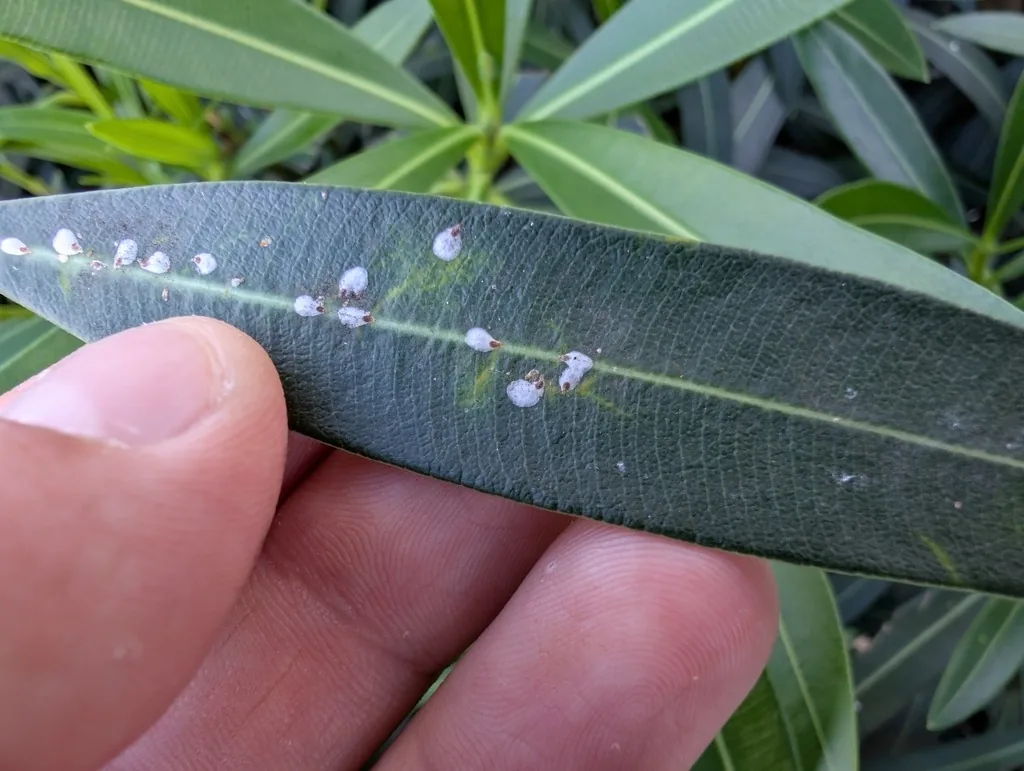
Rows of white false oleander scale covers along the midrib of an oleander leaf
Rows of white false oleander scale covers along the midrib of an oleander leaf. Photo: Damien Wallace, public domain (CC0), via iNaturalist
On this page
  1. Identification
  2. Where it lives
  3. Biology
  4. Damage and signs
  5. Health risk
  6. Control
  7. Common questions
  8. Sources

How to identify it

  • Female covers are pear-shaped, glossy white and about 2-3 mm (1/16 to 1/8 inch) long; male covers are smaller, elongate, snow-white and three-ribbed, often on leaf undersides.[1][2]
  • Feeding causes chlorotic yellow spots on the leaves; as an armored scale it produces no honeydew.[2]

Where it lives

Spread through the southeastern coastal states on nursery stock; first found in Florida in 1942 and now widespread there and in southern Mississippi.[1][2]

US map: public records from 10 states since 1990 (GBIF).

Biology and life cycle

Crawlers hatch and settle on leaves; once feeding, females stay in place for life.[2]

Damage and signs

  • Recorded on more than 100 plants in Florida, including magnolia, sweetbay, aucuba, bird-of-paradise, English ivy, dogwood, yew, oleander, banana shrub and sago palm.[1][2]
  • Heavy infestations cause leaf drop and poor growth; Mississippi sees the worst on sago palms and magnolias.[2]

Health risk

None to people or pets.[1][2]

Control

Pesticides

Mississippi State lists soil-applied systemic dinotefuran as among the most effective treatments for armored scales (two successive years), along with timely horticultural oil sprays; follow the label.[2]

Common questions

What are the white specks on my magnolia leaves?
Often false oleander scale covers.[1][2]
Will it hurt my sago palm?
Heavy infestations yellow leaves, cause leaf drop and slow growth.[2]
Does it make honeydew?
No; it's an armored scale.[2]

Sources

  1. University of Florida IFAS Extension (EDIS, Featured Creatures), “False Oleander Scale, Pseudaulacaspis cockerelli (EENY-149/IN306).” ask.ifas.ufl.edu/publication/IN306 (accessed 2026-10-15)
  2. Mississippi State University Extension (Bug's Eye View), “False Oleander Scale, Vol. 5, No. 12.” extension.msstate.edu/newsletters/bugs-eye-view/2019/false-oleander-scale-vol-5-no-12 (accessed 2026-10-15)
  3. iNaturalist, “Pseudaulacaspis cockerelli taxon page (order and family).” www.inaturalist.org/taxa/536683 (accessed 2026-10-06)

Updated 2026-10-15. Built from sourced records. Spot an error? Tell us.