On this page
How to identify it
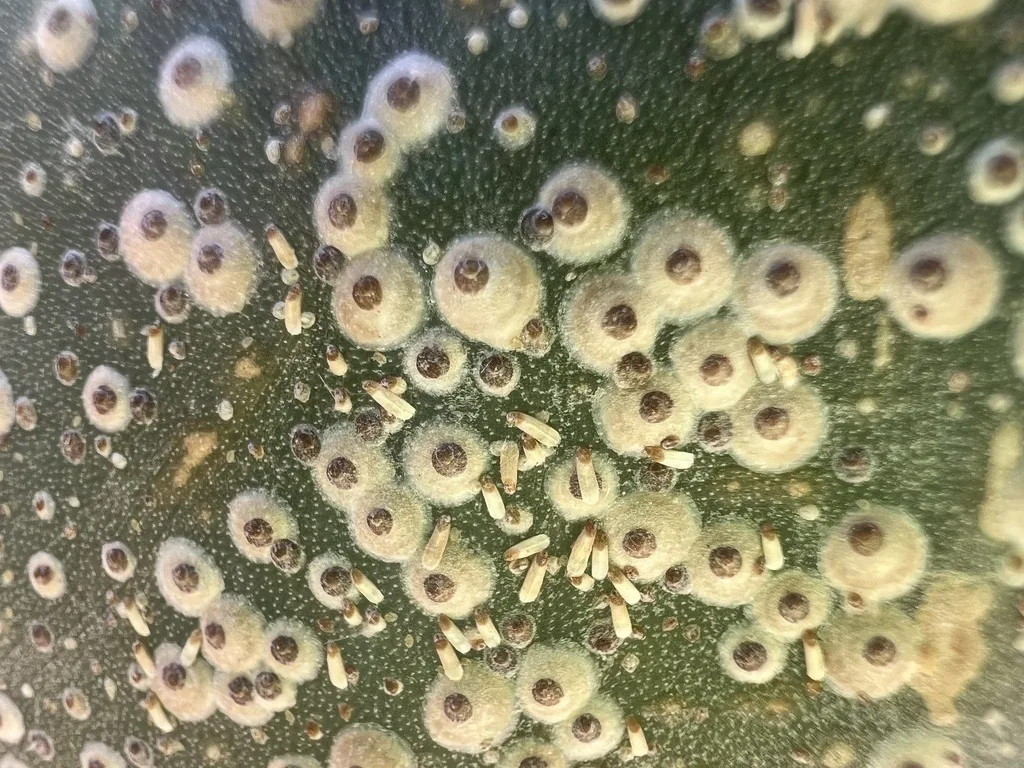
- The female's cover is circular and slightly convex, 1.5 to 2.5 mm across, whitish to tan with the brown shed skins just off center. The male cover is white, elongate oval with three weak lengthwise ridges and yellow shed skins at one end.[1]
- The female's body under the cover is greenish yellow.[1]
- Covers can be on any aerial part of the plant: pads, stems and fruit. Examine all of them, and look for wilting or drying of infested pads.[1]
- In the field it could be confused with Hemiberlesia cyanophylli; only slide-mounted adult females give an authoritative identification.[1]
Look-alikes
| Look-alike | How to tell them apart |
|---|---|
| Boisduval scale | Another Diaspis species. The cactus scale is the one recorded from 57 genera of cacti and from succulents such as Portulaca, with a slightly convex whitish to tan cover and brown off-center shed skins.[1] |
| Hemiberlesia cyanophylli | Diaspididae of the World says the two can be confused in the field; they differ clearly only as slide-mounted specimens under a microscope.[1] |
| Oleander scale | Also a round whitish armored scale on many ornamentals. On a cactus, a 1.5 to 2.5 mm circular, slightly convex, whitish to tan cover with brown shed skins just off center fits the cactus scale.[1] |
Where it lives
Probably native to the New World, spread wherever cacti are grown and kept under glass in northern countries. In the United States it has been reported from most states, is widespread in California, and is recorded from Texas and Hawaii; it is widespread in Mexico.[1]
Biology and life cycle
Hosts are the smooth surfaces of cacti and succulents: 57 genera of cacti in two plant families are recorded, including Opuntia (prickly pears), Cereus, Carnegiea (saguaro), Echinocactus, Mammillaria, Melocactus, Astrophytum, Epiphyllum, Hylocereus, Schlumbergera and Hatiora (holiday cacti), Trichocereus and Pachycereus, plus Portulaca.[1]
It reproduces sexually with several overlapping generations a year. Each female lays about 150 eggs (276 is the record) and lives up to 230 days; at 27 C an egg becomes an adult in about 23 days and a generation takes about 50 days.[1]
Crawlers are the only stage that spreads on its own, walking to new parts of the plant or carried by wind or animals, and most die to weather; settled scales and eggs travel only on infested plants.[1]
Parasitoid wasps attack it, including Aphytis species and Plagiomerus diaspidis in California, Mexico and Sicily; 2025 trials in Morocco combined Plagiomerus with Aphytis debachi and insect-killing Alternaria fungi, reaching about 90 percent mortality in the laboratory and about 50 percent in semi-field trials.[1][2]
Damage and signs
- Feeding on the pads reduces photosynthesis. Heavy infestations cause entire cactus pads or even whole plants to wither and die, and chlorotic spots develop on infested prickly pear fruit. It is a particularly serious pest of susceptible cacti in greenhouses and a pest of forage prickly pear in Brazil; control is occasionally needed on cactus nursery stock in California.[1][2]
Health risk
Neither source mentions any effect on people or pets; the scale lives fixed to cactus surfaces.[1][2]
Control
Prevention
Inspect new cacti and succulents before adding them to a collection or landscape, since settled scales and eggs arrive on infested plant material, and check pads, stems and fruit regularly for the round whitish covers.[1]
Biological control
Parasitoid wasps such as Aphytis species and Plagiomerus diaspidis attack the scale in California and elsewhere. Research combining parasitoids with insect-pathogenic fungi shows the mix of agents matters, with some pairings additive and others antagonistic.[1][2]
Pesticides
Diaspididae of the World notes that control treatments are occasionally required on cactus nursery stock in California but names no products; for a valuable collection, ask your extension office what is currently labeled for armored scales on cacti.[1]
Common questions
- My prickly pear pads are covered in small round whitish spots with a brown dot. What is it?
- Cactus scale, an armored scale whose female covers are 1.5 to 2.5 mm, circular, slightly convex and whitish to tan with brown off-center shed skins. Check pads, stems and fruit, and watch for pads wilting or drying.[1]
- Can it kill a cactus?
- Yes. Heavy infestations wither entire pads and sometimes whole plants, especially on susceptible cacti in greenhouses.[1]
- How fast does it build up?
- Quickly in warm conditions: about 23 days from egg to adult at 27 C, roughly 50 days per generation, several overlapping generations a year, and around 150 eggs per female.[1]
Sources
- Naturalis Biodiversity Center (Diaspididae of the World, Linnaeus NG), “Diaspididae of the World 2.0: Diaspis echinocacti (Bouche, 1833).” diaspididae.linnaeus.naturalis.nl/linnaeus_ng/app/views/species/taxon.php?cat=names&id=113071 (accessed 2026-11-10)
- Sociedade Entomologica do Brasil (Neotropical Entomology, Springer), “Optimizing Opuntia spp. Protection: Parasitoids and Microorganisms Agents for Diaspis echinocacti Management (El Aalaoui, Rammali, Yasri and Sbaghi 2025, Neotropical Entomology 54:89).” doi.org/10.1007/s13744-025-01301-6 (accessed 2026-11-10)
- iNaturalist, “Diaspis echinocacti taxon page (order and family).” www.inaturalist.org/taxa/325703 (accessed 2026-11-10)