On this page
How to identify it
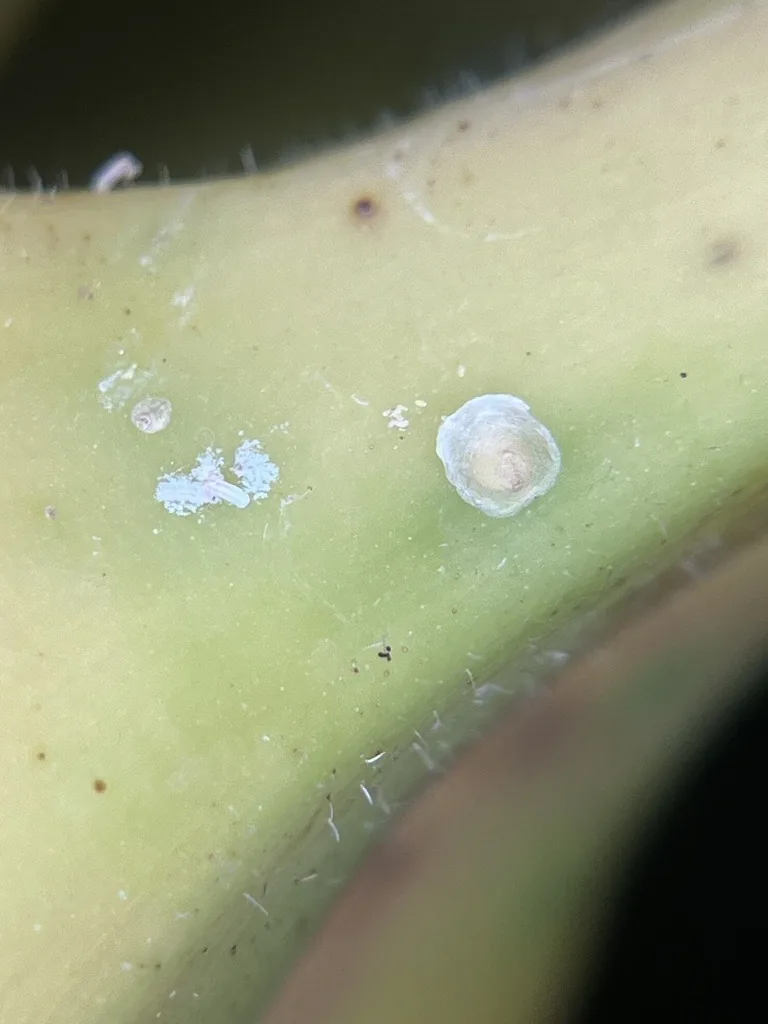
- The adult female's cover is circular or oval, thin and flat, white to light yellow and up to 1/16 inch across, with the shed skins of the first two stages at or near the center. NC State calls the cover semitransparent; ScaleNet describes it as opaque.[1][3]
- Male covers look like a different insect: smaller, elongate and snow white with three ridges down the back, the shed skin at the head end.[1][3]
- Males often gather in fluffy masses of white woolly wax.[1][3]
- Under the cover the female's body is creamy when young and pale yellow when mature. Eggs are oval and pale yellow to pale orange, and newly settled nymphs are pale orange.[3][1]
- Feeding sites show as irregular yellow (chlorotic) spots on the leaf.[1][3]
- It belongs to the armored scales, whose flat, platelike covers are under 1/8 inch across and can usually be lifted off, leaving the insect body behind on the plant.[4]
Look-alikes
| Look-alike | How to tell them apart |
|---|---|
| Mealybugs | The fluffy white male clusters can suggest mealybugs. Mealybugs are oval, segmented, wax-covered insects that usually produce sticky honeydew and black sooty mold; armored scales such as Boisduval scale make no honeydew, and Boisduval males sit in elongate white covers with three ridges.[5][4][1] |
| Soft scales (such as brown soft scale) | Soft scales are larger, more rounded and humped, and their surface is the insect's own body wall, so flipping one removes the whole insect. They excrete honeydew; armored scales do not.[4] |
| Diaspis bromeliae | ScaleNet notes that on palms and pineapple Boisduval scale can be confused with this close relative.[3] |
Where it lives
ScaleNet lists it from 91 countries and describes it as known worldwide in greenhouses, chiefly on palms but also on orchids and cacti. It is reported as a pest in California, Colorado, Hawaii, North Carolina and Ohio, among other places. GBIF's public U.S. records are thin: about 15 since 1990, from 5 states on the map, more than half of them from Mississippi.[3][1][6]
Biology and life cycle
Under ideal conditions it completes its life cycle in about 50 days; adult males take about 33 days to develop.[1][3]
Each female produces up to about 200 eggs, which hatch in 5 to 7 days. Most crawlers settle and begin feeding within 24 hours.[1][3]
Sources differ on how long females live: NC State gives up to 70 days, while ScaleNet, citing a 1942 greenhouse study, says adult females may live as long as 7 months.[1][3]
Because females lay eggs over a long period, generations overlap and usually all stages can be found at once.[1]
Crawlers can settle on any part of the plant above ground but favor the leaf midrib and major veins and the part of the leaf stalk covered by the sheath.[1][3]
Cattleya and Cymbidium orchids are favorite hosts. It also infests leaves and bark of other orchids, many palms, banana and cacti, and has been recorded on plants in 17 families. ScaleNet adds minor pest records on bananas, pineapple, coffee and coconuts.[1][3]
Damage and signs
- A few days after a scale settles, a large yellow spot develops around it. Lighter infestations leave irregular yellow spots that spoil the leaves; dense ones kill leaves, and heavy infestations can turn leaves yellow, drop them and sometimes kill whole plants.[1][3]
- Buds are frequently attacked before they open.[1]
- Only a few scales are needed to cause damage, and numbers build fast: one study cited by ScaleNet counted 10,000 scales produced from 7 females on a Cattleya in 5 months.[3]
Health risk
The sources treat it only as a plant pest; none mentions bites, stings or other risks to people or pets.[1][3][4]
Control
Prevention
Inspect plants regularly for female scales, crawlers and yellow feeding spots, and before treating, check a sample of scales to see whether they are still alive: dead or parasitized scales don't ooze fluid when squashed.[4][1]
Traps and physical control
On a few plants, wipe scales off with a cotton swab dipped in 70% isopropyl alcohol. Orchids with soft leaves may be damaged by the alcohol.[1]
Biological control
A tiny parasitic wasp in the genus Coccidencyrtus has been reported to parasitize Boisduval scale, and one species has been discussed for biological control in greenhouses, but these wasps may not always be present.[1][3]
Pesticides
Horticultural oils labeled for interior use work well on armored scales and should be safe on palms and orchids. Water plants well first and spray early in the morning or late in the afternoon to avoid plant injury. Thorough coverage timed to the crawler stage gives the best control.[1][4]
Systemic products vary: UC IPM says imidacloprid does not control most armored scales, while dinotefuran controls most types of scales. Read the label to confirm the plant and pest are listed.[4]
Common questions
- Are the fuzzy white clusters on my orchid mealybugs or Boisduval scale?
- They may be Boisduval scale males, which gather in fluffy white masses inside small, ridged white covers. Mealybugs are oval, wax-covered insects that usually leave sticky honeydew and sooty mold; armored scales leave no honeydew.[1][5][4]
- I treated my orchid. Why are the scales still there?
- Armored scale covers stay on the plant, so check whether the insects are alive before treating again: a live scale oozes fluid when squashed, and a dead or parasitized one does not.[4]
- Why didn't a systemic insecticide control it?
- UC IPM reports that imidacloprid, a common systemic, does not control most armored scales. NC State recommends horticultural oil, which works well on armored scales.[4][1]
Sources
- NC State Extension, “Boisduval Scale (J. Baker, PDIC factsheet).” content.ces.ncsu.edu/boisduval-scale (accessed 2026-11-11)
- iNaturalist, “Diaspis boisduvalii taxon page (order and family).” www.inaturalist.org/taxa/472229 (accessed 2026-11-11)
- ScaleNet (USDA ARS Systematic Entomology Laboratory scale insect database), “ScaleNet catalogue: Diaspis boisduvalii Signoret, 1869 (structure, biology, economic importance, distribution).” scalenet.info/catalogue/Diaspis%20boisduvalii/ (accessed 2026-11-11)
- UC Statewide IPM Program (UC IPM), “Pest Notes: Scales.” ipm.ucanr.edu/home-and-landscape/scales/ (accessed 2026-11-11)
- UC Statewide IPM Program (UC IPM), “Pest Notes: Mealybugs.” ipm.ucanr.edu/home-and-landscape/mealybugs/ (accessed 2026-11-11)
- Global Biodiversity Information Facility (GBIF), “Diaspis boisduvalii: occurrence records in the U.S., 1990-2026 (GBIF occurrence search).” api.gbif.org/v1/occurrence/search?taxonKey=2087459&country=US&hasGeospatialIssue=false&occurrenceStatus=PRESENT&year=1990%2C2026&facet=stateProvince&facetLimit=400&limit=0 (accessed 2026-11-11). State counts are records reported (iNaturalist research-grade, museum specimens, surveys), not abundance.