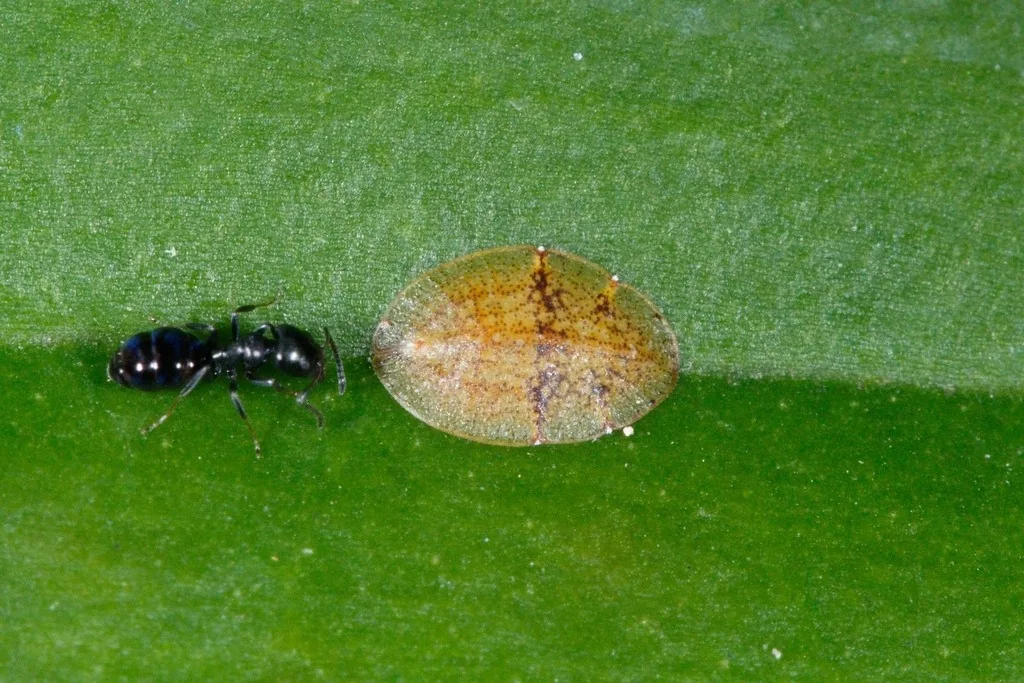
How to identify it
- Adult females are oval, up to 3/16 inch long and slightly domed, pale yellowish green to yellowish brown, often mottled with brown; older females are brown.[1]
- Crawlers and young nymphs are yellow and nearly flat; males are rare.[1][2]
- Shiny, sticky honeydew on leaves, sometimes landing more than an inch from the scale, is often the first sign.[2]
Look-alikes
| Look-alike | How to tell them apart |
|---|---|
| Mealybugs and aphids | They also excrete honeydew on houseplants, so look for the oval scales themselves on stems and leaf veins.[2] |
| Other soft scales | Hemispherical scale and nigra scale also produce honeydew on indoor plants.[2] |
Where it lives
It occurs worldwide and outdoors in the deep South, north along the East Coast to Virginia and on southern Vancouver Island; elsewhere it lives on indoor and greenhouse plants.[1][2]
Biology and life cycle
Females retain their eggs, and crawlers stay under the mother for a short time before settling, mostly on stems.[1][2]
Once they begin reproducing, females produce a few crawlers a day for three to four weeks or more, so generations overlap.[2]
A generation takes about 60 days, with three to seven generations a year depending on temperature.[1]
Damage and signs
Health risk
Control
Prevention
Inspect plants every one to two weeks for fresh honeydew, especially on new growth and stems; continued fresh honeydew after treatment means scales are still alive.[2]
Biological control
Outdoors, small parasitic wasps often keep it in check; no natural enemy reliably controls it indoors.[1][2]
Pesticides
Insecticidal soap or horticultural oil kills crawlers it contacts but needs repeated applications; NC State suggests waiting about 10 days between treatments and keeping treated plants out of direct sun.[1][2]
Common questions
- What is the sticky stuff on my houseplant's leaves?
- Often honeydew from brown soft scale feeding on the stems and leaf veins above.[1][2]
- Will brown soft scale kill my plant?
- Seldom, but heavy infestations cause wilting, leaf drop and dieback.[1][2]
- Why didn't one spray work?
- Soap and oil kill only the scales they contact, and new crawlers keep appearing, so repeat treatments are needed.[1][2]
Sources
- NC State Extension, “Brown Soft Scale (Entomology Insect Notes).” content.ces.ncsu.edu/brown-soft-scale (accessed 2026-10-15)
- Colorado State University Extension, “Brown Soft Scale: A Common Insect Pest of Indoor Plants.” extension.colostate.edu/resource/brown-soft-scale-a-common-insect-pest-of-indoor-plants/ (accessed 2026-10-15)
- iNaturalist, “Coccus hesperidum taxon page (order and family).” www.inaturalist.org/taxa/330200 (accessed 2026-10-06)