On this page
How to identify it
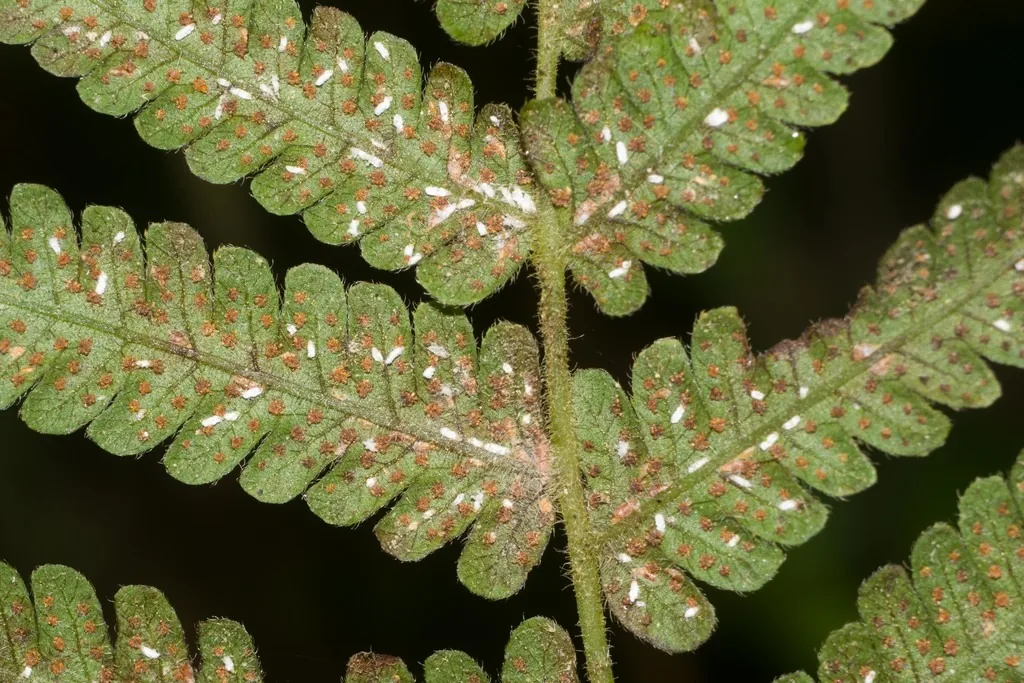
- Female covers are flat, mussel-, oystershell- or pear-shaped and light to dark brown, with the paler, yellowish-brown cast skin at the narrow end. Sources give different sizes: up to 3/16 inch (NC State) or 1.5 to 2.5 mm (Diaspididae of the World).[1][2]
- Male covers are snow white, narrow and parallel-sided, with three raised lengthwise ridges. On infested ferns they are the most conspicuous sign.[1][2]
- Crawlers are about the size of a pollen grain, flat and yellow with red eyes; adult males are tiny two-winged, gnat-like insects that are easily overlooked.[1]
- It lives mainly on leaves and only rarely on branches or fruit.[2]
- Like other armored scales it makes no sticky honeydew, and its cover can be lifted off, leaving the insect's body on the leaf.[4]
Look-alikes
| Look-alike | How to tell them apart |
|---|---|
| Pinnaspis strachani | A close relative that is often hard to tell from fern scale in the field, because cover color is not a reliable difference; a slide-mounted female examined under a microscope is needed for a sure identification.[2] |
| Liriope scale (Pinnaspis caricis) | Clemson lists Pinnaspis caricis, which it calls liriope scale, alongside fern scale as a scale of liriope, causing yellow or reddish spotting. Names overlap: ScaleNet records 'liriope scale' as one of fern scale's own common names, so go by the scientific name when reading advice.[3][5] |
Where it lives
It occurs worldwide, preferring tropical and subtropical conditions and living in greenhouses in cooler regions; ScaleNet's catalog lists 117 countries. U.S. records cover many states, from North Carolina and Florida to California and Hawaii, though older records may mix it up with a close relative; NC State reports it on ferns and liriope in North Carolina and on foliage plants, citrus and woody ornamentals in Florida and Hawaii.[2][5][1]
Biology and life cycle
It feeds on a very wide range of plants, especially ferns, palms and lily-family plants. Diaspididae of the World cites hosts in about 60 genera and 27 families, while ScaleNet's current catalog lists 163 genera in 78 families. In North Carolina it mainly infests true ferns (not asparagus ferns) and liriope; other hosts include bird of paradise, Chamaedorea and Chrysalidocarpus palms, dracaena, ficus, lady palm, mondo grass, monstera, pygmy date palm, staghorn fern and ti.[2][5][1]
Females lay groups of eggs under their armor, up to about 108 each, and, as in other armored scales, die after the last egg; the eggs hatch in about 10 days, and reproduction can be sexual or without mating.[1][2]
As in other armored scales, crawlers move about until they push their long, thread-like mouthparts into the leaf to feed, then molt and begin secreting wax; they spread to new parts of the plant on their own or by wind and contact with animals, while moving infested plants carries the species farther.[1][2]
Under glass there are about two generations a year, with roughly 95 days from egg to egg-laying female.[2]
Males stop feeding after their second stage and emerge as winged adults that crawl or fly to females to mate. Empty covers stay stuck to the leaf long after the insect has emerged or died.[1]
When populations get dense, females tend to lay male eggs, which is why heavily infested plants become conspicuously spotted with white male covers.[1]
Damage and signs
- Feeding causes yellow spots on some fern cultivars and on liriope, and infested ferns are disfigured by the white male covers against the dark green fronds. On liriope, Clemson also lists reddish spotting and dead leaf tissue.[1][3]
- It is an important pest of foliage plants and has been reported as a pest of foliage ferns in North Carolina; elsewhere it damages coconut, banana, citrus, tea and greenhouse ornamentals.[2]
Health risk
It is a plant pest; none of the sources mentions any risk to people or pets.[1][2][3]
Control
Sanitation
Inspect ferns and foliage plants for brown female covers and white male covers; moving infested plants is how the scale spreads to new places.[2][1]
On liriope, cut back the foliage in late winter and clean up the clippings, which Clemson says helps scale control considerably.[3]
Pesticides
Horticultural oil is the main tool. NC State says it controls fern scale without excessive injury to ferns when applied twice, thoroughly, two weeks apart; Clemson advises a 2 percent oil spray (5 tablespoons per gallon of water) on liriope after pruning.[1][3]
Ferns are notoriously sensitive to pesticides. Treat them, and other sensitive plants, at a time when the spray will dry on the foliage before the plants are in full sun.[1]
Cover every infested surface, including leaf undersides. Armored scales are generally less susceptible to pesticides than soft scales, so coverage matters, and the popular systemic imidacloprid does not control armored scales.[4]
Common questions
- What are the white specks on my fern fronds?
- They may be the snow-white, ridged covers of male fern scales; look nearby for the brown, oyster-shaped female covers, which are easy to miss.[1][2]
- Does fern scale infest asparagus fern?
- In North Carolina it is found mainly on true ferns, not asparagus ferns, and on liriope, though asparagus appears among its recorded hosts worldwide.[1][2]
- How do I treat fern scale without killing the fern?
- Use horticultural oil, which NC State says controls fern scale without excessive injury to ferns. Apply it twice, two weeks apart, and time sprays so they dry before the plants get full sun.[1]
- Will a systemic insecticide drench kill fern scale?
- Probably not with imidacloprid: UC IPM says this popular systemic does not control armored scales such as this one. Thorough oil sprays are the usual approach.[4][1]
Sources
- NC State Extension, “Fern Scale Insect (PDIC Factsheet).” content.ces.ncsu.edu/fern-scale-insect (accessed 2026-11-11)
- Naturalis Biodiversity Center (Diaspididae of the World, with USDA scale insect data), “Diaspididae of the World 2.0: Pinnaspis aspidistrae.” diaspididae.linnaeus.naturalis.nl/linnaeus_ng/app/views/species/taxon.php?id=113120 (accessed 2026-11-11)
- Clemson Cooperative Extension, Home & Garden Information Center, “Liriope (HGIC factsheet).” hgic.clemson.edu/factsheet/liriope/ (accessed 2026-11-11)
- University of California Statewide IPM Program, “Scales (Pest Notes).” ipm.ucanr.edu/home-and-landscape/scales/ (accessed 2026-11-11)
- ScaleNet (scale insect database begun at the USDA ARS Systematic Entomology Laboratory), “ScaleNet catalogue: Pinnaspis aspidistrae (Signoret, 1869).” scalenet.info/catalogue/Pinnaspis%20aspidistrae/ (accessed 2026-11-11)
- iNaturalist, “Pinnaspis aspidistrae taxon page (order and family).” www.inaturalist.org/taxa/196737 (accessed 2026-11-09)