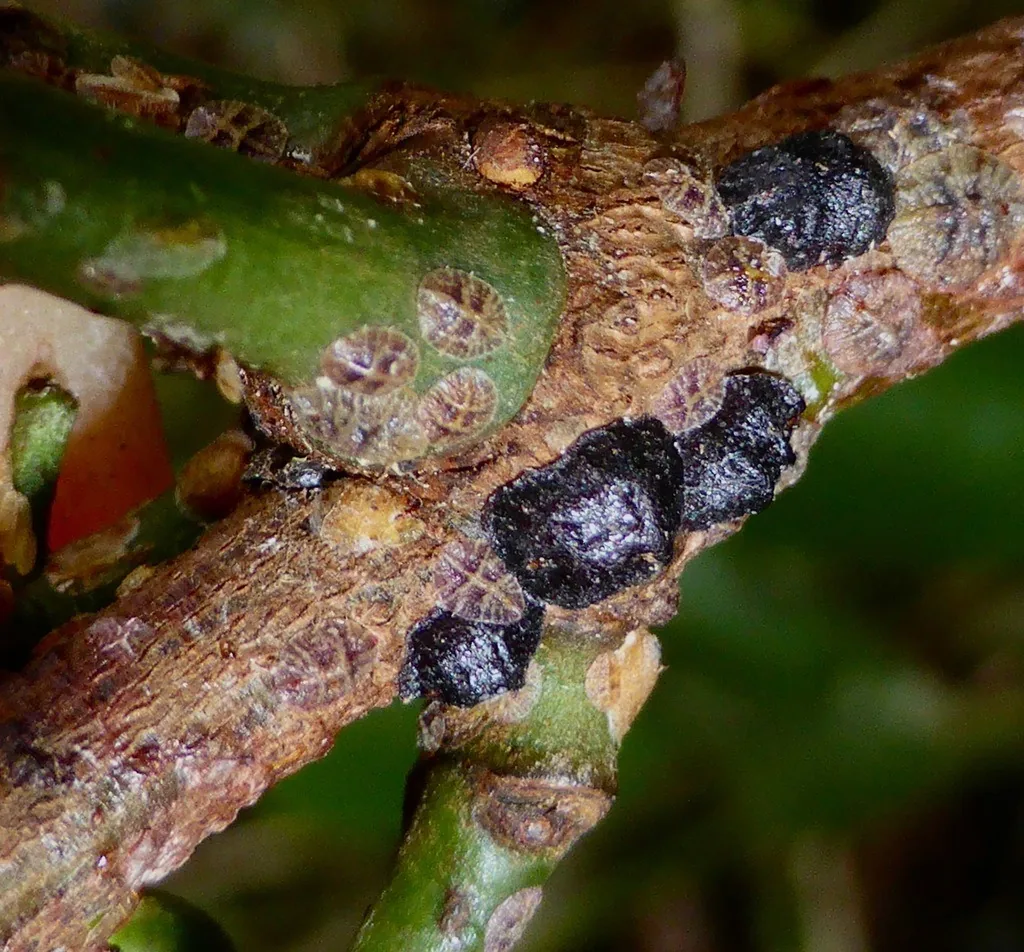
How to identify it
Look-alikes
| Look-alike | How to tell them apart |
|---|---|
| Cottony cushion scale | A different scale with a white fluted egg sac rather than a dark H-ridged shell.[1][2] |
Where it lives
Native to southern Africa, it occurs in the southern and western United States; hosts include olive, citrus, oleander, privet, rose, pistachio and many more.[1]
Biology and life cycle
There are two generations a year on the California coast and one inland.[1]
Females don't need to mate and may produce over 2,000 eggs under their bodies.[1]
It's more common on the coast and in dense canopies, where nymphs escape hot, dry conditions.[1]
Damage and signs
- Sap feeding and heavy honeydew with sooty mold weaken plants and foul leaves.[1]
Health risk
It feeds on plants; UC IPM mentions no risk to people.[1]
Control
Traps and physical control
Thin dense canopies to remove the cool, humid conditions young scales need, and prune out infested branches.[1]
Biological control
Tiny parasitic wasps such as Scutellista caerulea and Metaphycus helvolus control it in coastal and northern areas; look for exit holes.[1]
Pesticides
If populations are high and parasitism low, a narrow-range oil timed to the crawler stage helps; test first for plant damage.[1]
Common questions
Sources
- University of California Statewide IPM Program, “Pest Notes: Black Scale (Publication 74160).” ipm.ucanr.edu/PMG/PESTNOTES/pn74160.html (accessed 2026-10-06)
- University of California Statewide IPM Program, “Pest Notes: Cottony Cushion Scale (Publication 7410).” ipm.ucanr.edu/PMG/PESTNOTES/pn7410.html (accessed 2026-10-06)
- iNaturalist, “Saissetia oleae taxon page (order and family).” www.inaturalist.org/taxa/396652 (accessed 2026-10-06)