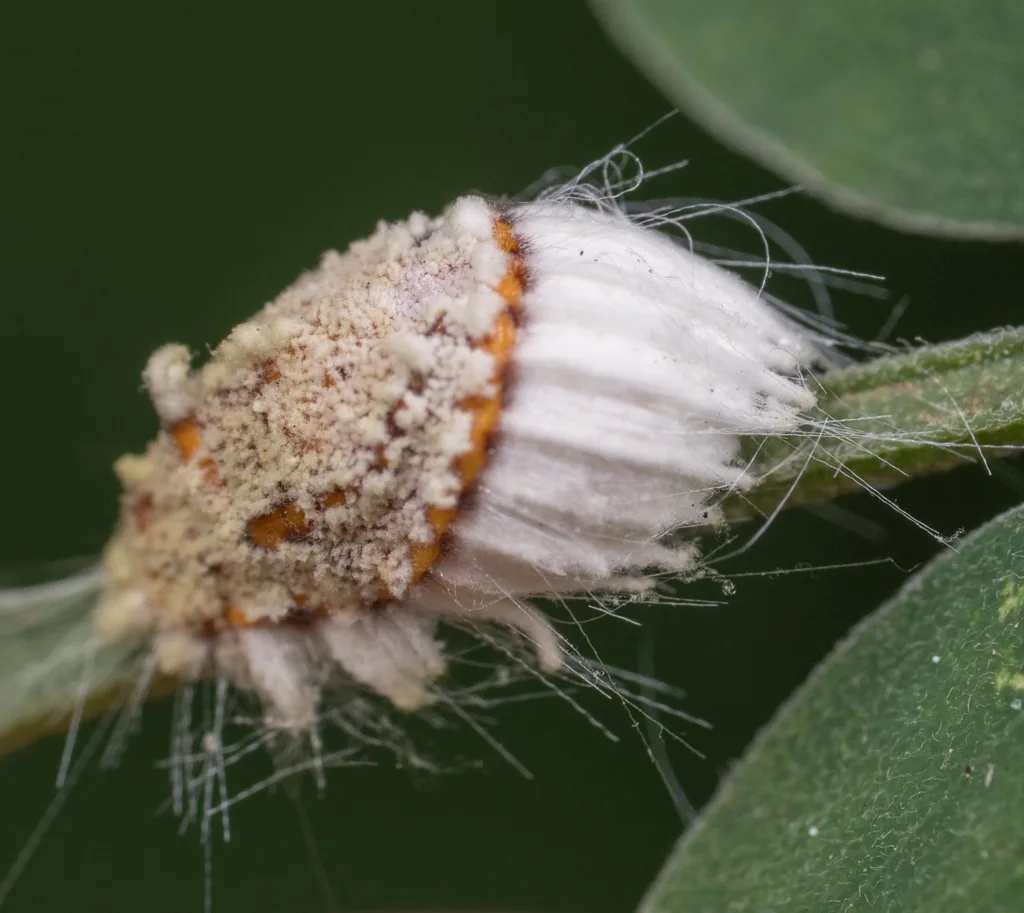
How to identify it
- Adult females are orangish brown and carry a long, fluted white cottony egg sac; together they can reach almost 1/2 inch.[1]
- The egg sac holds 600 to 800 red eggs.[1]
- Crawlers are red with black legs and antennae and settle along leaf veins.[1]
- Unlike most scales, it keeps its legs and can move throughout its life.[1]
Look-alikes
| Look-alike | How to tell them apart |
|---|---|
| Vedalia beetle larvae | Reddish vedalia larvae feed on top of the egg sacs; young ones have red legs, while scale crawlers have black legs and antennae.[1] |
Where it lives
Common hosts in California include citrus, cocculus, nandina and pittosporum.[1]
Biology and life cycle
Eggs hatch in a few days in warm weather but can take two months in winter.[1]
Young scales settle on twigs and leaf veins and move to branches and trunk as they grow; females don't need to mate.[1]
There are two to three generations a year, and the life cycle takes about three months in warm weather.[1]
Damage and signs
Health risk
It feeds only on plants; UC IPM describes no risk to people.[1]
Control
Biological control
Look for vedalia beetles, their red eggs and larvae on egg sacs, or round exit holes of the Cryptochaetum fly; if present, no spray is needed.[1]
Keep ants out of trees with sticky trunk bands on a protective wrap, or with ant baits, so natural enemies can work.[1]
Pesticides
Don't use imidacloprid: it doesn't kill cottony cushion scale, but it poisons vedalia beetles, and outbreaks have followed its use.[1]
If natural enemies are absent and crawlers are active, horticultural oil is least disruptive; sticky tape around twigs shows when crawlers hatch.[1]
Common questions
- What is the white fluted insect on my citrus?
- Likely cottony cushion scale; the ridged white cottony egg sac attached to an orange-brown female is its trademark.[1]
- Should I spray cottony cushion scale?
- Usually not. Natural enemies give excellent control unless insecticides, dust or ants disrupt them.[1]
- Why is my cocculus always infested?
- Vedalia beetles avoid Cocculus laurifolius, so it is often heavily infested, especially away from the coast.[1]
Sources
- University of California Statewide IPM Program, “Pest Notes: Cottony Cushion Scale (Publication 7410).” ipm.ucanr.edu/PMG/PESTNOTES/pn7410.html (accessed 2026-10-06)
- iNaturalist, “Icerya purchasi taxon page (order and family).” www.inaturalist.org/taxa/60921 (accessed 2026-10-06)