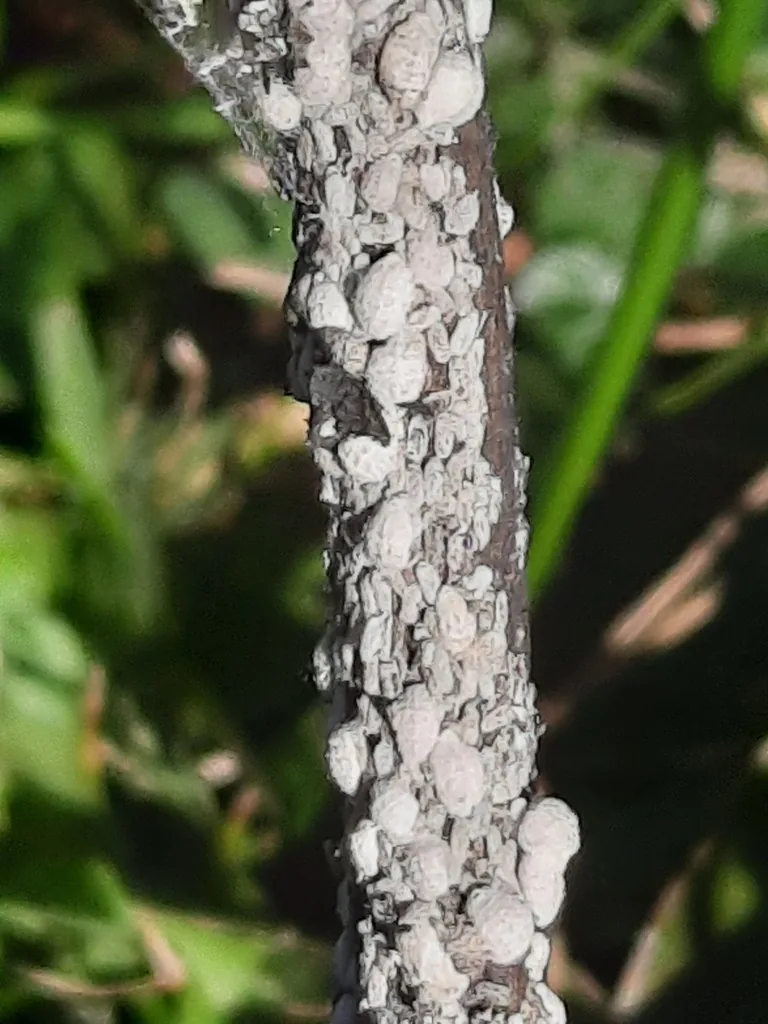
How to identify it
- Mature females sit under white to gray, felt-like waxy covers up to about 2 mm long on trunks, branches and twigs, often clustered at pruning wounds and branch crotches.[1][2]
- Pull back the white cover and you may see a mass of pink eggs; live scales ooze a pink to ruby fluid when crushed, while dead ones are dry and flaky.[1]
- Newly hatched crawlers are tiny and pink to purple, and spread over new woody growth.[1][2]
- Infested trees are usually marked by sticky honeydew and black sooty mold on the bark and on plants and surfaces below.[1][2][3]
Look-alikes
| Look-alike | How to tell them apart |
|---|---|
| Other scale insects | Crapemyrtle bark scale is a felt scale, neither armored nor soft, and the only bark scale known to feed on crape myrtle in the United States.[1] |
| Azalea bark scale | Looks virtually identical and is in the same genus, but it feeds mainly on azaleas and isn't known to feed on crape myrtle.[1] |
| Crapemyrtle aphid | Also causes honeydew and sooty mold, but it feeds on leaves and tender green shoots, while the bark scale lives on woody parts and is rarely seen on leaves.[1] |
Where it lives
First seen in Richardson, Texas, in 2004. By 2018 it was reported in a dozen states from Texas and New Mexico to Virginia and Washington; it has since been found as far north as Delaware.[1][2]
Biology and life cycle
Each female lays about 100 to 300 pink eggs under her felt cover; crawlers move to new growth, then settle in place and lose their legs after the first molt.[1][2]
Males develop inside small white sacs and emerge as tiny winged, gnat-like insects with no mouthparts that live only to mate.[1][2]
In the Southeast there seem to be two to four overlapping generations a year, with crawler peaks around early summer and again in late summer.[1]
In Delaware, the first crawlers appeared from late May through early June and a second wave in early August.[2]
Besides crape myrtle, it has been found on American beautyberry in the U.S.; Delaware also lists hosts such as fig, persimmon, pomegranate and apple.[1][2]
Damage and signs
Health risk
A plant pest only; it feeds on woody plants and is not described as a health risk to people or pets.[1]
Control
Prevention
The best control is not bringing it home: inspect crape myrtles carefully before buying or planting, especially pruning wounds and branch crotches.[3][1]
Bag infested branches or plants before hauling them away, so crawlers don't blow off and start new infestations.[1]
Traps and physical control
Before treating a heavily infested tree, scrub reachable branches with a mild soap solution and soft brush to remove many females and egg masses.[1]
Biological control
Twice-stabbed lady beetles are effective predators, but they usually arrive too late to prevent damage; pyrethroid sprays can make scale outbreaks worse by killing them.[1]
Pesticides
Systemic insecticides such as imidacloprid, dinotefuran or thiamethoxam, applied as a soil drench or soil injection, are the best treatments available; late March through May is the best time to treat.[3][2]
These treatments don't give complete control, so plan to treat again the next year; never treat while the tree is in flower, to protect bees.[3][1]
Common questions
- Why is the bark on my crape myrtle turning black?
- Black bark is often sooty mold growing on honeydew from crapemyrtle bark scale; look for white, felt-like specks on the trunk and branches.[1][2]
- Will crapemyrtle bark scale kill my tree?
- Usually not; the main harm is unsightly sooty mold and fewer, smaller flowers, though heavy infestations can cause poor growth and some branch dieback.[1][3]
Sources
- University of Florida IFAS Extension, “Crapemyrtle Bark Scale, Acanthococcus (=Eriococcus) lagerstroemiae (Featured Creatures, EDIS IN1218).” edis.ifas.ufl.edu/publication/IN1218 (accessed 2026-10-06)
- University of Delaware Cooperative Extension, “Crape Myrtle Bark Scale Insect (March 2025).” www.udel.edu/academics/colleges/canr/cooperative-extension/fact-sheets/crape-myrtle-bark-scale/ (accessed 2026-10-06)
- Mississippi State University Extension Service, “Crape Myrtle Bark Scale (Bug's Eye View, Vol. 5, No. 6).” extension.msstate.edu/newsletters/bugs-eye-view/2019/crape-myrtle-bark-scale-vol-5-no-6 (accessed 2026-10-06)
- iNaturalist, “Acanthococcus lagerstroemiae taxon page (order and family).” www.inaturalist.org/taxa/1513579 (accessed 2026-10-06)