On this page
How to identify it
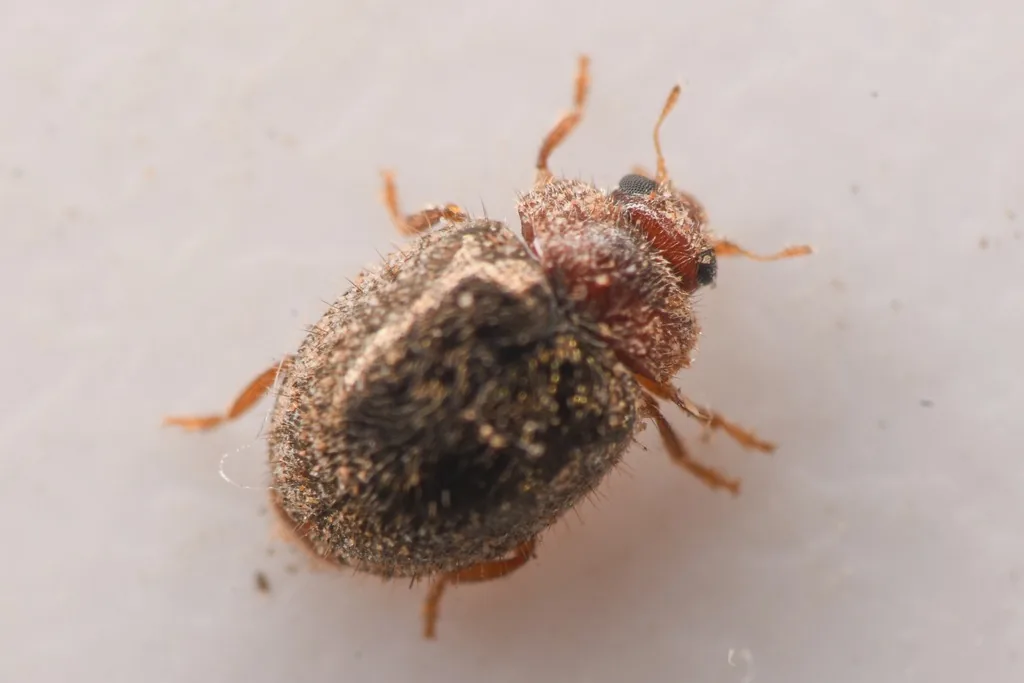
- Adults are only about 1/12 inch (2 mm) long, oval and dome-shaped, with a shiny, finely pitted surface covered in short, pale grayish hairs.[1]
- The wing covers are black to dark reddish brown, while the head, legs and thorax are reddish brown and the underside is reddish brown to orange.[1]
- Larvae are dark brown to black on top, paler underneath and covered with short hairs, reaching about 1/7 inch (3.5 mm). Young larvae hide under the bodies or covers of female scales as they feed.[1]
- Pupae are oval, black or dark gray and about adult size, glued by the rear end to the plant with a little white wax and the shed larval skin at the base.[1]
Look-alikes
| Look-alike | How to tell them apart |
|---|---|
| Rhyzobius forestieri | A related scale-eating lady beetle in California that looks much the same at every stage, but adults are larger (about 1/8 inch) and entirely black, including the legs and the underside of the thorax.[1] |
Where it lives
Native to Australia and now spread around the world. In California it occurs at least from Mendocino County to the state's southern border. It also occurs in Florida, though there is no record of an early introduction there. It has also been introduced to Guam and Rota against an invasive cycad scale.[1][2][3][4]
Biology and life cycle
Each female lays about 200 to 400 eggs, tucked under a scale's body, glued to a scale or in sheltered spots on the infested plant. The larvae pass through four stages and then pupate in the open on the plant.[1]
In warm weather it goes from egg to egg-laying adult in about a month, and California has about three generations a year. Adult females live about two months, and adults spend the winter in sheltered places.[1]
Young larvae feed mostly on scale eggs and crawlers, while older larvae and adults eat every scale stage. In its lifetime a female eats about 100 soft scale nymphs or 200 soft scale eggs, and about twice that many or more armored scales.[1]
It prefers armored scales, soft scales and felt scales. In Florida trials it also ate Asian citrus psyllid eggs and young nymphs, averaging about 25 eggs and 9 nymphs per beetle per day.[1][3]
Damage and signs
Health risk
The sources describe it only as a predator of scale insects and other plant-sucking insects; they mention no harm to people.[1][2]
Control
Prevention
No control is needed; it is a beneficial predator. Help it by controlling ants, which attack lady beetles, growing flowering plants that feed adult natural enemies, hosing dust off small plants, and avoiding broad-spectrum, persistent insecticides.[1]
Biological control
It is sold commercially as a biological control agent and was among the ladybirds imported for sale into Florida between 1982 and 1993.[3][2]
Common questions
- What is the tiny hairy dark beetle on my scale-infested plant?
- It may be Rhyzobius lophanthae, a scale-eating lady beetle only about 2 mm long, with dark wing covers, a reddish brown head and thorax, and a coat of short grayish hairs.[1]
- Is Rhyzobius lophanthae native to the United States?
- No. It comes from Australia and was introduced to California in the late 1800s; there is no record of an early introduction to Florida.[1][2][3]
- Can I buy Rhyzobius lophanthae for scale control?
- Yes. It is available commercially as a biological control agent.[3]
Sources
- University of California Statewide IPM Program, “Scale Predatory Rhyzobius Lady Beetles, Natural Enemies Gallery.” ipm.ucanr.edu/natural-enemies/scale-predatory-rhyzobius-lady-beetles/ (accessed 2026-11-09)
- University of Florida IFAS Extension (EDIS), “Ladybirds, Ladybird beetles, Lady Beetles, Ladybugs of Florida, EENY-170 (J. H. Frank and R. F. Mizell III).” journals.flvc.org/edis/article/view/108387 (accessed 2026-11-09)
- Insects (MDPI), “Biocontrol Potential of a Commercially Available Predator Rhyzobius lophanthae Blaisdell against Asian citrus psyllid (Insects 2025).” pmc.ncbi.nlm.nih.gov/articles/PMC12653257/ (accessed 2026-11-09)
- Insects (MDPI), “Rhyzobius lophanthae Behavior is Influenced by Cycad Plant Age, Providing Odor Samples in a Y-tube Olfactometer (Marler and Marler 2018, Insects 9:194).” pmc.ncbi.nlm.nih.gov/articles/PMC6315894/ (accessed 2026-11-09)
- iNaturalist, “Rhyzobius lophanthae taxon page (order and family).” www.inaturalist.org/taxa/272002 (accessed 2026-11-09)