On this page
How to identify it
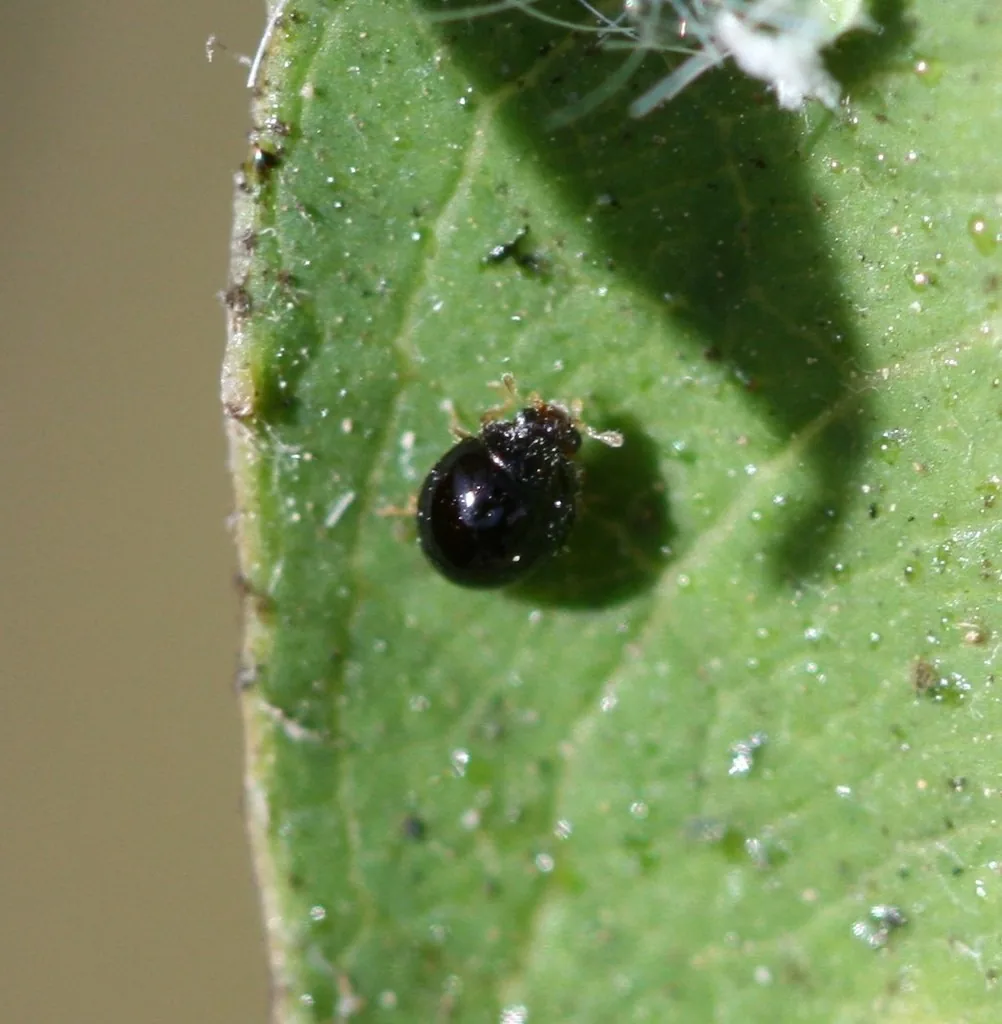
- Adults are about 1.4 to 1.5 mm long, round from above and dome-shaped from the side, and black with yellowish to orange-brown legs.[1][2]
- Females have a black head and males an orange head.[1]
- Larvae are pale yellow to cream, elongated, segmented and covered with fine short hairs, reaching about 2 mm. Unlike fly larvae, they have visible legs.[1][2]
- Eggs are tiny (0.2 mm), oval and pale yellow, laid in loose clusters among whitefly colonies on the undersides of leaves. Pupae are round, hairy and yellowish, often clustered along leaf veins.[1][2]
Look-alikes
| Look-alike | How to tell them apart |
|---|---|
| Fly larvae in whitefly colonies | Delphastus larvae have visible legs; fly larvae have none.[1] |
| Other Delphastus species | Florida has three Delphastus species and California at least three. They look and behave much alike, and D. catalinae is the one most often sold and the most common in California.[1][2] |
Where it lives
Native to Colombia. It is established in tropical and subtropical parts of the United States, including California and Florida, and has been released in Florida, Hawaii and across the Southwest. Related Delphastus species, including D. pusillus, occur in the eastern United States.[1][2]
Biology and life cycle
Each female lays 200 to 300 eggs over a life of about two months; males live about 45 days.[1][2]
Egg to adult takes about three weeks at 77°F to 86°F (25°C to 30°C), and there are several generations a year. Older larvae may move down the plant to pupate in a sheltered spot.[1][2]
Adults and larvae eat all whitefly stages but prefer eggs. An adult eats about 150 to 160 whitefly eggs a day, and a female needs about 100 eggs a day to keep laying. A larva eats about 1,000 eggs before it pupates.[1][2]
They avoid whitefly nymphs that have been parasitized, so they work well alongside parasitic wasps such as Encarsia. When whiteflies are scarce they will eat spider mites and aphids, and they also take honeydew, which helps them live longer.[1][2]
Cold limits it, though small populations survive mild winters where lows stay above freezing. Very dry air (10 percent relative humidity) reduces egg-laying and survival.[1]
Damage and signs
Health risk
The sources describe it only as a predator of whiteflies and other small insects; they mention no harm to people.[1][2]
Control
Prevention
No control is needed; it is a beneficial predator. Help resident beetles by controlling ants, growing flowering plants that feed adult natural enemies, hosing dust off small plants, and avoiding broad-spectrum, persistent insecticides.[2]
Biological control
It is sold by insectaries, mostly for whitefly-infested greenhouse crops, since it disperses widely outdoors. UF/IFAS suggests releasing it as soon as whiteflies appear, about 100 adults per whitefly hot spot or 10 per infested plant, weekly for three to four weeks, and combining it with parasitic wasps.[1][2]
Common questions
- What is the tiny black beetle among the whiteflies on my plants?
- It may be a Delphastus lady beetle, a 1.5 mm black whitefly predator that lives in whitefly colonies on the undersides of leaves.[1][2]
- Is Delphastus pusillus the same as Delphastus catalinae?
- They are different species, but the beetle sold for whitefly control and most studied as D. pusillus is actually D. catalinae.[1][2]
- Does Delphastus work with Encarsia wasps?
- Yes. It avoids eating whitefly nymphs that wasps have parasitized, so the two can be used together.[1][2]
Sources
- University of Florida IFAS Extension (EDIS), “Whitefly Predatory Lady Beetle (suggested common name), Delphastus catalinae (Horn), Featured Creatures (J. Razze and O. E. Liburd, 2017).” journals.flvc.org/edis/article/view/132749 (accessed 2026-11-09)
- University of California Statewide IPM Program, “Whitefly Predatory Delphastus Lady Beetles, Natural Enemies Gallery.” ipm.ucanr.edu/natural-enemies/whitefly-predatory-delphastus-lady-beetles/ (accessed 2026-11-09)
- iNaturalist, “Delphastus catalinae taxon page (order and family).” www.inaturalist.org/taxa/320341 (accessed 2026-11-09)