On this page
How to identify it
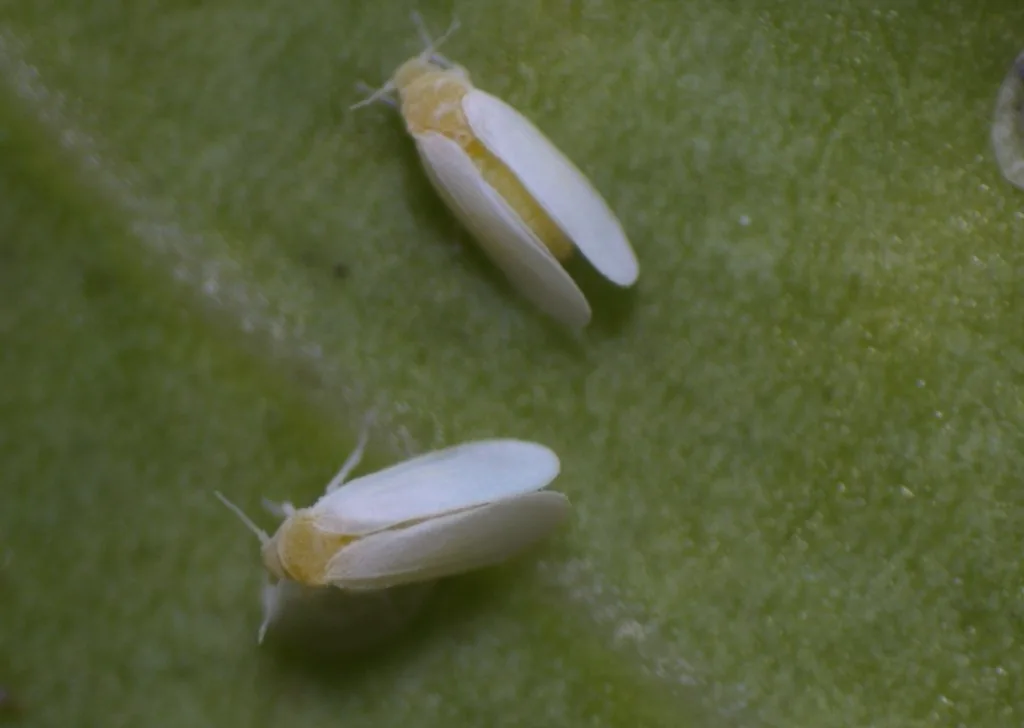
- Adults are about 1 mm long (0.8 mm for males, 1.2 mm for females), pale yellow, with white wings held tent-like over the back and a fine powdery wax that makes them look dusty.[1][2]
- They are slightly smaller, more yellowish and more slender than greenhouse, giant and banded-wing whiteflies.[2][3]
- On the undersides of leaves, the eggs are pearly white to yellow and teardrop-shaped, darkening before they hatch, and unlike other whiteflies the females don't lay them in a circle.[1][2]
- Nymphs are flat, whitish-green to greenish-yellow ovals 0.25 to 0.5 mm long; the last stage, the pupa or red-eyed nymph, shows visible red eyes.[1][2]
Look-alikes
| Look-alike | How to tell them apart |
|---|---|
| Greenhouse whitefly | Larger than the silverleaf whitefly, which stands out by its more yellowish color, slimmer build and eggs that are not laid in circles.[2][3] |
Where it lives
A widely distributed pest throughout the tropics that also thrives in greenhouses farther north; in the southeastern United States it is the most common and destructive whitefly in nurseries, and outdoors there adults are active from mid-July to mid-October.[1][2]
Biology and life cycle
A female lays 50 to 400 eggs on the undersides of leaves, more in warm weather; the eggs hatch in about 4 to 12 days into crawlers, which settle down to feed and lose their legs at the first molt.[2][1]
There are four nymphal stages; adults emerge through a T-shaped slit in the last stage's skin and live about a month, and a complete life cycle takes 16 to 31 days.[1][2]
A strain described in 1994 as a separate species, Bemisia argentifolii, is known as the B biotype, though not all taxonomists accept the split; a Q strain from the Mediterranean region, identified in the United States in 2005, resists many insecticides.[3]
Damage and signs
- Sap feeding causes severe yellowing, stunting, drying and early leaf drop, and young plants rarely survive heavy infestations.[2][1]
- Sticky honeydew grows black sooty mold that cuts photosynthesis and makes plants unsightly.[1][2]
- It spreads plant viruses and disorders, including tomato yellow leaf curl virus, cucurbit yellow stunting disorder, bean golden mosaic virus and squash silverleaf disorder.[1]
- Hosts include poinsettia, begonia, hibiscus, gerbera, lantana, verbena, chrysanthemum, salvia, roses and many vegetables; adults are especially drawn to blooming plants with yellow flowers.[2][3]
Health risk
It feeds only on plants; none of the sources reports any harm to people or pets.[1][2]
Control
Prevention
Inspect new plants and keep them apart for 1 to 2 weeks before planting them, and check the undersides of leaves regularly; yellow sticky cards at canopy height catch the adults.[2]
Sanitation
Remove heavily infested leaves, old plant residues and weeds to reduce nymphs and pupae.[2]
Biological control
Lacewing larvae, lady beetles, minute pirate bugs, mites, spiders and parasitic wasps such as Eretmocerus eremicus attack it, and the tiny lady beetle Delphastus catalinae eats its eggs and nymphs.[1][2]
Pesticides
Sprays must reach the undersides of the leaves; the University of Georgia reports control with 4 to 5 applications at 5- to 7-day intervals while rotating products with different modes of action, since the insect resists many insecticides. Follow the label of any product used.[2][3]
Common questions
- What are the tiny white bugs that fly up from my plants?
- Clouds of tiny white insects rising from the undersides of leaves are whiteflies; small, yellowish ones with tent-like wings on vegetables or ornamentals such as lantana are likely silverleaf whiteflies.[2][1]
- Why are my plant's leaves sticky and black?
- Whiteflies excrete sugary honeydew, and black sooty mold grows on it.[2][1]
Sources
- UF/IFAS Extension (EDIS), “Silverleaf Whitefly - Life Cycle (ENY-878, N. Casuso and H. Smith, August 2017; reviewed August 2024).” edis.ifas.ufl.edu/publication/IN1057 (accessed 2026-10-17)
- University of Georgia Department of Entomology, “Silverleaf Whitefly: A Pest in Nursery and Greenhouse Ornamental Crops (April 2023).” site.caes.uga.edu/entomologyresearch/2023/04/silverleaf-whitefly-a-pest-in-nursery-and-greenhouse-ornamental-crops (accessed 2026-10-17)
- NC State Extension, “Silverleaf Whitefly (factsheet).” content.ces.ncsu.edu/publication/silverleaf-whitefly (accessed 2026-10-17)
- iNaturalist, “Bemisia tabaci taxon page (order and family).” www.inaturalist.org/taxa/199414 (accessed 2026-10-06)