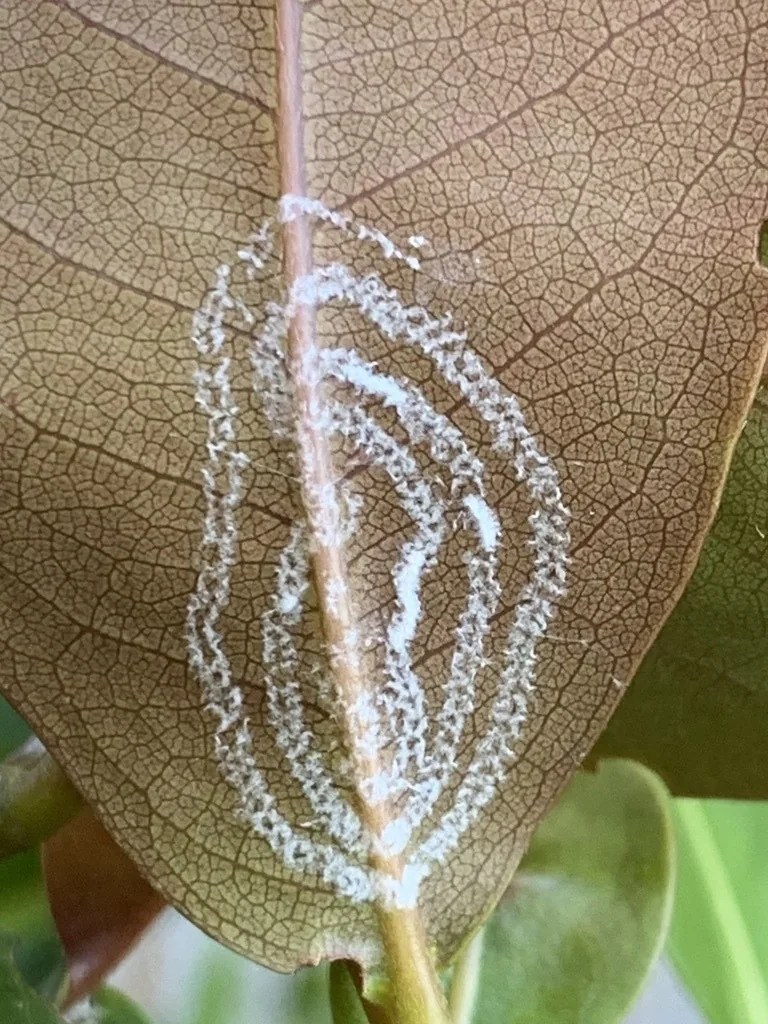
How to identify it
Look-alikes
| Look-alike | How to tell them apart |
|---|---|
| Common whiteflies | Rugose spiraling whitefly adults are about three times larger.[1] |
Where it lives
Native to Central America, it was first reported in Florida in Miami-Dade County in 2009 and has spread from coastal South Florida into central Florida.[1]
Biology and life cycle
The life cycle takes about 30 days in warm weather.[1]
Hosts include palms (especially coconut), gumbo limbo, Calophyllum, avocado, black olive and mango.[1]
Damage and signs
- It rarely kills plants, but honeydew grows thick black sooty mold on leaves and on nearby cars, windows and walls.[1]
Health risk
It feeds on plants; UF/IFAS mentions no risk to people.[1]
Control
Traps and physical control
Early on, pressure washing with water, repeated regularly, removes many eggs and immatures; take care not to damage plants.[1]
Biological control
Two Encarsia parasitic wasps and a predatory beetle often show up on infested plants and are spreading north.[1]
Pesticides
Soaps and horticultural oils need thorough coverage and repeat applications; systemic insecticides are the main tool, used only when necessary.[1]
Common questions
Sources
- University of Florida IFAS Extension (Featured Creatures), “Rugose Spiraling Whitefly, Aleurodicus rugioperculatus (EENY-578).” edis.ifas.ufl.edu/publication/IN1015 (accessed 2026-10-06)
- iNaturalist, “Aleurodicus rugioperculatus taxon page (order and family).” www.inaturalist.org/taxa/204448 (accessed 2026-10-06)