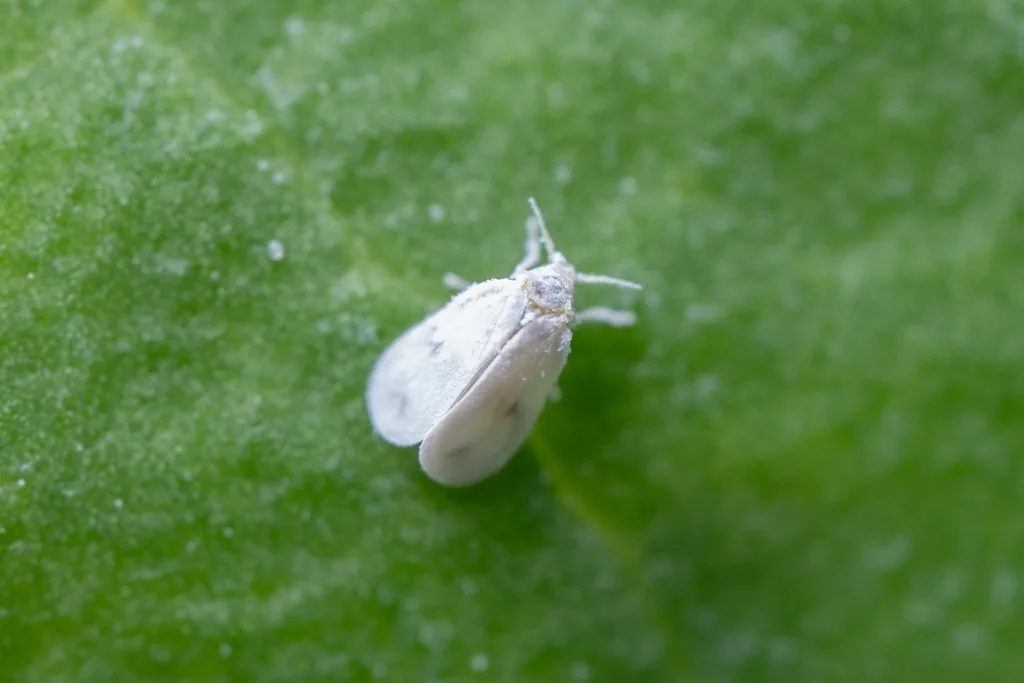
How to identify it
Look-alikes
| Look-alike | How to tell them apart |
|---|---|
| Greenhouse whitefly | Has longer wings, a yellow thorax and a much wider host range.[1] |
Where it lives
The PNW Insect Management Handbook covers it as an emerging pest of brassica crops and ornamental brassicas in the Pacific Northwest.[1]
Biology and life cycle
Adults overwinter on host plants, including nearby related weeds, and can spend the whole year on one plant.[1]
When problems persist, check nearby brassica weeds; as they mature or die off, whiteflies move to more valuable plants.[1]
Damage and signs
Health risk
It feeds on plants; the PNW Insect Management Handbook mentions no risk to people.[1]
Control
Prevention
Monitor with yellow sticky traps next to suspect plants, and look closer when paper wasps and yellowjackets patrol the beds.[1]
Keep them out
Isolate new plants until you've checked them for eggs, nymphs and pupae, since adults may not be present on arrival.[1]
Biological control
The parasitic wasp Encarsia formosa and predatory Delphastus beetles are effective biological controls.[1]
Common questions
Sources
- Pacific Northwest Pest Management Handbooks (OSU, WSU, University of Idaho), “Emerging Insect Pests in the Pacific Northwest: Cabbage whitefly (2016).” pnwhandbooks.org/insect/emerging-insect-pests/emerging-insect/cabbage-whitefly-2016 (accessed 2026-10-06)
- iNaturalist, “Aleyrodes proletella taxon page (order and family).” www.inaturalist.org/taxa/409563 (accessed 2026-10-06)