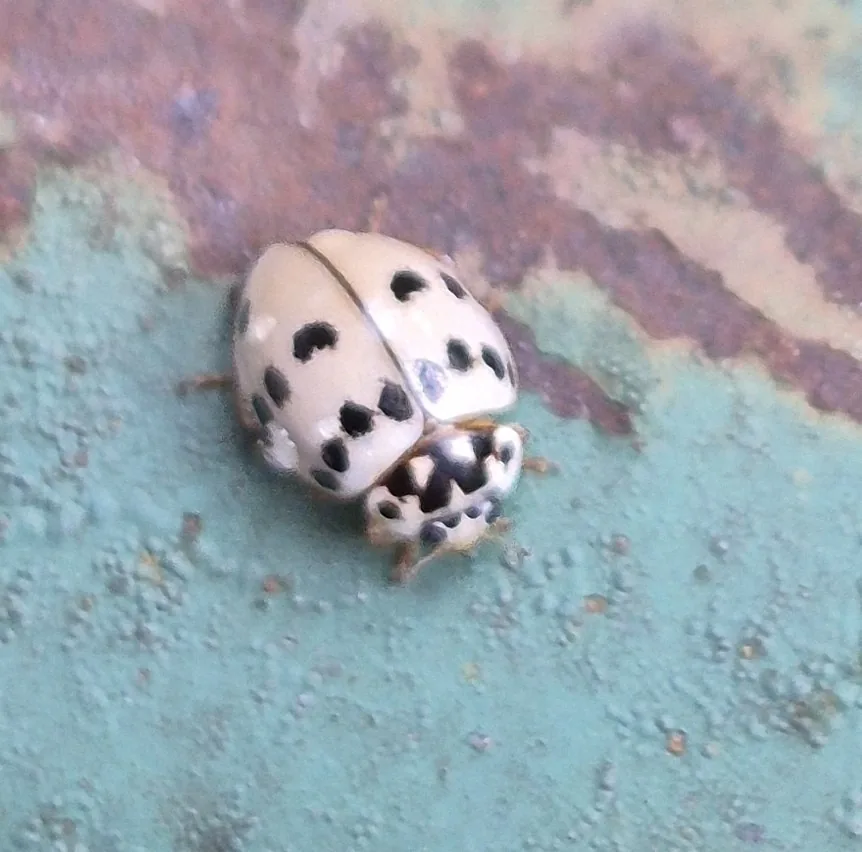
How to identify it
- Adults are 1/6 to 1/4 inch long, oval to round and domed.[1]
- The usual form is gray or pinkish gray with more than a dozen black spots on the thorax and wing covers.[1]
- A black form has two red spots, and another is gray with a large black blotch on each wing cover.[1]
- Larvae are alligator-like and fairly smooth, blackish with white and yellow marks; all stages sit in the open on leaves and stems.[1]
Look-alikes
| Look-alike | How to tell them apart |
|---|---|
| Twicestabbed and similar lady beetles | Black two-spotted look-alikes have wing-cover edges that flare out into a ridge, lack pale color on the head and thorax, and have spiny larvae.[1] |
Where it lives
It lives mostly in trees and shrubs, including fruit and nut trees, landscape plantings and wildland woody plants. It's the only Olla species reported in the U.S.[1]
Biology and life cycle
Females lay eggs on end in loose groups of about one to three dozen.[1]
Newly hatched larvae stay near their egg shells and feed on them at first.[1]
Egg to reproductive adult takes about three weeks at 77 degrees F, with several generations a year.[1]
Damage and signs
- It eats aphids and psyllids especially, plus whiteflies and other soft-bodied insects.[1]
Health risk
UC IPM covers it only as a predator of soft-bodied insects; nothing in the source points to a concern for people.[1]
Control
Prevention
Avoid broad-spectrum insecticides that persist on foliage.[1]
Biological control
Flowering insectary plants feed adults with nectar and pollen.[1]
Ants attack lady beetles, so controlling ants helps them.[1]
Common questions
- What's the gray ladybug with black spots?
- Most likely the ashy gray lady beetle, which is usually gray or pinkish gray with many black spots.[1]
- Is a black lady beetle with two red spots always a twicestabbed?
- No. One form of the ashy gray lady beetle looks like that too; its head and thorax show some pale gray or white.[1]
Sources
- University of California Statewide IPM Program, “Ashy Gray Lady Beetle (Natural Enemies Gallery).” ipm.ucanr.edu/natural-enemies/ashy-gray-lady-beetle/ (accessed 2026-10-06)
- iNaturalist, “Olla v-nigrum taxon page (order and family).” www.inaturalist.org/taxa/313246 (accessed 2026-10-06)