On this page
How to identify it
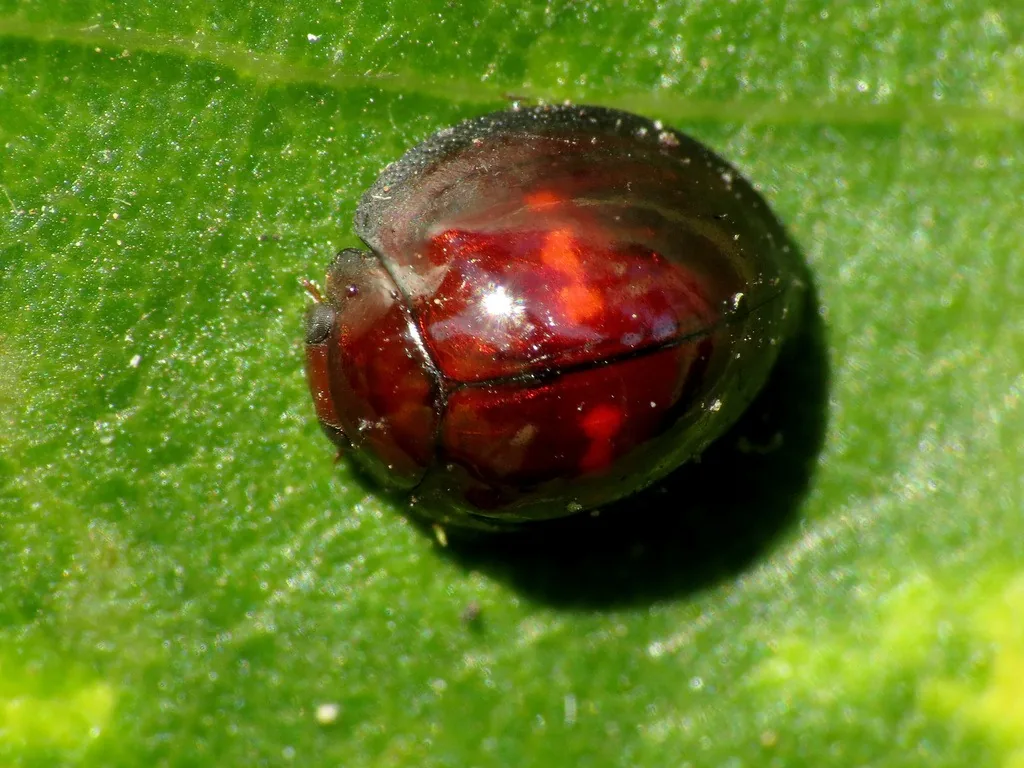
- Adults are about 1/6 inch (4 mm) long, round from above and dome-shaped from the side, and shiny burgundy to dark brown or nearly black.[1]
- Each wing cover has two or three reddish orange spots, which on some beetles run together into a band across the back. The species name bipustulatus means 'two-blistered.'[1]
- Larvae are spiny and mostly dark brown with black and pale or yellowish markings, reaching about 1/5 inch (5 mm).[1]
- Eggs are oblong, yellowish and about 1 mm long. The pupa sits inside the spiny last larval skin, glued to bark or leaves.[1]
Look-alikes
| Look-alike | How to tell them apart |
|---|---|
| Kuwana's lady beetle and other Chilocorus | California has at least four other Chilocorus lady beetles, including Kuwana's lady beetle, a black beetle with a single deep red spot on each wing cover. All of them mainly eat scale insects.[1][3] |
Where it lives
Released in California's northern San Joaquin Valley in 1951 after earlier attempts to establish it in the United States failed. It now occurs at least in the Central Valley and Central Coast of California.[1]
Biology and life cycle
Each female lays about 30 to 60 eggs, one at a time, near scale insects that the hatching larvae will eat. Larvae pass through four stages, and pupae form on bark or leaves, mostly on scale-infested plants.[1]
Egg to egg-laying adult takes about six weeks in warm weather, and there are about six generations a year. The beetles are most common from late spring through fall and become inactive and hard to find in winter.[1]
In lab tests, development sped up as temperatures rose from 15°C to 30°C (59°F to 86°F). Eggs and first-stage larvae died at the highest rates, and survival was best at moderate temperatures of about 17.5°C to 30°C (63°F to 86°F).[2]
Damage and signs
Health risk
The sources describe it only as a predator of scale insects; they mention no harm to people.[1][2]
Control
Prevention
No control is needed; it is a beneficial predator. Help it by controlling ants, which attack lady beetles, growing flowering plants that feed adult natural enemies, hosing dust off small plants, and avoiding broad-spectrum, persistent insecticides.[1]
Biological control
It was imported and released in California as a biological control agent for olive scale and has stayed established there.[1]
Common questions
- What is the small dark lady beetle with a band of orange spots on my olive tree?
- In California it may be the heather lady beetle, a scale predator about 4 mm long, burgundy to nearly black, with two or three reddish orange spots on each wing cover that sometimes merge into a band.[1]
- When is the heather lady beetle active?
- It is most abundant from late spring to fall and becomes inactive, and hard to find, in winter.[1]
Sources
- University of California Statewide IPM Program, “Scale Predatory Chilocorus bipustulatus Lady Beetle, Natural Enemies Gallery.” ipm.ucanr.edu/natural-enemies/scale-predatory-chilocorus-bipustulatus-lady-beetle/ (accessed 2026-11-09)
- Environmental Entomology (Entomological Society of America), “Temperature-dependent development of Chilocorus bipustulatus (Eliopoulos, Kontodimas and Stathas 2010, Environmental Entomology 39:1352-1358), abstract.” pubmed.ncbi.nlm.nih.gov/22127187/ (accessed 2026-11-09)
- University of California Statewide IPM Program, “Scale Predatory Chilocorus kuwanae Lady Beetle, Natural Enemies Gallery.” ipm.ucanr.edu/natural-enemies/scale-predatory-chilocorus-kuwanae-lady-beetle/ (accessed 2026-11-09)
- iNaturalist, “Chilocorus bipustulatus taxon page (order and family).” www.inaturalist.org/taxa/123596 (accessed 2026-11-09)