On this page
How to identify it
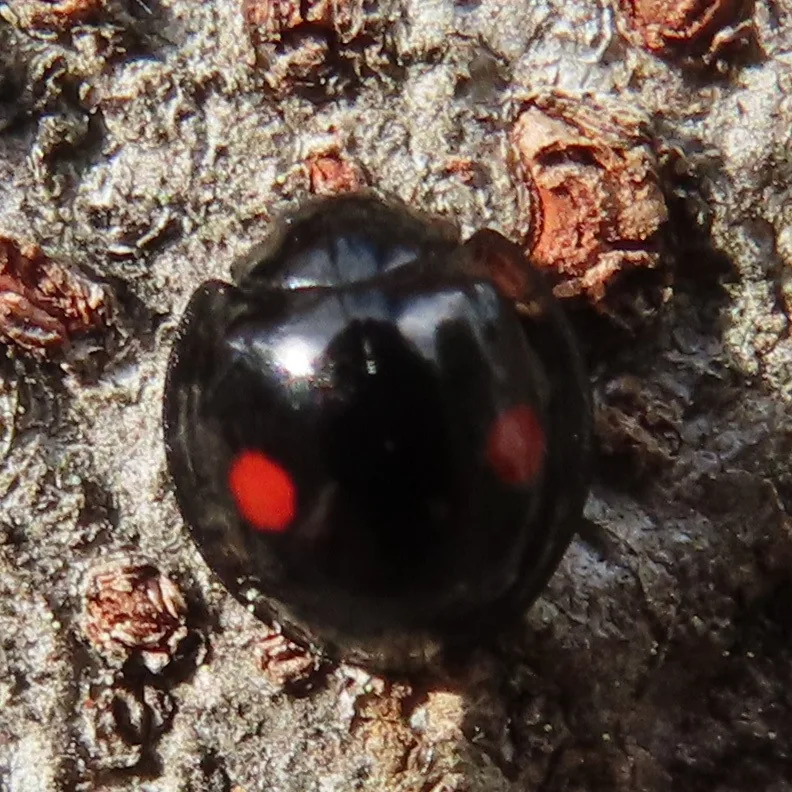
- Adults are about 3 to 5 mm long and black, with one red spot on each wing cover.[1][3]
- The spots are somewhat rectangular rather than round, deep red rather than orange, and sit in the middle or slightly toward the rear of the wing covers. The lower edge of the wing covers flares outward like a ridge.[1]
- Eggs are oblong and bright red, laid singly or a few together in bark cracks or under scale insects and their covers.[1]
- Larvae are brown to dark pinkish and covered with many black, branched spines, reaching about 1/5 inch (5 mm). The black-and-brown pupae stay inside the spiny last larval skin, often in groups on bark.[1]
Look-alikes
| Look-alike | How to tell them apart |
|---|---|
| Twicestabbed lady beetle and other Chilocorus | Also black with two red spots, but their spots are rounder, more orange and their wing-cover edges less flared. Telling the species apart reliably may take dissection by an expert.[1] |
| Ashy gray lady beetle (black form) | One form is black with two red spots, but it has gray or whitish markings on the head and thorax, and its larvae are smooth rather than spiny.[1] |
| Axion lady beetle (Axion plagiatum) | Black with red to orange spots, but the spots sit toward the front and outer sides of the wing covers.[2] |
Where it lives
Brought from Asia. After repeated USDA introductions it is established in California and much of the United States, including the eastern states, where it was released to help manage euonymus scale. It lives mostly on woody plants: landscape trees and shrubs, tree crops and wildland plants infested with scales.[1][3]
Biology and life cycle
With nectar and pollen to feed on, a female can live about 10 weeks and lay about 200 eggs.[1]
Larvae pass through four stages over about three weeks in warm weather, and each eats more than 100 scales. They pry off the scale cover or flip the scale over to reach its soft body.[1]
Egg to egg-laying adult takes about a month in warm weather, giving at least three generations a year.[1]
Adults spend the winter in sheltered places. Where winters are mild and scales are present, they become active whenever it is warmer than about 50°F.[1]
Damage and signs
Health risk
The sources describe it only as a predator of scale insects; they mention no harm to people.[1][3]
Control
Prevention
No control is needed; it is a beneficial predator. Help it by controlling ants, which attack lady beetles, growing flowering plants that feed adult natural enemies, hosing dust off small plants, and avoiding broad-spectrum, persistent insecticides.[1]
Biological control
It was introduced in the eastern United States to help manage euonymus scale, and it was released in many states, including California, against California red scale and San Jose scale as well.[3][1]
Common questions
- What is the black lady beetle with two red spots on my euonymus?
- It may be Kuwana's lady beetle, a scale predator released in the eastern United States to help control euonymus scale. Adults are 3 to 4.5 mm long and black with two red spots.[3]
- What do Kuwana's lady beetle larvae look like?
- They are brown to dark pinkish and bristle with black, branched spines. Each one eats more than 100 scales as it grows.[1]
- Where did Kuwana's lady beetle come from?
- The USDA imported it from China, Korea and Pakistan several times from 1895 through the 1980s for biological control of scales.[1]
Sources
- University of California Statewide IPM Program, “Scale Predatory Chilocorus kuwanae Lady Beetle, Natural Enemies Gallery.” ipm.ucanr.edu/natural-enemies/scale-predatory-chilocorus-kuwanae-lady-beetle/ (accessed 2026-11-09)
- University of California Statewide IPM Program, “Axion Lady Beetle, Natural Enemies Gallery.” ipm.ucanr.edu/natural-enemies/axion-lady-beetle/ (accessed 2026-11-09)
- Penn State Extension, “Euonymus Scale.” extension.psu.edu/euonymus-scale (accessed 2026-11-09)
- iNaturalist, “Chilocorus kuwanae taxon page (order and family).” www.inaturalist.org/taxa/319337 (accessed 2026-11-09)