On this page
How to identify it
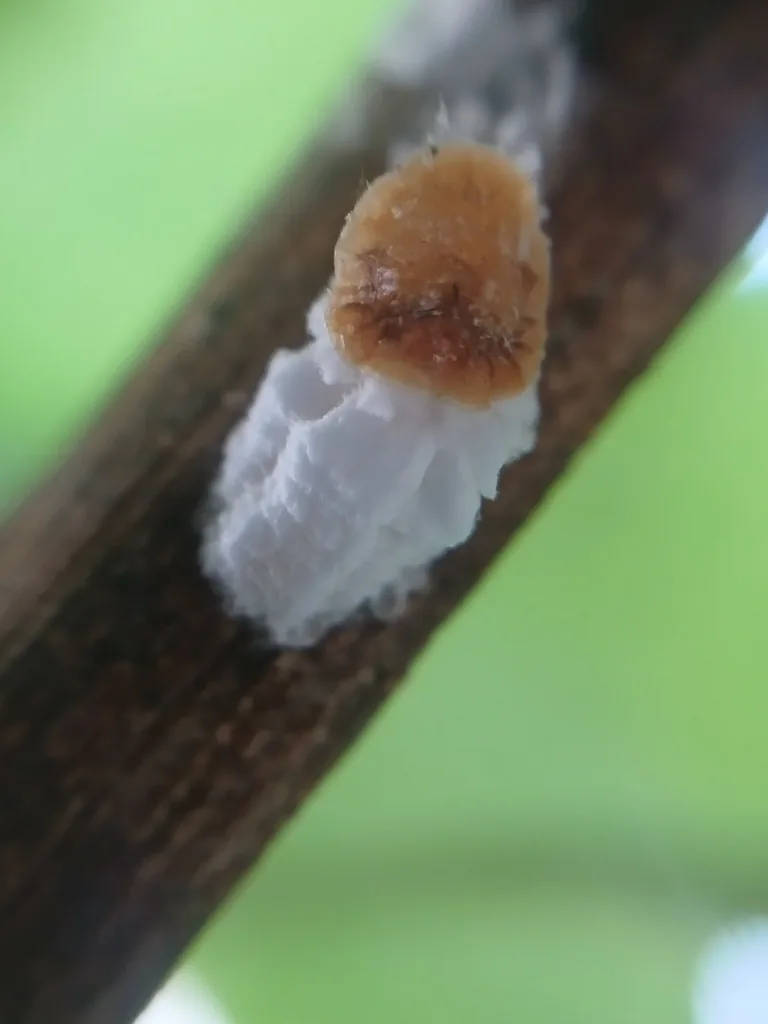
- Overwintering immature scales on grape canes are brownish to black, flat and oval, about 0.06 to 0.14 inch long.[1]
- The scales grow to about 0.25 inch long in spring.[1]
- Mature females produce a conspicuous white, cottony egg sac two to three times the length of the scale body, and the sac stays on the vine after the female dies.[1]
- Ants tending the scales for honeydew may be the first thing you notice.[1]
Where it lives
A grapevine pest that the Pacific Northwest handbook notes has not been common in Oregon vineyards; research on its role as a virus carrier comes from vineyards in Alsace, France.[1][2]
Biology and life cycle
It spends the winter as an immature scale on the grape canes and matures in June.[1]
Each female lays about 3,000 eggs in her cottony sac. The crawlers hatch in July and August and disperse to the undersides of leaves.[1]
Parasitic wasps generally prey heavily on scale insects.[1]
Damage and signs
- Feeding on the foliage reduces vine vigor and causes twig dieback.[1]
- Feeding scales excrete honeydew, which attracts ants and grows black sooty mold.[1]
- In laboratory tests, first- and second-stage nymphs transmitted grapevine leafroll-associated virus 1 and grapevine virus A from vine to vine, the first report of this species spreading those viruses.[2][1]
Health risk
The sources describe it only as a grapevine pest; neither mentions any risk to people or pets.[1][2]
Control
Traps and physical control
Much of the vine is removed at pruning, so control may be unnecessary unless the scale is infesting the main trunk or cordons.[1]
Biological control
Parasitic wasps attack scale insects heavily; watch for ants, which tend the scales for honeydew, as a sign of an infestation.[1]
Pesticides
For home vineyards, the PNW handbook lists a dormant-season horticultural oil spray. Scales hide in crevices, under bark and in clusters, so contact insecticides have trouble reaching them.[1]
Common questions
- What are the white cottony tufts on my grape canes?
- They may be the egg sacs of cottony grape scale. Each sac is two to three times as long as the scale and can hold about 3,000 eggs.[1]
- Do I need to treat cottony grape scale?
- Often not, since pruning removes much of the infested wood. Control is mainly worth considering when the scale is on the trunk or cordons.[1]
- Can cottony grape scale spread grape viruses?
- Yes. Lab studies showed its nymphs can transmit grapevine leafroll-associated virus 1 and grapevine virus A.[2]
Sources
- Pacific Northwest Pest Management Handbooks (Oregon State University, Washington State University and University of Idaho Extension), “Grape-Cottony grape scale, Pacific Northwest Insect Management Handbook.” pnwhandbooks.org/insect/small-fruit/grape/grape-cottony-grape-scale (accessed 2026-11-09)
- MDPI (Viruses), “Hommay G, Alliaume A, Reinbold C, Herrbach E. Transmission of Grapevine leafroll-associated virus-1 (Ampelovirus) and Grapevine virus A (Vitivirus) by the cottony grape scale, Pulvinaria vitis (Hemiptera: Coccidae). Viruses 13(10):2081 (2021) (abstract).” doi.org/10.3390/v13102081 (accessed 2026-11-09)
- iNaturalist, “Pulvinaria vitis taxon page (order and family).” www.inaturalist.org/taxa/396032 (accessed 2026-11-09)