On this page
How to identify it
- Females are cream to tan or yellow-tan, flat and oval, up to about 1/8 inch long; young females have a dark stripe down the middle, and older ones turn dark brown.[1][2]
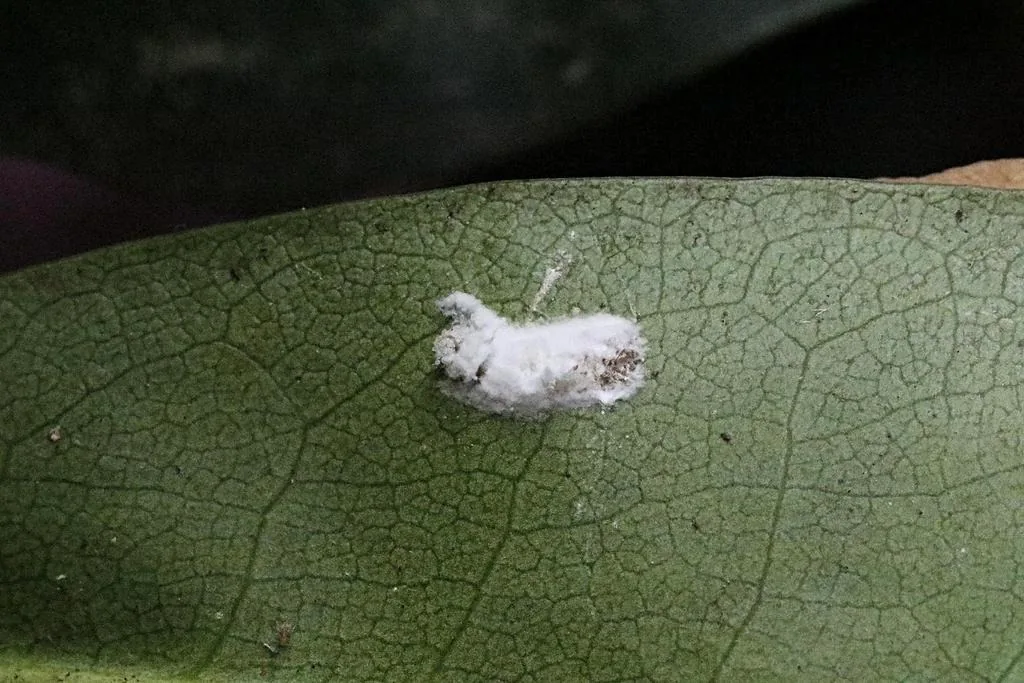
- The white, fluffy egg sacs are about 1/4 inch long, two or more times the length of the scale, and stay on the leaf after the female dies.[1][2]
- Mature females and their egg sacs sit mostly on the undersides of leaves.[2]
Where it lives
A non-native scale found in Florida and the tropics and in North Carolina, Maryland and other states.[1][2]
Biology and life cycle
Females overwinter on twigs or leaves and lay hundreds of eggs in the ovisac in spring; males, when present, emerge in fall.[1][2]
UMD gives the crawler period as roughly mid-June through mid-October, depending on temperature.[2]
Damage and signs
- Hosts include camellia, yew, Chinese holly and jasmine in North Carolina, plus English ivy, euonymus, hydrangea, maple, mulberry, pittosporum and rhododendron.[1][2]
- Honeydew grows sooty mold that blackens plants; heavy, long infestations yellow leaves and weaken plants, though dieback is uncommon.[1][2]
Health risk
Control
Biological control
Hyperaspis lady beetles feed inside the egg sacs; spraying before they leave in June kills the beetles but not the protected eggs.[1]
Pesticides
Target the crawler stage; UMD notes dormant oil plus systemic or growth-regulating insecticides works best, and big populations may need more than a year.[1][2]
Common questions
Sources
- NC State Extension, “Cottony Camellia Scale Insect (PDIC Factsheet).” content.ces.ncsu.edu/cottony-camellia-scale-1 (accessed 2026-10-16)
- University of Maryland Extension (Home and Garden Information Center), “Cottony Camellia Scale.” extension.umd.edu/resource/cottony-camellia-scale (accessed 2026-10-16)
- iNaturalist, “Pulvinaria floccifera taxon page (order and family).” www.inaturalist.org/taxa/396029 (accessed 2026-10-06)