On this page
How to identify it
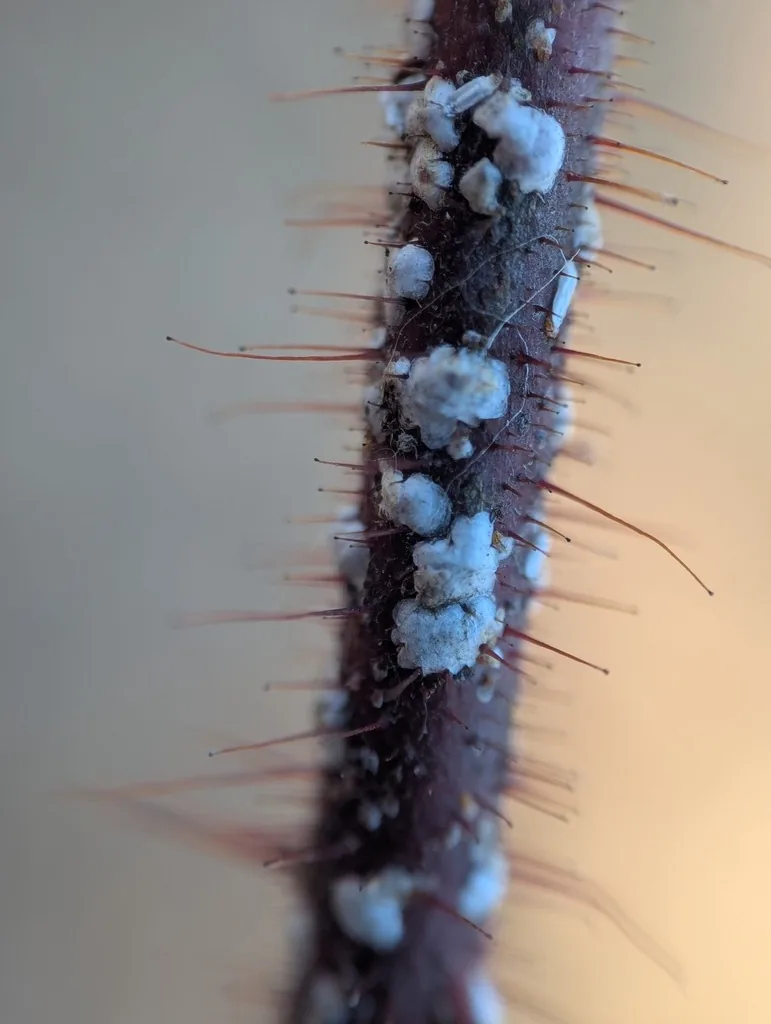
- The female's cover is almost circular, 1.5 to 2 mm across, nearly flat and white, with a yellow or gold shed skin at or near the margin. The male's cover is smaller, elongate, parallel-sided and white with three ridges and a yellow shed skin at one end.[1]
- Pry a cover off with a knife tip or pin and the female beneath is elongate, about 1 mm long, orange or dark red-brown and usually mottled, with a swollen front end. Adult males are winged.[1][5]
- Covers sit on the stems, occasionally the leaves. On rose canes armored scales show as small grayish round to oval encrustations, 1/8 to 1/4 inch, with no legs or antennae and no movement for most of their lives. Mississippi State notes that scale covers often blend in with the bark, so they are easy to miss.[1][2][4]
- Hosts are in the rose family; it does not feed on grasses. In California it is particularly common on Rubus (raspberries and blackberries).[1]
Look-alikes
| Look-alike | How to tell them apart |
|---|---|
| San Jose scale | The other armored scale UC IPM lists on roses. It can blow in from nearby orchards, so it turns up on roses near fruit and nut growing areas; the rose scale's covers are white and its hosts are rose-family plants such as rose, brambles and currants.[2][1] |
| Cottony cushion scale and soft scales on roses | These produce honeydew that makes leaves sticky and allows black sooty mold; UC IPM lists them separately from the two armored scales of roses, and washing with soap and water may reduce them.[2] |
Where it lives
Listed as a pest of deciduous fruit trees of world importance and named on quarantine lists. In the United States it overwinters as eggs and is an occasional pest of ornamental roses in some areas, especially in damp, shady spots. UC IPM lists it among the scales of roses in California, where it is particularly common on raspberries and blackberries, and Mississippi State calls it one of the more common armored scales on roses.[1][2][4]
Biology and life cycle
Hosts are Rosaceae: rose, raspberry and other Rubus, pear, agrimony and others, with records on currant (Ribes) and a few non-rosaceous plants such as hydrangea, bay laurel and cycads.[1]
Reports of its biology conflict and it appears to vary from place to place. Females lay 50 to 150 eggs each, there are one to four generations a year, and in the United States it overwinters as eggs (in Europe in all stages).[1]
Females lay their eggs under the scale cover. The crawlers that hatch move a short distance, insert their mouthparts and form a cover of their own; females never move again. For scale insects in general, crawler emergence lasts about 2 to 4 weeks, and black electrical tape wrapped sticky side out around an infested twig will catch them.[4][5]
Crawlers are the dispersal stage, moving to new parts of the plant or carried by wind or animal contact; most die to weather and other abiotic causes. Settled adults and eggs spread only when people move infested plant material.[1]
Many parasitoid wasps attack it, including Aphytis, Encarsia and Metaphycus species. Neat round exit holes in mature scale covers show that parasitoids have emerged.[1][2][5]
Damage and signs
- Heavy infestations coat the stems with white scales and make ornamentals unsightly. It is primarily a pest of rose, where heavy infestation can kill plants, and it seriously damages currants and brambles; heavy infestations near the crown can weaken or kill the plant. On roses UC IPM notes cane decline or dieback when numbers are high.[1][2]
- The Connecticut Agricultural Experiment Station links armored scales in general to decline and dieback of their hosts, possibly triggered by toxic saliva injected as they feed.[5]
Health risk
None of the sources describes any effect on people or pets; the scale lives fixed to the stems of rose-family plants.[1][2][4]
Control
Prevention
Don't buy scale-infested plants: examine the stems of new roses and brambles for white scale covers before planting, since settled scales and eggs arrive on infested stock. Keep plants healthy and vigorous so they can better resist or tolerate infestation.[1][4]
Traps and physical control
In winter, cut back and destroy infested canes; prune and discard heavily infested canes.[2][4]
Biological control
Scales on roses are attacked by many natural enemies, parasitic wasps above all. Check mature covers for exit holes before treating; if natural enemies are active, the Connecticut station advises holding off on insecticides and watching whether they bring the scale under control.[2][1][5]
Pesticides
If the population is high, apply horticultural (insecticidal) oil to the remaining infested canes in winter after pruning. UC IPM says pruning plus a winter oil application should provide sufficient control of armored scales on roses. Mississippi State calls horticultural oil one of the best treatments for armored scales such as rose scale, but only the scales the spray actually covers are killed, so coverage must be thorough; it adds that a systemic soil treatment such as dinotefuran also helps control armored scales.[2][4]
Common questions
- My rose canes are crusted white. Is it a disease?
- Flat, round white covers 1.5 to 2 mm across with a yellow dot at the edge are rose scale, an armored scale insect. Scrape one off and look for the orange to red-brown body underneath.[1]
- Will it kill the roses?
- It can. Heavy infestations have killed roses, and UC IPM notes cane decline and dieback when numbers are high. Light infestations mostly make the canes unsightly.[1][2]
- What is the treatment?
- Prune out and destroy the worst canes in winter and spray the rest thoroughly with horticultural oil while the plant is dormant. Parasitic wasps often keep it in check; exit holes in the covers mean they are working.[2][4]
- Why didn't my spray work?
- An armored scale's hard cover protects it from insecticides, and oil kills only the scales it actually coats, so spotty coverage leaves survivors.[5][4]
Sources
- Naturalis Biodiversity Center (Diaspididae of the World, Linnaeus NG), “Diaspididae of the World 2.0: Aulacaspis rosae (Bouche, 1833).” diaspididae.linnaeus.naturalis.nl/linnaeus_ng/app/views/species/taxon.php?cat=names&id=113052 (accessed 2026-11-11)
- University of California Statewide IPM Program, “Roses: Insects and Mites (Pest Notes), scale insects section.” ipm.ucanr.edu/home-and-landscape/roses-insects-and-mites/ (accessed 2026-11-11)
- iNaturalist, “Aulacaspis rosae taxon page (order and family).” www.inaturalist.org/taxa/386328 (accessed 2026-11-11)
- Mississippi State University Extension Service, “Insect Pests of Roses (Publication 2472).” extension.msstate.edu/sites/default/files/publications/P2472_web.pdf (accessed 2026-11-11)
- The Connecticut Agricultural Experiment Station, “Scale Insect Pests of Connecticut Trees and Ornamentals (Smith, Cowles and Hiskes).” portal.ct.gov/-/media/caes/documents/publications/fact_sheets/entomology/scaleinsectpestsofconnecticuttreesandornamentalspdf.pdf (accessed 2026-11-11)