On this page
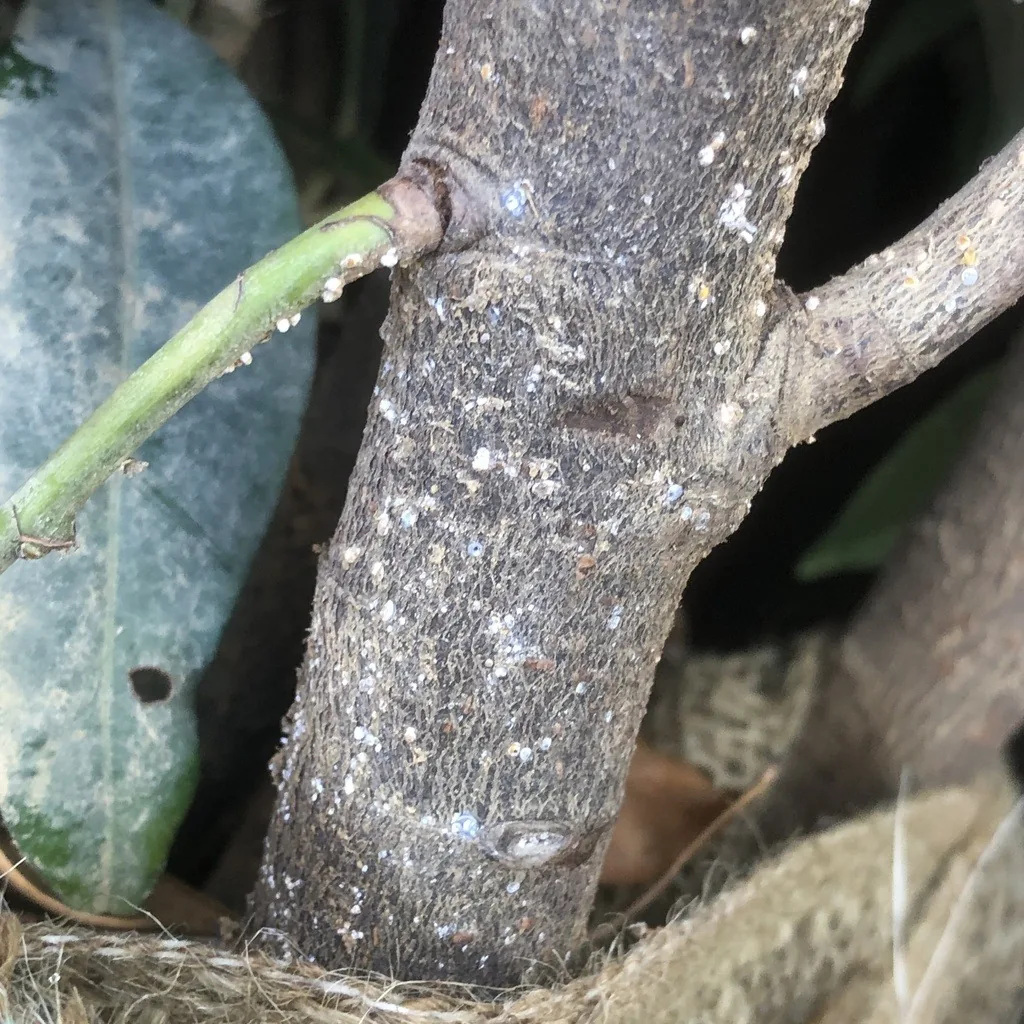
How to identify it
Look-alikes
| Look-alike | How to tell them apart |
|---|---|
| White peach scale | Identical in the field; white prunicola scale is the more likely one on cherry, lilac and privet in the Northeast, while white peach scale is more tropical and subtropical with a much wider host list.[1][2] |
Where it lives
A temperate species common in Maryland and New England.[1][2]
Biology and life cycle
There are three generations a year in Maryland, with first crawlers around 513 degree days (peak bloom of tulip poplar) and the second around 1,637 degree days (after golden raintree peaks, before rose-of-Sharon is in full bloom).[1]
Crawlers can be monitored with electrical tape wrapped sticky side out around branches.[2]
All stages stay on the bark of twigs, branches and trunks year-round.[1][2]
Damage and signs
- Preferred hosts are cherry laurel and other Prunus, Japanese flowering cherry, lilac and privet; it also turns up on holly and boxwood (UMD counts 16 plant families, UMass 18).[1][2]
- Infestations start on outer, smaller branches and cause yellowing, leaf drop, stunting and, when heavy, branch death.[1]
Health risk
Control
Traps and physical control
On small plants, gently scrub scales off with a soft brush; pruning is hard because it colonizes trunks and larger branches.[2]
Pesticides
Horticultural oil and sprays timed to the crawler stage give the best control.[1][2]
Common questions
- What is the white crust on my cherry laurel and lilac stems?
- Often white prunicola scale.[1][2]
- Is it white peach scale?
- They look identical in the field; on cherry, lilac and privet in the Northeast it is more likely white prunicola scale.[1][2]
- When should I treat?
- When crawlers hatch, about three times a year in Maryland, starting around tulip poplar bloom.[1]
Sources
- University of Maryland Extension (Home & Garden Information Center), “White Prunicola Scale (Home & Garden Information Center).” extension.umd.edu/resource/white-prunicola-scale (accessed 2026-10-16)
- UMass Extension Landscape, Nursery and Urban Forestry Program (Landscape Insect & Mite Guide), “Pseudaulacaspis prunicola, White Prunicola Scale (Landscape Insect & Mite Guide).” www.umass.edu/agriculture-food-environment/landscape/publications-resources/insect-mite-guide/pseudaulacaspis-prunicola (accessed 2026-10-16)
- iNaturalist, “Pseudaulacaspis prunicola taxon page (order and family).” www.inaturalist.org/taxa/1007739 (accessed 2026-10-06)