On this page
How to identify it
Look-alikes
| Look-alike | How to tell them apart |
|---|---|
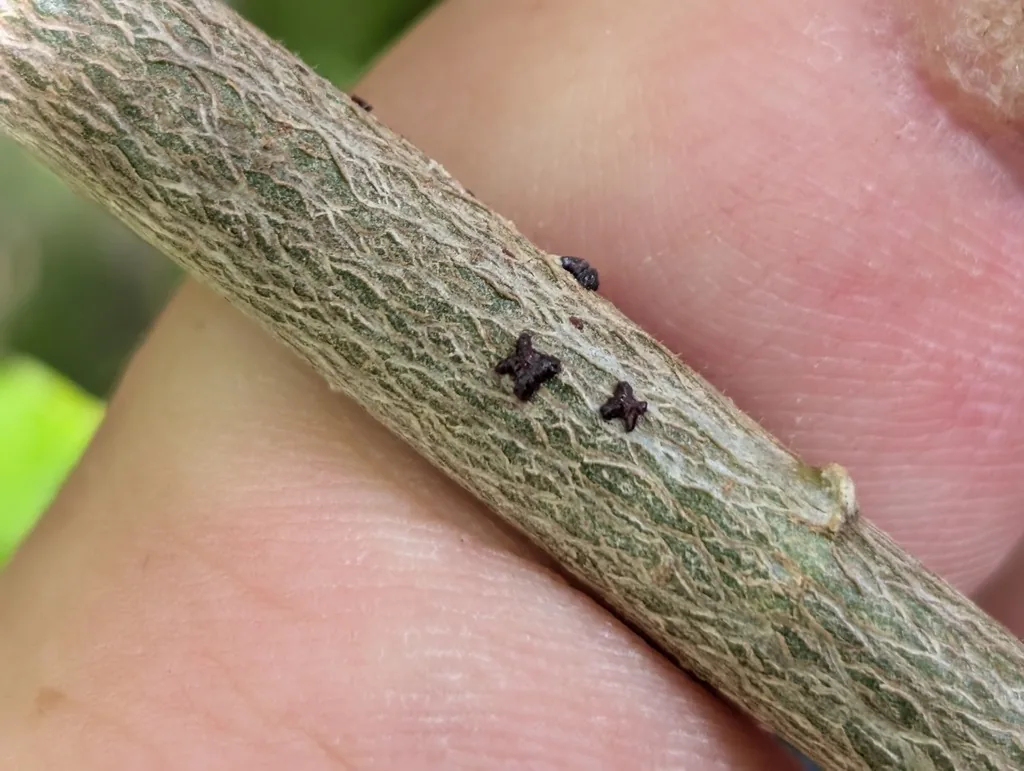
| Mexican lac scale | Florida's other lac scale, found on wild tamarind and acacias in a few counties; its cover lacks the distinctive bow-tie lobes.[2] |
Where it lives
Native to India and Sri Lanka and found in the Bahamas in 1992; first found in Florida on hibiscus in Davie (Broward County) in 1999, it spread through Palm Beach and Miami-Dade counties within a few years and is now widely distributed throughout southern Florida.[1][3][2]
Biology and life cycle
The crawlers are wingless but can be carried to new plants on air currents and by animals such as birds.[3]
Shipments of ornamental plants are the main risk for spread beyond Florida, to the Caribbean, California and Hawaii.[3][1]
Damage and signs
- It attacks woody broadleaf plants; by 2003 it had been documented on 94 of 155 native South Florida woody species and roughly as many landscape and crop plants.[3]
- Heavy infestations can kill plants: wax myrtle is especially prone and has died both as hedges and in the wild, and cocoplum and myrsine are also hit, while mango leaves develop sooty mold.[1][3]
Health risk
It feeds on plants only; none of the sources reports harm to people or pets.[1][3]
Control
Biological control
Biological control is the likeliest approach for natural areas, and USDA has evaluated parasitoids from India and Thailand.[3]
Pesticides
Insecticide treatment can protect landscape and agricultural plants; an early University of Florida trial found that a root drench of the systemic insecticide imidacloprid controlled the scale on large Benjamin fig trees. Follow the label.[3][1]
Common questions
Sources
- UF/IFAS Extension (EDIS), “Lobate Lac Scale, Paratachardina lobata lobata (Featured Creatures, EENY-276).” edis.ifas.ufl.edu/publication/IN471 (accessed 2026-10-17)
- UF/IFAS Extension (EDIS), “The Mexican Lac Scale, Tachardiella mexicana (Featured Creatures).” edis.ifas.ufl.edu/publication/IN990 (accessed 2026-10-17)
- Don't Move Firewood (The Nature Conservancy), “Lobate Lac Scale (pest page, F. Campbell).” www.dontmovefirewood.org/pest_pathogen/lobate-lac-scale-html/ (accessed 2026-10-17)
- iNaturalist, “Paratachardina pseudolobata taxon page (order and family).” www.inaturalist.org/taxa/498129 (accessed 2026-10-06)