On this page
How to identify it
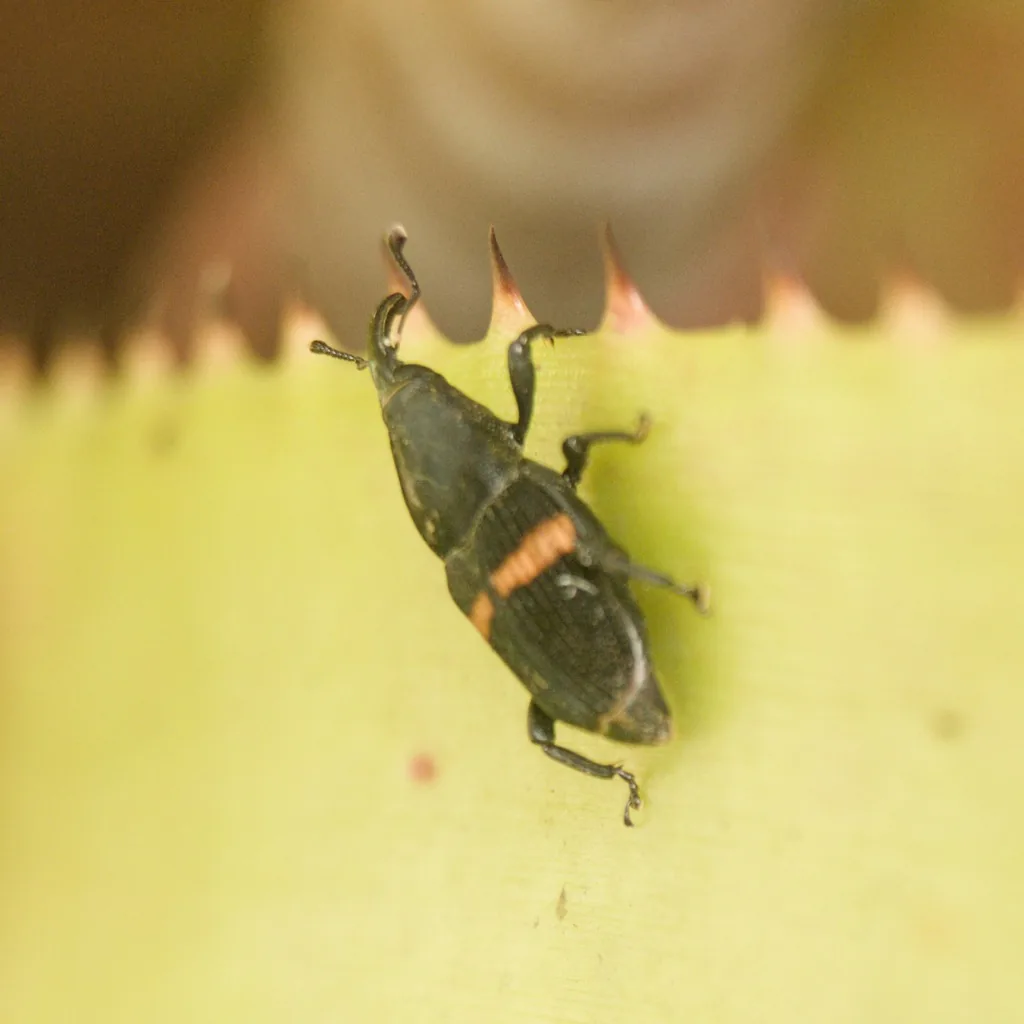
- Adults are 11 to 16 mm (0.4 to 0.6 inch) long and black, with a single yellow or orange band across the wing covers above the middle.[1]
- Larvae are cream-colored grubs with a dark head, and they pupate in a fibrous cocoon made of shredded plant material.[1]
- Damage shows as feeding scars and egg slits on the leaves, then large holes at the base where grubs tunnel into the stem, so infested plants may fall off the branches they grow on.[1]
Look-alikes
| Look-alike | How to tell them apart |
|---|---|
| Florida bromeliad weevil | A native, considerably smaller weevil that attacks small bromeliads, is found only occasionally and does not threaten native bromeliad populations.[3][2] |
| Silky cane weevil | Another Metamasius weevil in Florida, a pest of sugarcane, bananas and ornamental palms, with a different color pattern.[1] |
Where it lives
Native to Mexico and Central America. It was first found in Florida in 1989 at a Fort Lauderdale bromeliad nursery, probably arriving in plants imported from Veracruz, Mexico; it spread to four southern Florida counties by 1991, to 12 more by 1999, and into the Everglades.[1]
Biology and life cycle
Females cut slits in leaves near their feeding sites and lay eggs one at a time; the young larvae feed on leaf tissue as they move down to the base and tunnel into the stem.[1]
In the laboratory, development from egg to adult took about eight weeks, and females lived about five months.[1]
Damage and signs
- In natural areas it mainly attacks large tank bromeliads such as the giant airplant (Tillandsia utriculata), which it kills directly, and the cardinal airplant (T. fasciculata); both were listed as endangered in Florida because of the weevil.[1][2]
- It also damages ornamental bromeliads in nurseries and gardens, and adults feed on plants such as pineapple.[1]
Health risk
It feeds on bromeliads only; none of the sources reports harm to people or pets.[1][2]
Control
Biological control
Biological control is considered the best hope for natural areas, and a parasitic fly from Central America, Lixadmontia franki, has been studied against it.[1]
Pesticides
For ornamental bromeliads in infested areas, UF/IFAS suggests a reduced rate of an insecticide labeled for beetle adults and grubs applied as a spray or dip every two to three months, while noting that this is based on general principles rather than trials against the weevil; follow the label.[1]
Common questions
- What is killing the bromeliads on my trees in South Florida?
- If large air plants are collapsing with holes at the base of the stem, the Mexican bromeliad weevil's grubs are a likely cause.[1][2]
- Does the Mexican bromeliad weevil attack garden bromeliads?
- Yes; it infests ornamental bromeliads in nurseries and landscapes as well as native air plants.[1]
Sources
- UF/IFAS Extension (EDIS), “Mexican Bromeliad Weevil (suggested common name), Metamasius callizona (Featured Creatures, EENY-161; B. Larson and J. H. Frank; reviewed May 2022).” edis.ifas.ufl.edu/publication/IN318 (accessed 2026-10-17)
- UF/IFAS Extension (EDIS), “Florida's Native Bromeliads (UW205).” edis.ifas.ufl.edu/publication/UW205 (accessed 2026-10-17)
- UF/IFAS Extension (EDIS), “Florida Bromeliad Weevil (suggested common name), Metamasius mosieri (Featured Creatures).” edis.ifas.ufl.edu/publication/IN366 (accessed 2026-10-17)
- iNaturalist, “Metamasius callizona taxon page (order and family).” www.inaturalist.org/taxa/510263 (accessed 2026-10-06)