On this page
How to identify it
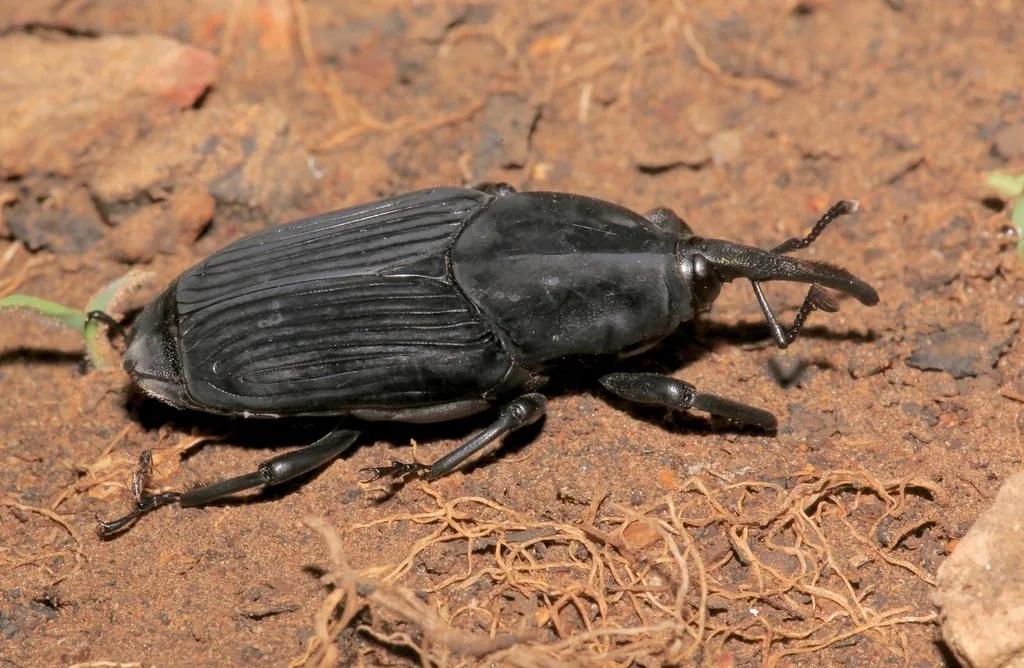
- Adults are large black weevils about 1.5 inches long with a long snout; they have wings and are strong fliers.[2][1]
- Larvae are whitish grubs up to five inches long that pupate in fibrous cocoons in the crown or in tunnels at the base of the fronds.[2][1]
- Infested palms lose their strong upright central fronds; in advanced decline a Canary Islands date palm often has a 'halo' of green fronds around the top of the trunk as the crown disintegrates, and damaged tissue inside starts to ferment and smell.[3][1]
Where it lives
Native to Mexico, Central and South America and the Caribbean. It was found infesting palms in Tijuana in 2010 and in traps in San Ysidro in 2011, likely established in San Diego County by about 2014, and has been detected in Alamo, Texas (2012) and Yuma, Arizona (2015) without establishing there.[1][2][3]
Biology and life cycle
Males release an aggregation pheromone that draws both sexes to suitable palms; females drill holes with the snout and lay eggs in them or in cracks and wounds, probably a hundred or more in a lifetime.[1]
The grubs feed on the palm's growing tissue in the crown, and severe feeding kills the palm.[1][3]
Damage and signs
- Canary Islands date palms and edible date palms are most at risk; it also breeds in coconut, African oil, acai and sago palms and in sugarcane, and adults feed on ripe fruit such as avocado, banana, mango and papaya without reproducing on them.[1][4]
- Adults can carry red ring nematode, which can kill palms within 3 to 4 months of symptoms, but the nematode has not been detected in California weevils or anywhere else in the United States.[1][4]
Health risk
It attacks palms only; none of the sources reports harm to people or pets.[1][2]
Control
Prevention
Don't move live ornamental palms out of infested areas, and report palms suspected of being infested or killed through UC's online form.[1][2]
Pesticides
Systemic insecticides, mainly neonicotinoids, applied as soil drenches, trunk sprays or injections, or crown drenches are the most effective way to protect and sometimes cure valuable palms; follow the label.[1]
When to call a professional
Infested, dying or dead palms should be removed by professional arborists, with the crown and fronds chipped and hauled covered to a landfill that buries waste quickly; the whole trunk usually doesn't need to come out, because larvae stay in the top quarter of the palm.[1]
Common questions
- Why is the top of my Canary Island date palm collapsing?
- In San Diego County, a collapsing crown with a 'halo' of fronds around the top of the trunk is a classic sign of South American palm weevil attack.[3][2]
- Can a palm infested by palm weevils be saved?
- Sometimes, if it is caught early: systemic insecticides can protect and potentially cure palms, but untreated infested palms die.[1][4]
Sources
- University of California, Riverside (Department of Entomology, biological control program), “Biology and Management of South American Palm Weevil, Rhynchophorus palmarum, in California (M. Hoddle and I. Milosavljevic).” biocontrol.ucr.edu/south-american-palm-weevil (accessed 2026-10-17)
- University of California, Riverside, Center for Invasive Species Research, “The South American Palm Weevil Invasion in San Diego County, California (M. Hoddle, October 18, 2018).” cisr.ucr.edu/blog/2018/10/18/south-american-palm-weevil-invasion-san-diego-county-california (accessed 2026-10-17)
- University of California, Riverside, Center for Invasive Species Research, “South American Palm Weevil (invasive species page).” cisr.ucr.edu/invasive-species/south-american-palm-weevil (accessed 2026-10-17)
- University of California Agriculture and Natural Resources, “About SAPW (South American Palm Weevil site; after UC Cooperative Extension fact sheet 1 of 5, 2019).” ucanr.edu/site/south-american-palm-weevil/about-sapw (accessed 2026-10-17)
- iNaturalist, “Rhynchophorus palmarum taxon page (order and family).” www.inaturalist.org/taxa/304994 (accessed 2026-10-06)