On this page
How to identify it
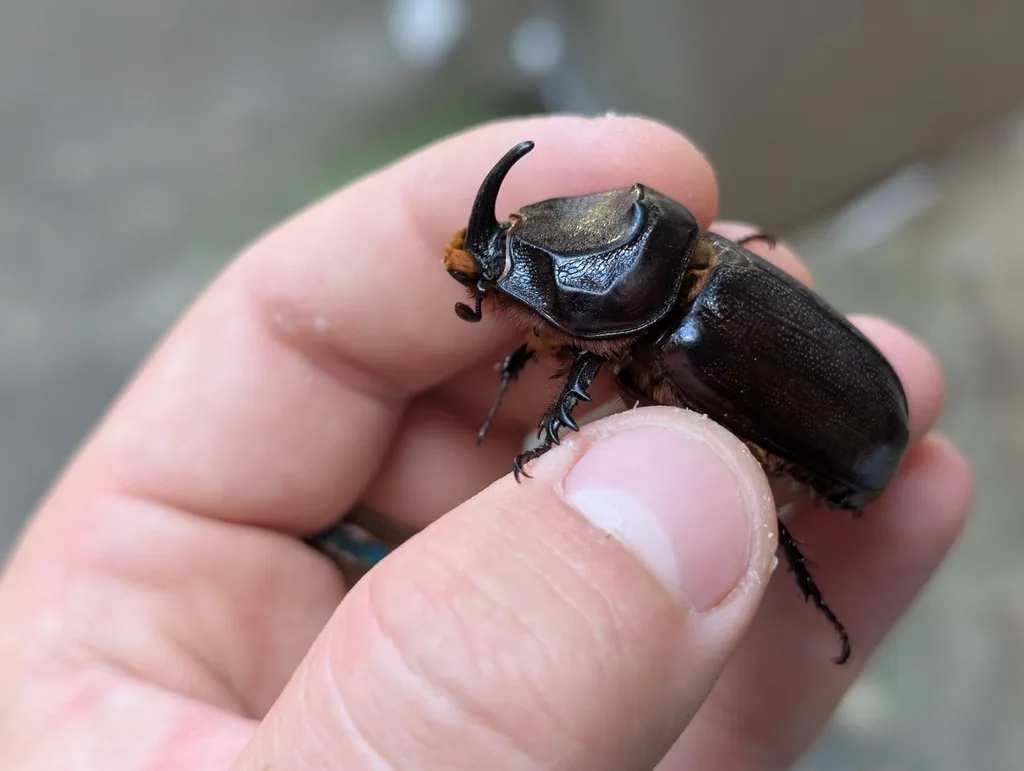
- Adults are stout black beetles with a single distinctive horn on the head, and they are active at night.[2]
- The clearest sign on palms is V-shaped cuts in the fronds as damaged leaves unfold, along with holes through the midrib and bore holes into the crown.[1][2]
- Grubs live in decaying organic matter such as mulch, compost, green waste and rotting palm stumps; the grubs of the common Oriental flower beetle look similar.[1][2][4]
- Bags of mulch, compost or soil with chewed entry holes can mean grubs are inside.[3]
Look-alikes
| Look-alike | How to tell them apart |
|---|---|
| Oriental flower beetle grubs | Common grubs in Hawaii compost that resemble coconut rhinoceros beetle grubs, so suspicious grubs should be identified by the state.[4] |
Where it lives
First detected in Hawaii on palms at Joint Base Pearl Harbor-Hickam on Oahu in December 2013; it has since turned up in traps at Waikoloa on Hawaii Island in 2024 and at Kahului Airport and Waikapu on Maui in 2026. It is also a major palm pest in India, the Philippines, Palau, Fiji, Samoa and Guam.[1][3][4]
Biology and life cycle
Grubs breed in mulch, compost, green waste, tree stumps and other decaying plant material; compost becomes suitable for them once it cools to around 110 °F.[1][2]
Adults fly at night and bore into the crowns of palms to feed on the sap.[2][3]
Damage and signs
- Feeding injures the young growing tissue in the crown, and if the beetles kill or damage the growing point, the palm may die.[1][3]
- Coconut palms are preferred, but royal, date and fan palms, the native loulu palm, and plants such as hala, banana, sugarcane, taro and pineapple can also be attacked.[2][4]
Health risk
It damages palms and crops; none of the sources reports harm to people or pets.[1][2]
Control
Prevention
Inspect mulch, compost and bagged soil before buying or using them, especially bags with holes, and check compost and green-waste piles and nearby palms for signs of the beetle at least every four months.[3][1]
Limit moving green waste, mulch and compost, which can carry grubs to new areas.[4][1]
Report suspected beetles, grubs or palm damage on any island right away; the state's CRB Response site (crbhawaii.org) and the 643-PEST line take reports.[1][2][3]
Common questions
- What makes V-shaped cuts in palm fronds in Hawaii?
- V-shaped cuts in coconut palm fronds, often with holes through the midrib, are the telltale sign of coconut rhinoceros beetle feeding.[1][2]
- I found big white grubs in my mulch in Hawaii. What should I do?
- They could be coconut rhinoceros beetle grubs, though Oriental flower beetle grubs look similar; report them so the state can identify them.[4][1]
Sources
- Hawaii Department of Agriculture and Biosecurity, “Coconut Rhinoceros Beetle (Biosecurity program page).” biosecurity.hawaii.gov/coconut-rhinoceros-beetle/ (accessed 2026-10-17)
- Plant Pono (Hawaii Invasive Species Council), “Coconut Rhinoceros Beetle (Pest Prevention Training fact sheet, May 2022).” plantpono.org/wp-content/uploads/Coconut-rhinoceros-beetle-Fact-Sheet-05.22.pdf (accessed 2026-10-17)
- Hawaii Department of Agriculture, “Coconut Rhinoceros Beetle Found in Waikoloa Trap (news release, September 21, 2024).” dab.hawaii.gov/blog/main/nr24-28crb-waikoloa/ (accessed 2026-10-17)
- The Maui News, “Dead coconut rhinoceros beetles found in Waikapu traps (June 2026).” www.mauinews.com/news/local-news/2026/06/dead-coconut-rhinoceros-beetles-found-in-waikapu-traps/ (accessed 2026-10-17)
- iNaturalist, “Oryctes rhinoceros taxon page (order and family).” www.inaturalist.org/taxa/320058 (accessed 2026-10-06)