On this page
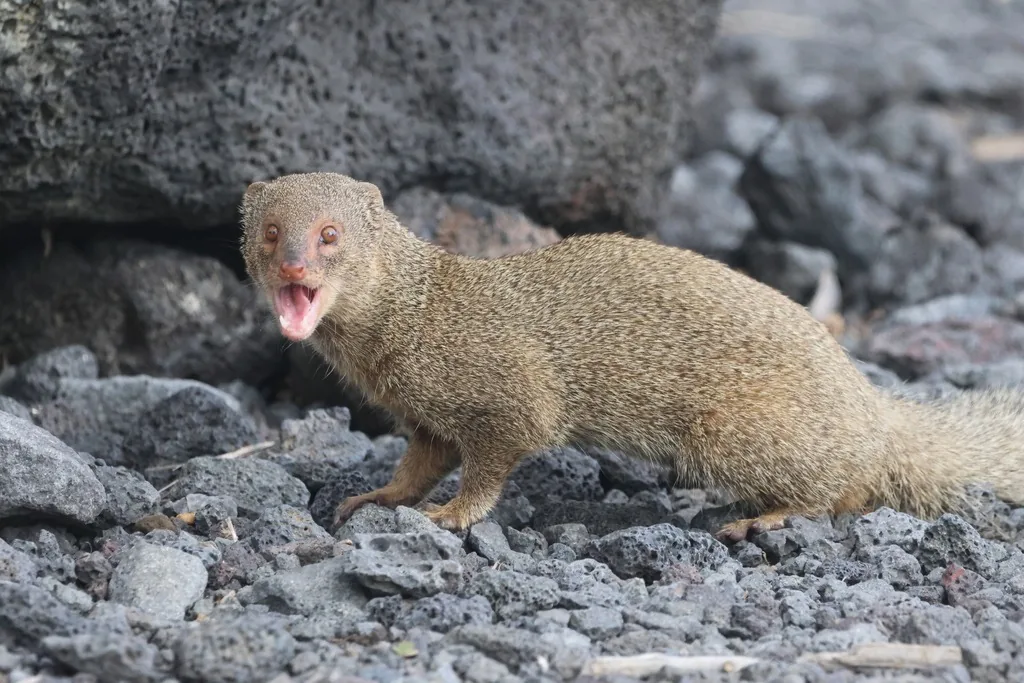
How to identify it
Where it lives
Widespread on Hawaii Island, Oahu, Maui and Molokai, with no known established populations on Lanai or Kauai; on Kauai, single animals arriving with cargo have been trapped near Nawiliwili Harbor and Lihue Airport in 2012, 2016, 2021 and 2023.[1][3][2]
Biology and life cycle
Females can breed from about 10 months of age and have two or three litters of about three pups a year.[2]
They live in wet and dry places alike, including gardens, grasslands and forests.[1]
Damage and signs
- Mongooses eat birds, small mammals, reptiles, insects, fruits and plants; the eggs and hatchlings of ground-nesting seabirds and waterbirds such as the nene, and of endangered sea turtles, are especially at risk.[1][2]
- They kill birds, including 8 federally listed endangered Hawaiian species such as the Hawaiian crow, Hawaiian petrel and nene.[1]
Health risk
The Kauai Invasive Species Committee describes mongooses as vectors of disease as well as predators.[2]
Control
Prevention
On Kauai and Lanai, report any mongoose sighting right away to the state pest hotline, 808-643-7378 (643-PEST), or at 643pest.org; on the islands where mongooses are established, routine sightings don't need to be reported.[1][3]
When to call a professional
On Kauai, rapid-response teams from the invasive species committee and the Department of Health catch arriving mongooses with live traps; 43 traps were set around Nawiliwili Harbor for the 2023 capture.[3][2]
Common questions
- Should I report a mongoose in Hawaii?
- Yes on Kauai or Lanai, where they aren't established: call 643-PEST. On Hawaii Island, Oahu, Maui and Molokai, sightings don't need to be reported.[1]
- Why are there mongooses in Hawaii?
- The sugar industry brought them in 1883 to control rats in cane fields, but mongooses are active by day while rats are mostly active at night, so they had little effect on the rats.[2][1]
Sources
- Hawaii Invasive Species Council (Hawaii Department of Land and Natural Resources), “Mongoose (Urva auropunctata) (species page).” dlnr.hawaii.gov/hisc/mongoose-urva-auropunctata/ (accessed 2026-10-17)
- Kauai Invasive Species Committee, “Mongoose (pest page).” www.kauaiisc.org/pests/mongoose/ (accessed 2026-10-17)
- Hawaii Department of Agriculture, “Mongoose Captured on Kauai (news release, May 2023).” dab.hawaii.gov/blog/main/nr23-08nawiliwilimongoose/ (accessed 2026-10-17)
- iNaturalist, “Urva auropunctata taxon page (order and family).” www.inaturalist.org/taxa/925979 (accessed 2026-10-06)