On this page
How to identify it
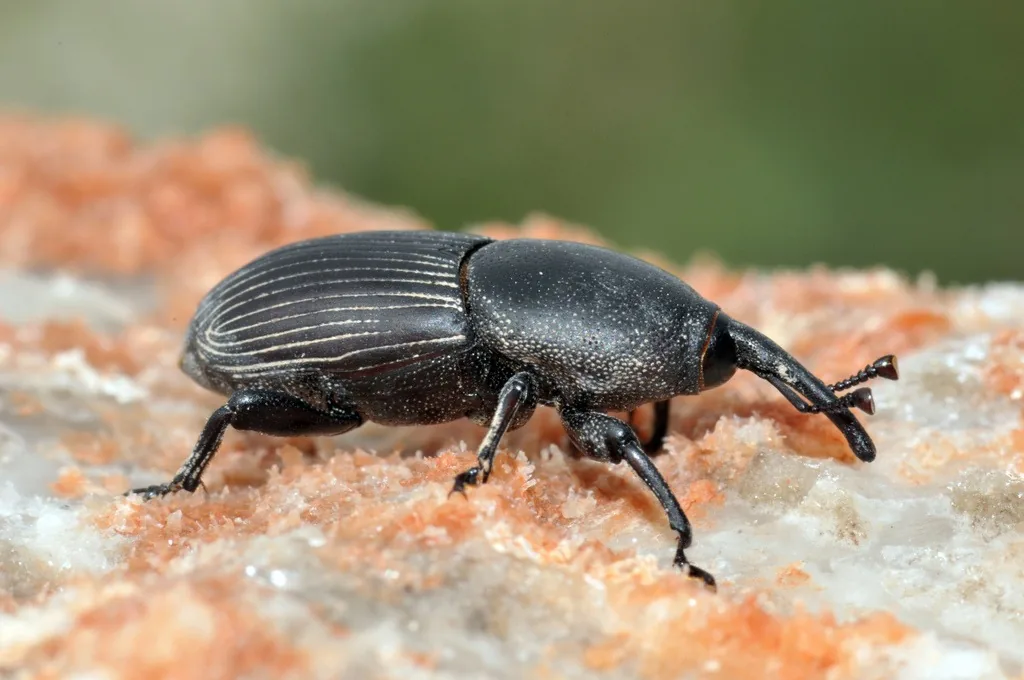
- Adults are black or brownish-black weevils with a long, narrow snout and lengthwise grooves on the wing covers; UC IPM gives a length of up to 3/4 inch, and University of Arizona Extension about 1/2 inch.[1][2]
- Larvae are legless white or yellowish grubs up to 1 inch long with a brown head, hidden in the plant's base, roots and central growing point.[1]
- Early signs are small entry holes at the base of the plant and dying or discolored leaves low down; often the first sign noticed is the whole plant collapsing or separating from its roots.[3][1]
Look-alikes
| Look-alike | How to tell them apart |
|---|---|
| Yucca weevil | A closely related weevil whose larvae infest chaparral yucca (Our Lord's candle) rather than agaves.[1] |
Where it lives
Found where native agaves grow, including Arizona, and a pest of landscape agaves in California and of commercial blue agave grown for tequila.[2][1]
Biology and life cycle
Females chew egg-laying tunnels in the base of the plant; larvae feed and tunnel inside, then usually leave to pupate in the topsoil, though some pupate in the plant base.[1]
A generation can take less than 2 months in warm weather, with 4 or 5 generations a year; adults are seen most from late winter through summer.[1]
Damage and signs
- Large agaves with wide, bluish or gray leaves, such as the century plant (Agave americana), are attacked most; smaller, narrow-leaved agaves are less often infested.[1][2][3]
- Adult feeding only leaves small spots and holes in the leaves; the larval tunnels and the decay organisms that follow them are what kill the plant.[1][2]
Health risk
It attacks agaves only; none of the sources reports harm to people or pets.[1][3]
Control
Prevention
Prevention is the only effective control: plant agaves in full sun in well-drained soil, on a mound or raised bed if needed, and water established plants little or not at all, letting the soil dry between waterings.[1]
Where the weevil keeps coming back, plant smaller, narrow-leaved agave species.[1][3]
Sanitation
Remove infested or dying plants along with the soil around their roots, where larvae and pupae may be, and dispose of them so the weevils can't escape to nearby agaves.[3][1]
Common questions
- Why did my big agave suddenly collapse?
- Agave snout weevil grubs tunnel into the base and roots, and rot follows; infestations usually go unnoticed until the plant collapses or separates from its roots.[3][1]
- Can I save an agave infested with snout weevils?
- Usually not; remove the infested plant and the soil around its roots to protect nearby agaves.[3][1]
Sources
- University of California Statewide IPM Program, “Agave and Yucca Weevils (Home and Landscape).” ipm.ucanr.edu/home-and-landscape/agave-and-yucca-weevils/ (accessed 2026-10-17)
- University of Arizona Cooperative Extension, “Problems and Pests of Agave, Aloe, Cactus and Yucca (AZ1399, revised March 2011).” extension.arizona.edu/sites/extension.arizona.edu/files/pubs/az1399.pdf (accessed 2026-10-17)
- iNaturalist, “Scyphophorus acupunctatus taxon page (order and family).” www.inaturalist.org/taxa/269419 (accessed 2026-10-06)