On this page
How to identify it
Look-alikes
Where it lives
Native to the Americas, where it is associated with prickly pear; common on prickly pear in Arizona landscapes and found as far east as Florida.[1][2]
Biology and life cycle
Crawlers feed for about three weeks before settling and becoming immobile, and the crawler stage is when the insects spread among cactus plants; there are several generations a year in warm areas.[1][2]
Damage and signs
Health risk
Control
Sanitation
If a plant is badly colonized and declining, prune off the worst pads at the joints and discard them.[1][3]
Traps and physical control
Blast the colonies with a strong stream of water from a hose to expose and weaken them; treating light infestations is optional.[1][3]
Pesticides
After hosing, spray the exposed scales with insecticidal soap, which is gentler on beneficial insects; a 1 percent horticultural oil also works.[1][3]
Common questions
- What is the white stuff on my prickly pear cactus?
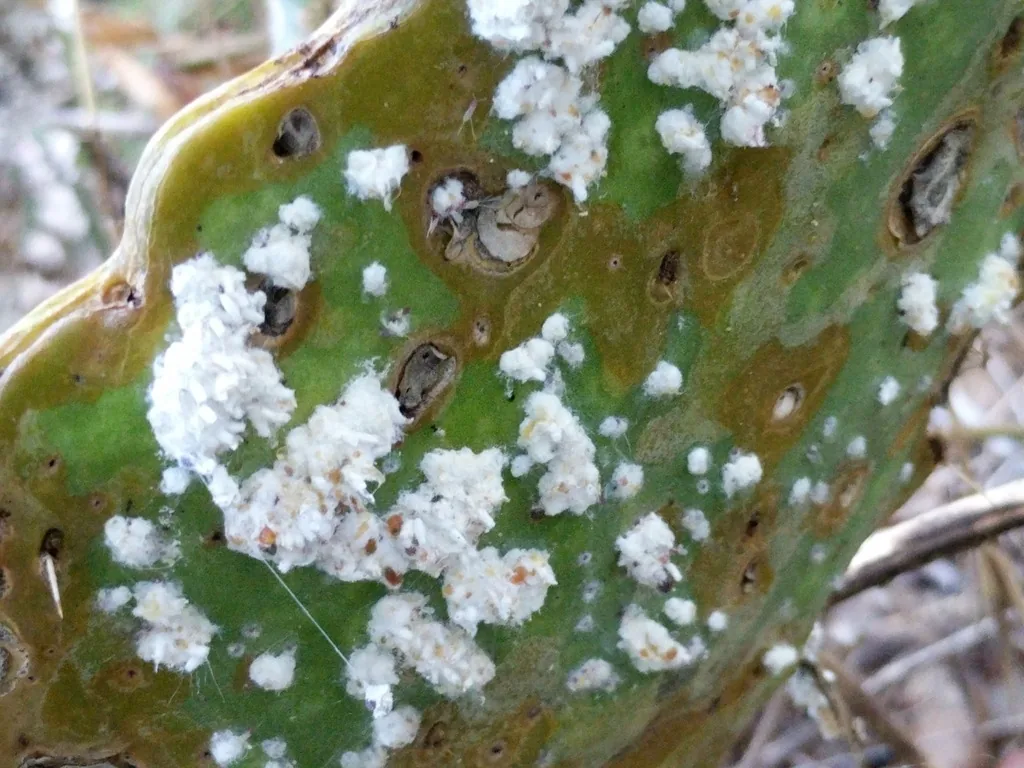
- White, cottony patches on prickly pear pads are usually cochineal scale insects; crush one, and a red stain confirms it.[2][1]
- Will cochineal scale kill my prickly pear?
- Rarely; the damage is usually minor, though heavy colonies can weaken a plant over time.[1][3]
Sources
- University of Arizona Cooperative Extension, Yavapai County, “Cochineal Scale (adapted from Backyard Gardener by J. Schalau; June 18, 2024).” extension.arizona.edu/sites/extension.arizona.edu/files/attachment/CochinealScale.pdf (accessed 2026-10-17)
- UF/IFAS Extension Nassau County, “Q: What is this white stuff on my prickly pear cactus? (June 30, 2017).” blogs.ifas.ufl.edu/nassauco/2017/06/30/q-white-stuff-prickly-pear-cactus (accessed 2026-10-17)
- Arizona Daily Star, “Garden Sage: chalky-white splotches on prickly pear (P. L. Warren, Pima County Cooperative Extension urban horticulture agent).” tucson.com/lifestyles/gardensage/article_726d4960-84cf-54c6-aabe-72cc1da31a06.html (accessed 2026-10-17)
- iNaturalist, “Dactylopius taxon page (order and family).” www.inaturalist.org/taxa/202091 (accessed 2026-10-06)