On this page
How to identify it
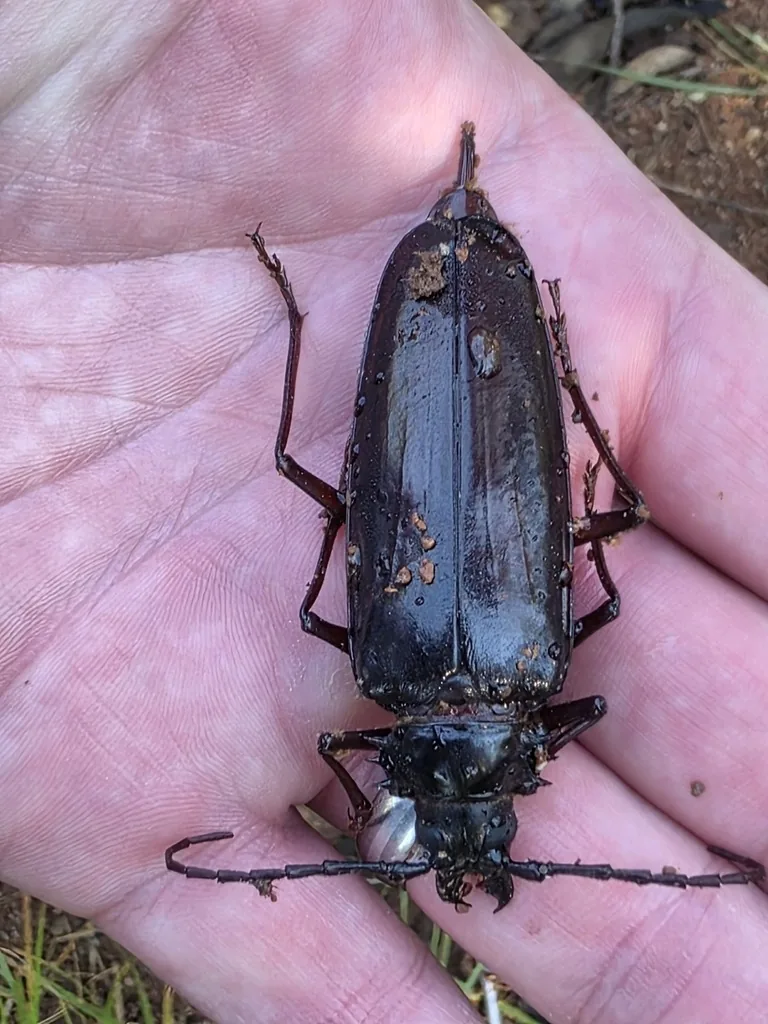
- Adults are about 3 to 3.5 inches long, dark brown to nearly black, with long antennae and a collar of spines behind the head; they have wings and fly clumsily at night.[1][2][3]
- Grubs are creamy white and grow to 3 to 5 inches long in the roots.[1][2]
- Damage often shows as one large branch at a time dying back, sometimes all the way to the trunk.[1]
Look-alikes
| Look-alike | How to tell them apart |
|---|---|
| Cockroaches | The adults are often mistaken for giant cockroaches, but they are beetles with long segmented antennae and a spiny collar, and they live outdoors and rarely come inside.[1][2] |
Where it lives
Found in the desert Southwest; the commonly seen species lives around Phoenix and Tucson, Arizona.[2][1]
Biology and life cycle
Adults emerge in early summer, usually June and July, with the first monsoon rains; they don't feed, live a few weeks at most and are active mainly at night.[1][3]
Females lay eggs in holes 2 to 3 inches deep in the soil beneath host trees, and the larvae feed in the roots for about two to four years before pupating.[1][2][3]
Damage and signs
Health risk
The adults are harmless apart from a possible pinch if a finger, toe or a pet's nose gets close to the jaws.[1]
Control
Prevention
There are no really effective control measures, so the best prevention is keeping trees healthy and well cared for so they can outgrow root damage.[1]
Keep them out
The beetles fly to lights, so keeping doors and windows closed when lights are on keeps them out; they rarely enter homes otherwise.[1]
Common questions
- What is the giant beetle at my porch light in Arizona?
- A dark, 3-inch beetle with long antennae flying to lights during the summer monsoon is most likely a palo verde root borer.[1][3]
- Are palo verde beetles dangerous?
- No; they can pinch if handled carelessly but are otherwise harmless, and the adults don't even eat.[1][3]
- Did palo verde root borers kill my tree?
- Probably not on their own; University of Arizona experts say they are often wrongly blamed, since healthy trees usually cope and trees tend to die from stress and other environmental factors.[3][1]
Sources
- University of Arizona Cooperative Extension, Pinal County, “Palo Verde Root Borers (Pinal County Extension newsletter, July 2019).” extension.arizona.edu/sites/extension.arizona.edu/files/attachment/july-2019.pdf (accessed 2026-10-17)
- Arizona-Sonora Desert Museum, “Animal Fact Sheet: Palo Verde Root Borer Beetle grub.” desertmuseum.org/kids/oz/long-fact-sheets/Palo%20Vere%20Grub.php (accessed 2026-10-17)
- University of Arizona News, “Bug Bonanza: 7 Big, Colorful Critters to Try to Spot This Monsoon Season (University of Arizona Insect Collection).” news.arizona.edu/news/bug-bonanza-7-big-colorful-critters-try-spot-monsoon-season (accessed 2026-10-17)
- iNaturalist, “Derobrachus hovorei taxon page (order and family).” www.inaturalist.org/taxa/354643 (accessed 2026-10-06)