On this page
How to identify it
- Adults are dark brown or black, about 1.5 to 2 inches long, with a small head, orange-red antenna tips that include a flattened, leaf-like segment, enlarged spiny hind legs, and wings with orange or yellow veins.[1]
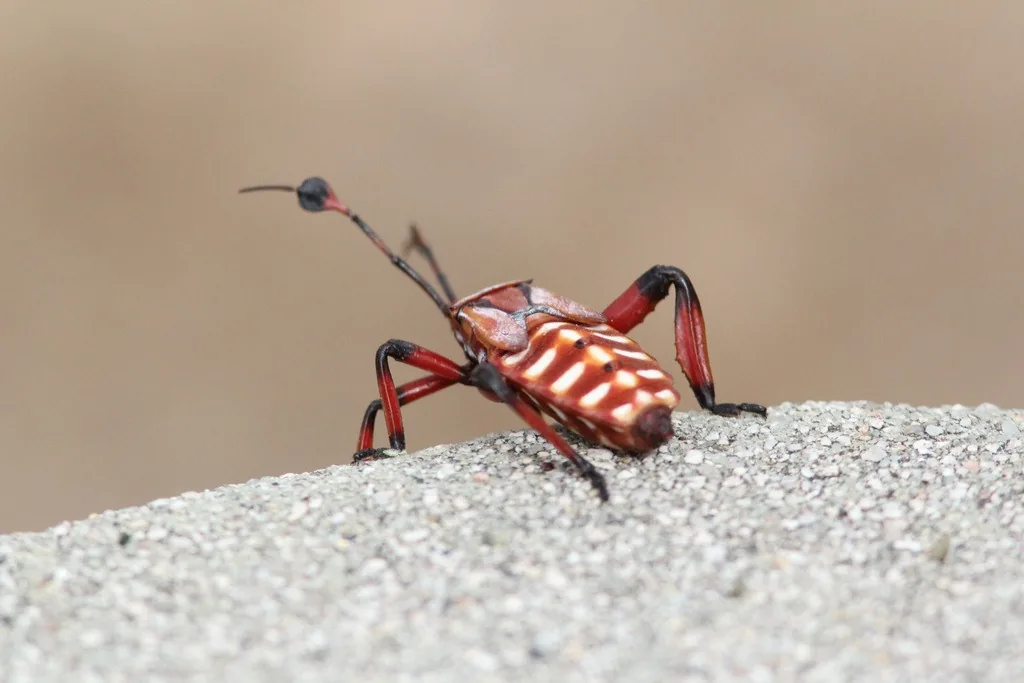
- Nymphs are patterned in vivid red, yellow, white and black, change pattern through five molts, and often gather in clusters.[1][3]
Look-alikes
| Look-alike | How to tell them apart |
|---|---|
| Kissing bugs | University of Arizona entomologists list the giant mesquite bug among harmless leaffooted bugs that people worry might be blood-feeding kissing bugs; the leaf-like antenna segment marks it as a plant feeder.[2][1] |
Where it lives
Common in desert Southwest landscapes, including around Tucson, Arizona.[1][3]
Biology and life cycle
Adults are slow, clumsy fliers usually seen in small groups, and adults and nymphs may give off a foul-smelling defensive secretion when threatened.[1]
As temperatures rise in summer, the bugs move down from the tops of mesquite trees to cooler spots near the base.[3]
Damage and signs
Health risk
They are harmless to people, with no venomous bite or sting.[1][3]
Control
Prevention
No control is needed; University of Arizona specialists suggest simply enjoying them.[1][3]
Common questions
Sources
- University of Arizona Cooperative Extension (Department of Entomology), “Leaffooted Bugs Want Your Veggies, Not Your Blood.” extension.arizona.edu/sites/extension.arizona.edu/files/attachment/leaffooted-bugs.pdf (accessed 2026-10-17)
- Arizona Daily Star (This Is Tucson), “Giant mesquite bugs are beautiful, harmless and common (Garden Sage, P. L. Warren, Pima County Cooperative Extension).” thisistucson.com/article_a8b43d24-46b9-11e5-ac0e-53471167e946.html (accessed 2026-10-17)
- iNaturalist, “Pachylis neocalifornicus taxon page (order and family).” www.inaturalist.org/taxa/1444994 (accessed 2026-10-06)