On this page
How to identify it
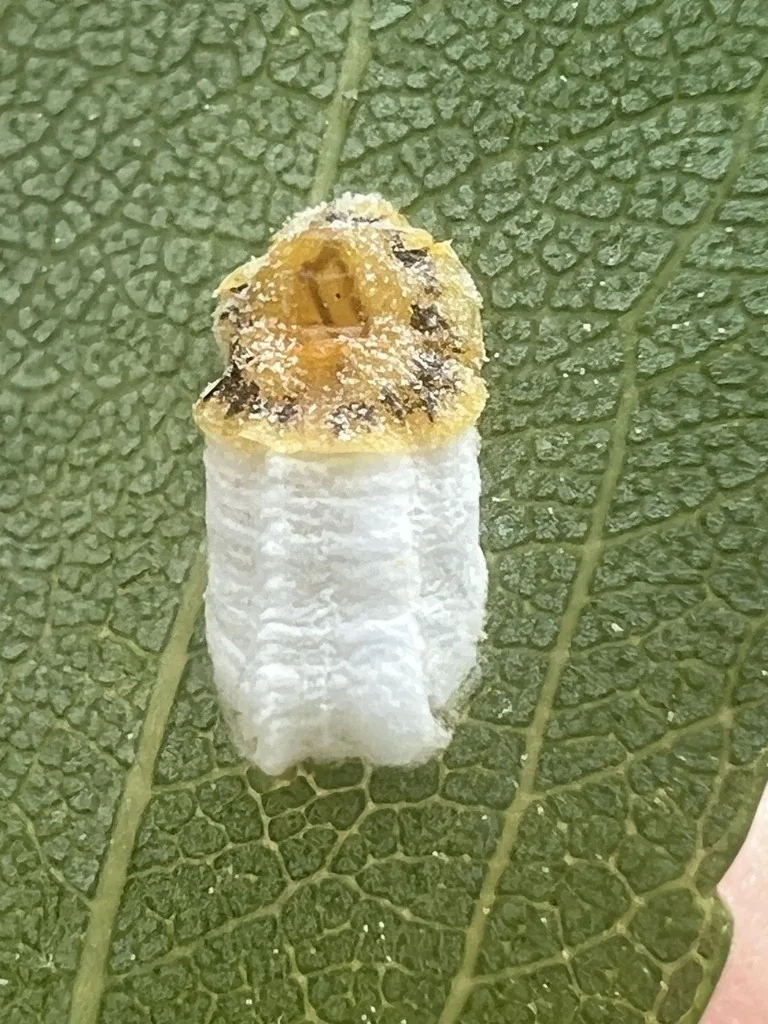
- Mature females are maroon, oval and slightly convex, 2.6 to 4.4 mm long, with a yellow-brown keel down the back and a dusting of clear wax flakes. Younger adults are purplish or greyish brown.[2][1]
- From May the females sit on the leaves with a white, lengthwise-ribbed egg sac two to three times the length of the body. Egg sacs on leaves rather than on twigs separate this scale from the cottony maple scale.[2][1]
- Newly hatched nymphs are pale green and settle along the leaf veins from late June; they are hard to see without magnification. In fall the immatures move to twig and branch bark, where they spend the winter.[1]
- Like other scales, it is small and immobile with no visible legs, and as a soft scale it excretes honeydew that leads to sooty mold.[3]
Look-alikes
| Look-alike | How to tell them apart |
|---|---|
| Cottony maple scale | Its white egg masses are laid along twigs and small branches, never on the leaves; the cottony maple leaf scale's are on the leaves. The cottony maple scale occurs only on stems and has stout, spike-like marginal setae.[1][2] |
| Gloomy scale | An armored scale that also infests maples but feeds differently and produces no honeydew, so there is no sooty mold beneath it.[3] |
Where it lives
Recorded across the eastern and central United States, from New York, Connecticut and Michigan south to Florida and Texas and west to Minnesota, Iowa and Oklahoma, plus Canada.[2]
Biology and life cycle
Hosts include red, silver and boxelder maples, flowering dogwood, sourgum (Nyssa sylvatica), Chinese, Japanese and American hollies, Japanese pieris, redbay and sassafras; UMass also lists andromeda, azalea, rhododendron and honeysuckle.[2][1]
One generation a year. The scale overwinters as a partly grown nymph feeding on twigs and branches. Males mature and mate with the immature females in April, and by May the mature females migrate to the leaves and lay eggs in a white ovisac that may hold up to 2,500 eggs.[1][2]
Eggs may hatch by the end of June; the nymphs settle along the leaf veins and feed there through summer, then migrate back to the bark of twigs and branches for winter.[1]
Damage and signs
- Feeding can cause premature leaf drop and sometimes the death of twigs and branches. Honeydew and the sooty mold that grows on it blacken leaves and branches below the infestation.[1][3]
- Heavily infested maples may show weakened or dying branches, yellowing leaves and stunted growth with smaller leaves.[3]
Health risk
None of the sources mentions any effect on people or pets; the only nuisance is sticky honeydew and sooty mold on plants and surfaces beneath them.[1][3]
Control
Prevention
Scout for the white cottony egg masses in late spring, when the scale is most conspicuous, and for crawlers on the leaves by June and July. Management may not be necessary unless populations are high and the plant is being damaged. Keep the host vigorous.[1]
Traps and physical control
Prune out and destroy heavily infested branches where practical, and scrape scales off small trees.[1][3]
Biological control
Lady beetles and parasitic wasps and flies attack the immature stages and commonly keep scale populations in check; several parasites of this species are recorded, though how well they control it is unknown.[1][3]
Pesticides
Massachusetts lists horticultural oil, insecticidal soap, neem oil, azadirachtin, pyriproxyfen (for eggs), buprofezin and systemic active ingredients such as dinotefuran, imidacloprid and acetamiprid for these scales, with applications after bloom to protect pollinators. Dormant oil is usually not recommended because of plant sensitivity, particularly on maple, and neonicotinoids are state-restricted for tree and shrub use in Massachusetts. Chemical control of large trees is often impractical because of their size and the equipment and cost involved.[1][3]
When to call a professional
Treating a large maple means specialized equipment and cost that often outweigh the benefit; an arborist can judge whether a systemic treatment is justified.[3]
Common questions
- White cottony blobs are on the undersides of my maple leaves in June. Cottony maple scale?
- If they are on the leaves, it is the cottony maple leaf scale; the cottony maple scale lays its egg sacs along the twigs and small branches. Both are soft scales that drip honeydew.[1][2]
- Do I need to spray?
- Usually not. Treatment is worth considering only when populations are high and the plant is dropping leaves or losing twigs. Natural enemies often do the job, and pruning out the worst branches helps.[1][3]
- When are the crawlers out?
- Eggs in the leaf ovisacs may hatch by the end of June, and the pale green nymphs settle along the leaf veins; they stay on the leaves until fall before moving to the bark for winter.[1]
Sources
- UMass Extension Landscape, Nursery and Urban Forestry Program, “Neopulvinaria innumerabilis (formerly Pulvinaria innumerabilis) or Pulvinaria acericola (soft scales), Professional Insect & Mite Management Guide for Woody Plants.” www.umass.edu/agriculture-food-environment/landscape/publications-resources/insect-mite-guide/neopulvinaria-innumerabilis-formerly-pulvinaria-innumerabilis-or-pulvinaria (accessed 2026-11-10)
- ScaleNet (scale insect database begun at the USDA ARS Systematic Entomology Laboratory), “ScaleNet catalogue: Pulvinaria acericola (Walsh & Riley, 1868).” scalenet.info/catalogue/Pulvinaria%20acericola/ (accessed 2026-11-10)
- Clemson Cooperative Extension Home & Garden Information Center, “Maple Diseases & Insect Pests (HGIC), scale insects on maple.” hgic.clemson.edu/factsheet/maple-diseases-insect-pests/ (accessed 2026-11-10)
- iNaturalist, “Pulvinaria acericola taxon page (order and family).” www.inaturalist.org/taxa/458937 (accessed 2026-11-10)