On this page
How to identify it
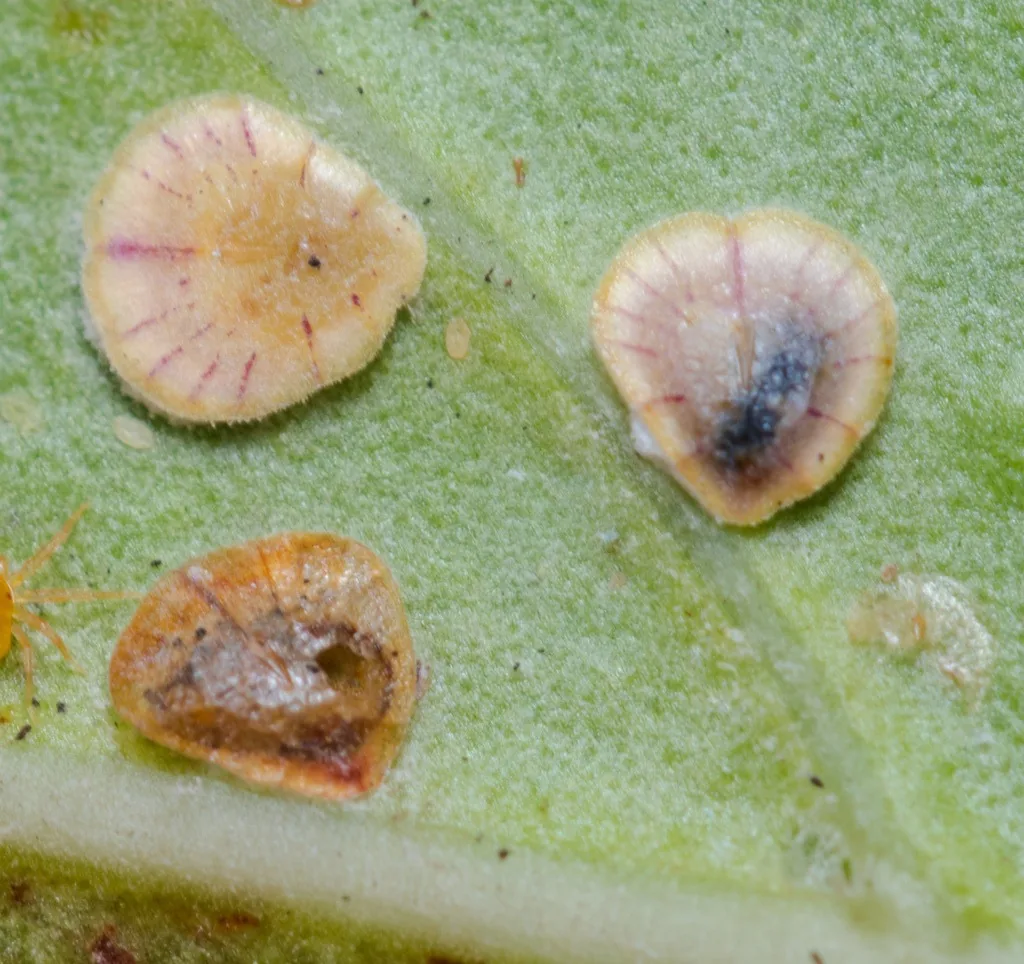
- Adult females are broadly oval to pear- or heart-shaped, often lopsided, and flat when seen from the side.[1]
- Young females are yellowish brown and older ones dark brown, often with hardened areas around the edge. The anal plates sit in the middle of the back and look like a ridge along the midline, and there is no obvious wax covering.[1]
- The egg sac shows as a narrow band of white wax around the edge of the female's body.[1]
Look-alikes
| Look-alike | How to tell them apart |
|---|---|
| Mango shield scale (Milviscutulus mangiferae) | Another flat soft scale on mango; ScaleNet notes that live specimens of the two look very similar.[2][3] |
Where it lives
It is found in more than 50 countries. In the United States, ScaleNet lists records from 12 states and the District of Columbia, including California, Florida, Texas and several other southern states, as well as New York and New Hampshire. It was recently reported in Morocco, where it is an emerging threat to citrus and avocado.[1][4]
Biology and life cycle
Females reproduce without mating, and each can lay up to about 200 eggs. The whole life cycle takes place on the lower leaf surface.[1]
It has two generations a year on avocado and three on English ivy in Israel, and several overlapping generations in California.[1]
ScaleNet lists hosts in 70 plant genera, including avocado, citrus, guava, mango, English ivy, schefflera, gardenia, ixora, bay laurel and Pittosporum.[1]
It fights back against parasitic wasps: when the wasp Metaphycus helvolus tries to lay an egg in it, the scale pulls its mouthparts out of the leaf, wiggles and sometimes walks, defeating about half of the attacks.[1]
Damage and signs
Health risk
The sources treat it only as a plant pest; none mentions bites or any risk to people or pets.[1][5]
Control
Prevention
Check the undersides of leaves now and then for scales, honeydew, sooty mold and ants. Before treating, look at some of the scales: if many are dead or parasitized, hold off.[1][5]
Traps and physical control
On small plants, prune off heavily infested twigs and branches if the scales are limited to a few parts of the plant.[5]
Biological control
Small parasitic wasps frequently attack scales on mango, and Microterys nietneri attacks soft scales. Other natural enemies recorded on pyriform scale include Coccophagus and Metaphycus wasps, Chilocorus lady beetles and lacewings.[3][1]
Ants that feed on honeydew protect scales from their enemies, so keep ants off infested plants with sticky barriers or insecticide baits.[5]
Pesticides
For fruit trees and smaller plants, a well-timed, thorough spray of horticultural oil when crawlers are active gives good control of most scales.[5]
Common questions
- Why are there flat brown bumps under my ivy or avocado leaves?
- Pyriform scale lives its whole life on the lower leaf surface, and English ivy and avocado are among its recorded hosts. Look for flat, pear- or heart-shaped scales that are yellowish to dark brown.[1]
- How is pyriform scale different from mango shield scale?
- Not easily. ScaleNet notes that live specimens of the two are very similar.[2]
Sources
- ScaleNet (scale insect database begun at the USDA ARS Systematic Entomology Laboratory), “ScaleNet catalogue: Protopulvinaria pyriformis (Cockerell).” scalenet.info/catalogue/Protopulvinaria%20pyriformis/ (accessed 2026-11-09)
- ScaleNet (scale insect database begun at the USDA ARS Systematic Entomology Laboratory), “ScaleNet catalogue: Milviscutulus mangiferae (Green).” scalenet.info/catalogue/Milviscutulus%20mangiferae/ (accessed 2026-11-09)
- University of Florida IFAS Extension (EDIS), “Mango Pests and Beneficial Insects (ENY-413/IG073, 2017).” journals.flvc.org/edis/article/view/138135 (accessed 2026-11-09)
- Springer for the Sociedade Entomologica do Brasil (Neotropical Entomology), “Host-associated occurrence of Wolbachia in natural populations of the pyriform scale Protopulvinaria pyriformis in Moroccan orchards (Mrabti et al. 2026, Neotropical Entomology 55:46).” doi.org/10.1007/s13744-026-01395-6 (accessed 2026-11-09)
- University of California Statewide IPM Program, “Pest Notes: Scales (UC ANR Publication 7408).” ipm.ucanr.edu/home-and-landscape/scales/ (accessed 2026-11-09)
- iNaturalist, “Protopulvinaria pyriformis taxon page (order and family).” www.inaturalist.org/taxa/481481 (accessed 2026-11-09)