On this page
How to identify it
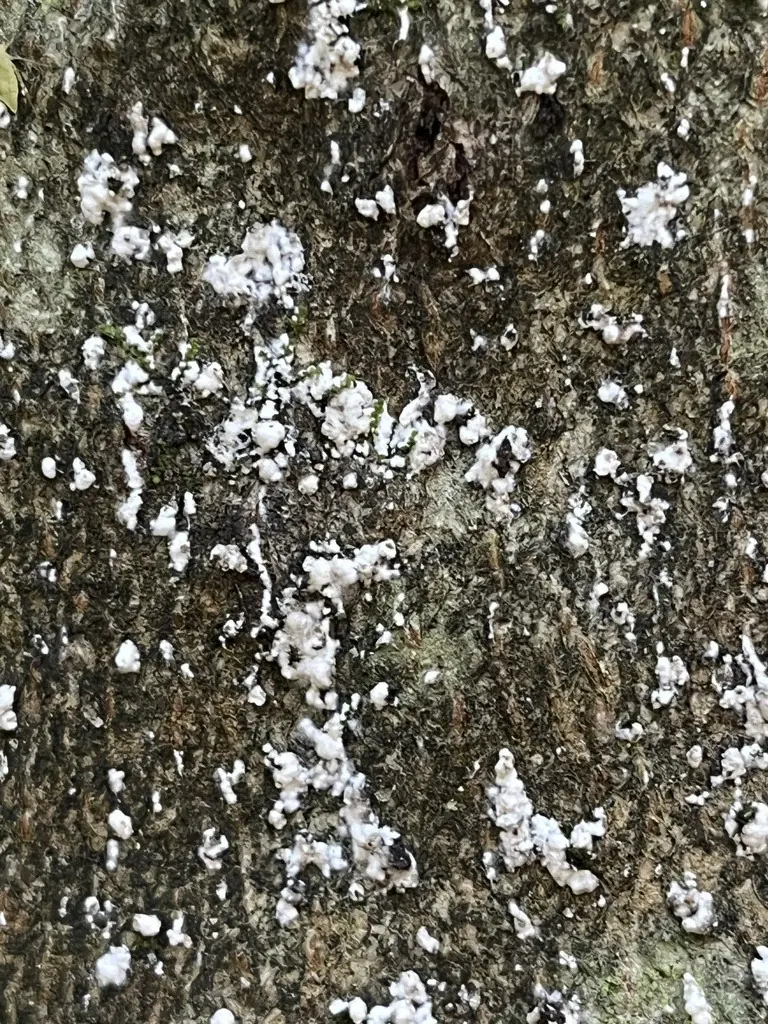
- Adult females are round, light yellow, wingless and under 1 mm long, hidden under a white woolly covering.[1][2]
- The white wool shows first in bark cracks and crevices and can spread until it coats the whole trunk.[1][2][3]
- Tarry black spots, red-brown ooze and, in fall, tiny bright red fungal fruiting bodies on the bark mean the fungus has followed.[1][2][3]
Where it lives
Introduced from Europe to Nova Scotia in 1890; beech bark disease now runs from Pennsylvania north through New England, with outbreaks in Michigan, Tennessee, Virginia, West Virginia, Maryland and the North Carolina mountains.[1][2][3]
Biology and life cycle
Every beech scale in North America is a female that reproduces without mating, with one generation a year.[1][2][3]
Females lay eggs on the bark in summer and die. The yellow crawlers that hatch are the only mobile stage and are carried by wind to new trees.[2][3]
Within days, crawlers settle, insert their mouthparts into the bark and stay put for life under a waxy cover; a tree can build a huge population in 2 to 3 years.[1][2]
Damage and signs
- The scale alone rarely kills a tree, but its feeding wounds and bark cracks let Neonectria canker fungi in.[1][2][3]
- The fungi kill the inner bark, forming cankers that can merge and girdle the tree; infected trunks look swollen and lumpy.[1][2][3]
- In some forests beech losses have approached 50 percent, and the disease also threatens beech planted in landscapes.[3]
- American beech is the preferred host; European beech is also susceptible, though UMass notes it is not thought to be as heavily attacked.[1][2]
Health risk
Control
Prevention
Because the disease is widespread in Massachusetts, UMass suggests planting European rather than American beech in landscapes; good care keeps any tree healthier.[1][2]
Traps and physical control
On a single landscape tree, scales can be scrubbed off the bark with a soft brush, though this may not be practical on large trees.[1][2]
Biological control
The twicestabbed lady beetle eats beech scale, but research suggests it cannot control the population.[1]
Pesticides
Insecticides work best timed for the crawler stage, before the waxy cover forms; Maryland suggests consulting a certified arborist for valuable ornamental beech.[2][3]
Common questions
Sources
- UMass Extension Landscape, Nursery and Urban Forestry Program (Landscape Insect & Mite Guide), “Cryptococcus fagisuga (Beech Scale).” www.umass.edu/agriculture-food-environment/landscape/publications-resources/insect-mite-guide/cryptococcus-fagisuga (accessed 2026-10-16)
- NC State Extension, “Beech Bark Disease (Invasive Forest Pests).” content.ces.ncsu.edu/beech-bark-disease (accessed 2026-10-16)
- University of Maryland Extension (Home and Garden Information Center), “Beech Bark Disease (updated Aug. 13, 2026).” extension.umd.edu/resource/beech-bark-disease (accessed 2026-10-16)
- iNaturalist, “Cryptococcus fagisuga taxon page (order and family).” www.inaturalist.org/taxa/54061 (accessed 2026-10-06)