The short answer
- Keep new plants away from your other plants for 30 days (Kentucky) to six weeks (Clemson), and look them over about once a week, especially under the leaves. Colorado State suggests at least three weeks and Minnesota one to two.[1][2][5][6]
- Move any plant you suspect is infested away from the others and keep it apart until the pest is completely controlled, which can take several weeks or more.[2][1][6]
- Many pests can be dabbed off with a cotton swab dipped in rubbing alcohol, knocked off with a water spray, or washed off with a soft cloth and soapy water. Expect to repeat it.[1][2][6][5]
- Fungus gnats breed in wet potting mix. Let the soil surface dry between waterings and don't leave water standing in saucers.[4][2][6]
- Before any spray, check that the label allows use on houseplants indoors and test it on a small part of the plant. A badly infested plant that's easy to replace is often better thrown out.[2][1][3][5][6]
- Each common pest has its own full guide on this site. This page covers the steps that work across all of them and points you to the right one.[2][6]
Pests found on houseplants
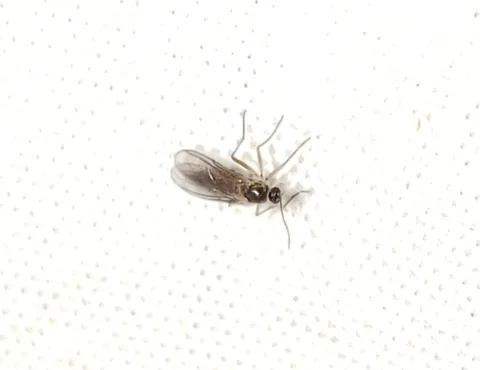 Fungus Gnat
Bradysia and related species
Fungus gnats are small flies whose larvae live in moist potting mix and organic matter. Indoors the adults emerge from houseplants and become a nuisance; they don't bite, and Colorado State calls the larvae minor pests of houseplants.
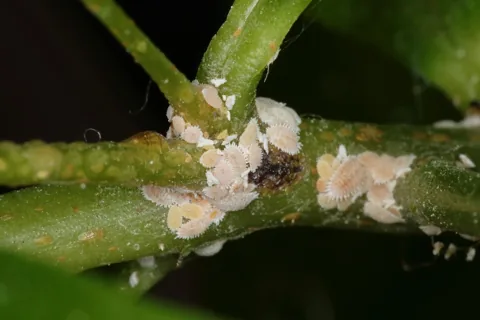 Mealybugs
Planococcus citri
Mealybugs are soft, oval insects covered in white wax that suck sap from houseplants and outdoor plants. They thrive indoors and where winters are mild, and their wax and hiding habits make them hard to reach with sprays.
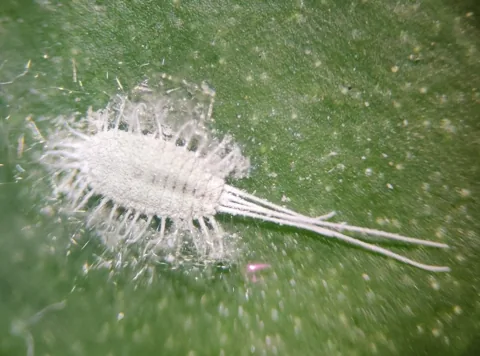 Longtailed Mealybug
Pseudococcus longispinus
The longtailed mealybug is a white, waxy mealybug named for the pair of tail filaments that are as long as or longer than the adult female's body. It is a common pest of houseplants and greenhouse plants, especially dracaena, and also turns up in some California vineyards.
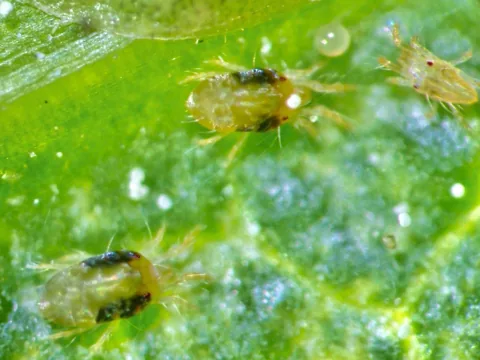 Spider Mites
Tetranychus urticae
Spider mites are tiny arachnids, relatives of spiders and ticks, that live in colonies on leaf undersides and suck out plant cells. The twospotted spider mite is the most important species in yards and gardens and on house plants, and Minnesota says it can infest over 200 species of plants.
 Brown Soft Scale
Coccus hesperidum
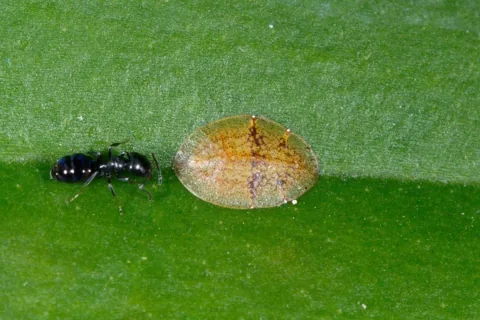
Brown soft scale is a small, oval, yellowish-brown scale insect that settles on stems and leaf veins of houseplants such as ficus, schefflera, English ivy and citrus, coating leaves with sticky honeydew.
 Aphids
Myzus persicae
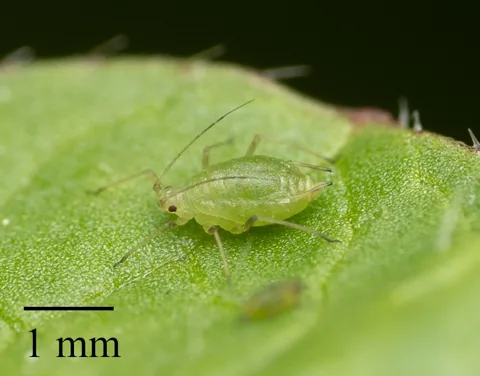
Aphids are small, soft-bodied insects that pierce tender stems and leaves and suck out plant sap. Almost every plant hosts at least one aphid species, but established plants usually tolerate them, treating aphids for the plant's health is usually unnecessary, and natural enemies often bring numbers down.
 Silverleaf Whitefly
Bemisia tabaci (the B biotype is also called Bemisia argentifolii)
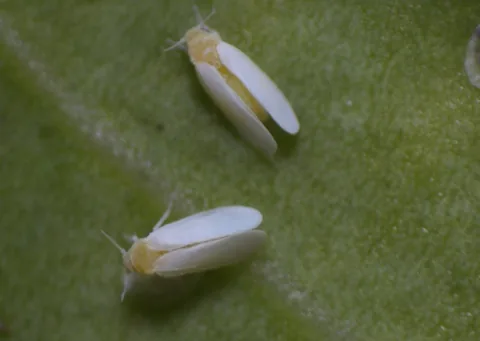
The silverleaf whitefly, also called the sweetpotato whitefly, is a tiny yellowish whitefly that can feed on more than 500 kinds of plants, from ornamentals to warm-season vegetables, weakening plants, coating leaves with honeydew and sooty mold, and spreading plant viruses.
 Western Flower Thrips
Frankliniella occidentalis
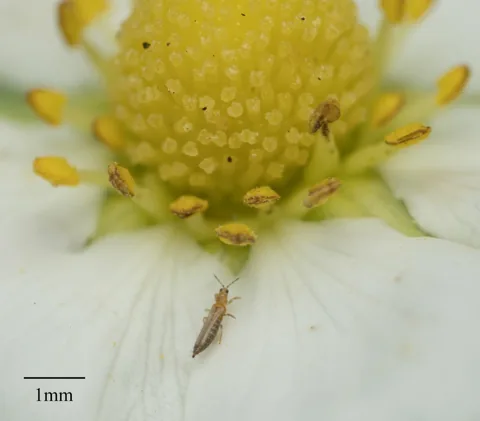
Western flower thrips are slender yellow to dark brown insects, about 1/16 inch long or smaller, that feed in flowers and buds and on fruit and leaves. Their feeding leaves silvery or pale scars and distorted growth, and they spread tospoviruses such as tomato spotted wilt and impatiens necrotic spot.
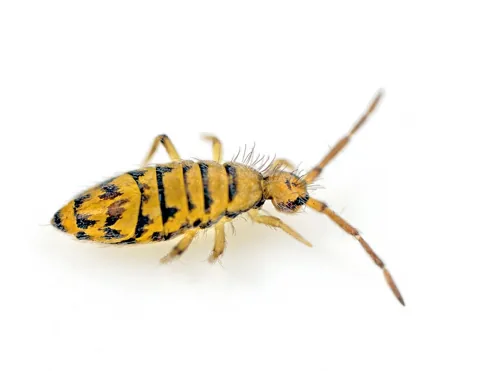 Springtail
Collembola (shown: Entomobrya sp.)
Springtails are tiny jumping creatures that sometimes appear in large numbers in moist spots indoors. They don't bite or sting and don't damage furniture or food; their presence indoors points to a moisture problem.
No photo yet
Cyclamen Mite
Phytonemus pallidus
Cyclamen mites usually go unnoticed until their damage, stunted, curled and distorted new leaves and buds, becomes severe.
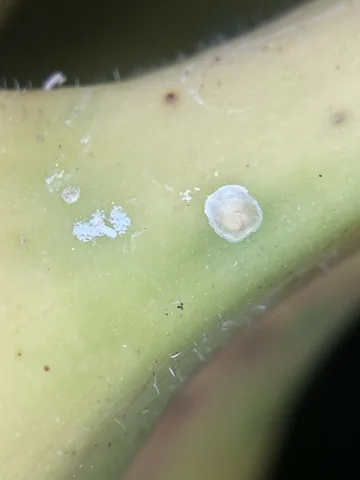 Boisduval scale
Diaspis boisduvalii
Boisduval scale is an armored scale insect and the most common armored scale pest of orchids in North Carolina; ScaleNet cites it as the most important insect pest of orchids in Florida and a serious pest of greenhouse orchids in California. It also lives on palms, banana and cacti, and a few scales are enough to damage a plant.
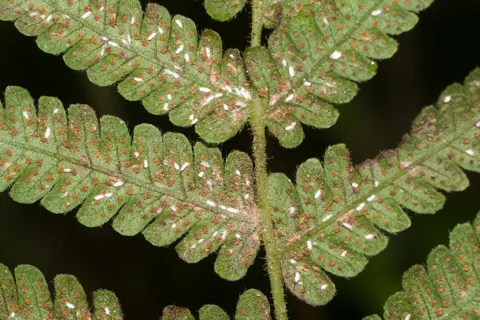 Fern scale
Pinnaspis aspidistrae
Fern scale is a small armored scale insect of ferns, liriope, palms and many foliage plants. The snow-white, ridged covers of the males stand out against dark green leaves, while the brown, oyster-shaped females are easy to overlook, and feeding can leave yellow spots.
No photo yet
Root mealybugs
Rhizoecus
Root mealybugs are small, bluish white mealybugs that live in the soil and feed on plant roots. They are most often a problem in potted plants such as African violets and gardenias, and because they stay underground, the first sign is often a declining plant whose roots and soil are dusted with white, waxy fluff.
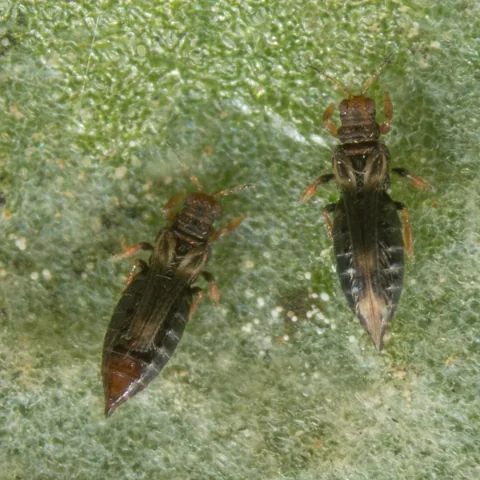 Banded greenhouse thrips
Hercinothrips femoralis
The banded greenhouse thrips, Hercinothrips femoralis, is a tiny thrips that lives outdoors on shrubs, flowers, vegetables and weeds and sometimes gets indoors onto house plants. Colonies of its pale larvae feed on the undersides of leaves and leave them scarred and discolored. It is also called the sugar beet thrips, because it is thought to have reached the United States on sugar beets.
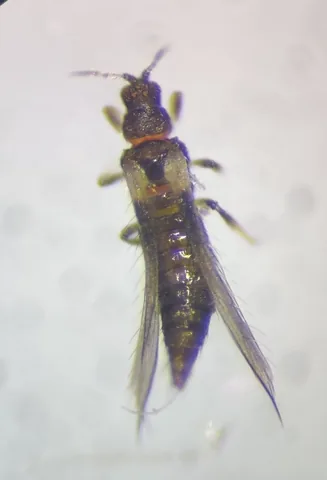 Poinsettia thrips
Echinothrips americanus
The poinsettia thrips, Echinothrips americanus, also called the impatiens thrips, is a leaf-feeding thrips native to eastern North America. Since it was first reported damaging greenhouse poinsettias in Georgia in 1984 it has become a pest of greenhouse ornamentals and vegetables, and it has spread to Europe and Asia.
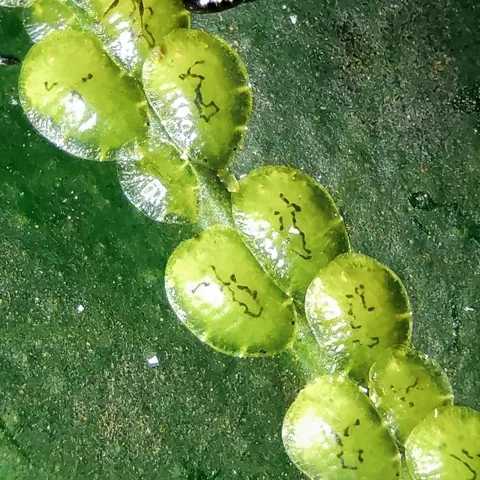 Green scale
Coccus viridis
Green scale, also called green coffee scale, is a soft scale of tropical and subtropical regions that feeds on more than 200 plant species, from coffee, guava and citrus to ornamentals such as gardenia and ixora. The scales settle along the leaf veins and on young stems, and their honeydew blackens plants with sooty mold.
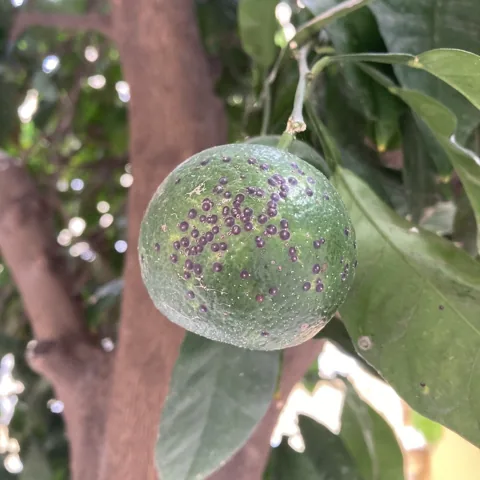 Florida red scale
Chrysomphalus aonidum
Florida red scale is an armored scale insect, apparently native to tropical Asia, and one of the most damaging scale pests of citrus. It dots leaves and fruit with small, round, dark scales, and heavy infestations yellow the leaves and can defoliate trees. It also attacks palms, orchids and many ornamentals, including plants kept in greenhouses.
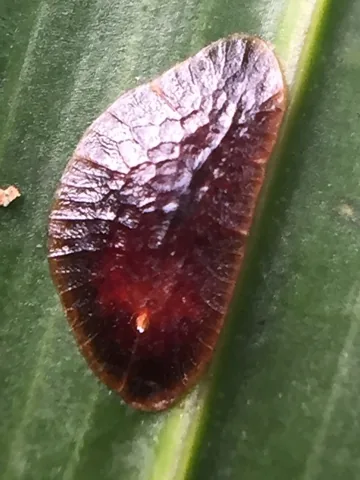 Tessellated scale
Eucalymnatus tessellatus
Tessellated scale is a soft scale insect named for the checkered, tile-like pattern on the adult female's back. It is probably South American in origin and has been carried around the world on cultivated plants. It is mainly a leaf-feeding greenhouse pest, and in south Florida it is often found outdoors on palms, crape-jasmine and mango.
No photo yet
Mexican mealybug
Phenacoccus gossypii
The Mexican mealybug is a short-tailed mealybug common on many ornamental plants, including English ivy, geraniums, chrysanthemums, lantana and poinsettias, and a minor pest of lima beans in the warmer parts of the United States. Females are grayish and dusted with white wax, and they lay their eggs in dense white sacs. Numbers can build up quite a bit before the plant shows damage.
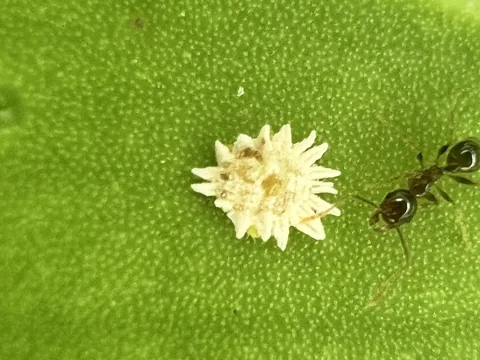 Coconut mealybug
Nipaecoccus nipae
Coconut mealybug, also called spiked, avocado or Kentia mealybug, is a small sap-feeding insect coated in thick yellowish-orange wax that is drawn out into rows of short spikes. It attacks plants in more than 40 families and can damage palms and tropical fruit crops. In the United States it has been recorded from Florida, California and Louisiana.
Rule out care problems first
When a houseplant looks unhealthy, the cause is most often its care: too much or too little water, light, heat or fertilizer. Pests are the cause in some cases.[2][6][5]
Pests usually come in on new plants or on plants that spent the summer outside. A pot that sat on the ground outdoors can pick up pests through its drainage holes, so slip the plant out of its pot and check the soil; most pests are on the outside of the root ball.[2][5]
Pillbugs, millipedes and slugs found along the root ball can simply be scraped away. Ants sometimes nest in the potting soil of plants kept outdoors.[2]
A 10X magnifying lens makes small pests and their young much easier to see. Infestations are often much easier to control when you catch them early.[2][6]
Minnesota Extension suggests checking for pests every time you water, fertilize or clean a plant. Springtails and fungus gnats move when the soil is watered, which makes them easier to spot, and a shiny, sticky film on the leaves or on the tabletop under a plant is honeydew from aphids, mealybugs or scale.[6]
Keeping pests out
- Buy only healthy plants from certified nursery dealers. Plants of uncertain origin are more likely to carry pests even when they look healthy.[1][6][5]
- Inspect new plants thoroughly. If you can't remove all the mealybugs on a new plant, UC IPM says to discard it or take it back to where you bought it.[3]
- Keep new plants isolated: Kentucky says for 30 days, Clemson for six weeks. Check them weekly, paying attention to the undersides of leaves. Other extension services give shorter periods: Colorado State says at least three weeks, followed by a careful inspection, and Minnesota says one to two weeks to let any pest problem become visible.[1][2][5][6]
- When repotting or handling plants, wash your hands and tools before moving from one group of plants to the next. Tiny stages of insects and disease organisms spread that way.[1]
- Repot with commercially prepared or pasteurized potting mix, not soil from the yard or garden, which can carry insects, mites, weed seeds and plant diseases.[1][2][4][6]
- Wash smooth-leaved plants every two to three weeks. Small plants can be turned upside down and swished in a bucket of lukewarm water, with foil or plastic wrap over the soil; larger ones can be hosed gently, wiped with a soft wet cloth, or rinsed in a lukewarm shower.[2][6]
- Check pots, stakes and other supplies for mealybugs and their egg sacs, and consider tossing older "grandmother" plants that may be the source of infestations on new plants. Minnesota also says to check the edges, rims and crevices of containers and the bottoms of pots and saucers.[3][6]
- Go easy on nitrogen fertilizer. Heavy feeding with regular watering spurs tender new growth and mealybug egg production.[3]
- Make sure window screens and doors fit well, since some pests come in from outdoors.[2]
- Colorado State notes that scale, mealybug and whitefly infestations almost always start from plants recently bought or received as gifts, and recommends quarantining new plants in a separate part of the house.[5]
Removing pests without insecticides
What makes sense depends on the pest, how heavy the infestation is, the kind of plant, and how much the plant matters to you.[1]
- Throw it out. A severely infested plant that's easy to replace is better discarded, with its soil, than nursed along while the pests spread to more valuable plants.[1][2][5][6]
- Prune. Cut away leaves, fronds and stems so heavily infested that they're dead or dying. Plants that regrow well tolerate heavy pruning; others can be disfigured by moderate pruning. If only the roots are infested, take a cutting and start a new plant in a clean pot with sterile potting mix.[1][2][6]
- Handpick. Caterpillars, grasshoppers or beetles that get indoors are best picked off as you find them.[1][6][5]
- Swab with alcohol. A cotton swab dipped in rubbing alcohol wipes off aphids, mealybugs and mites and kills some of those it misses. Scale insects may need to be scraped off with a fingernail.[1][2][6]
- For mealybugs, UC IPM uses 70% or weaker isopropyl alcohol and says to test it on a small part of the plant 1 to 2 days ahead to make sure it doesn't burn the leaves. For extensive infestations it suggests a 10 to 25% solution in a spray bottle, repeated weekly until the mealybugs are gone. Colorado State gives a stronger range for sprays, 25 to 50 percent alcohol, and also warns that alcohol can burn leaves, so test a small area first and keep it on the insects as much as you can.[3][5]
- Spray with water. A brisk spray strong enough to knock insects off but too weak to damage the plant removes or greatly reduces aphids, mites, mealybugs and thrips on sturdy plants. Cover all surfaces and repeat as needed.[1][2][5][6]
- Wash. Broadleaved plants can be washed with soapy water and a soft brush or cloth to remove scales, aphids and mealybugs; Kentucky uses one teaspoon of mild detergent or soap in a gallon of water. It's slow, but it may be the best alternative to insecticide sprays that could injure the plant, and a thorough washing often holds scale at bay for several months.[1]
- Homemade soap washes: sources differ here. Minnesota says not to mix homemade soap products because they can burn plants, and Colorado State says many hand soaps and dish detergents have insecticidal effects but can injure plants. Minnesota's advice is to use a product sold specifically as an insecticidal soap.[6][5]
- Dip. Kentucky describes dipping as a variation on washing for plants with finer foliage: turn the plant upside down and dip only the above-ground parts in a container big enough to hold it.[1]
- Dunk. Colorado State says an infested plant can be set in a bucket or tub of water for 1 to 2 hours to drown insects living on the upper part of the plant, since the plant can tolerate several hours underwater.[5]
- Sticky traps. Yellow sticky cards catch whiteflies, winged aphids and fungus gnats; Minnesota suggests yellow or blue cards, which also catch thrips. Colorado State and Minnesota both say traps alone won't solve the problem, and Colorado State explains why: much of the population, including the young stages, stays on or around the plant.[5][6]
- Hot water for cyclamen mites. Kentucky describes immersing an infested African violet, pot and all, for 15 minutes in water held at 110°F, after trimming off badly injured parts. Success depends on holding the temperature carefully.[1]
Insecticidal soap and other sprays
Insecticidal soap can often wipe out an infestation in its early stages. It kills only the pests it touches and does nothing once it dries, and it works best on soft-bodied pests: aphids, mealybugs, young scales (crawlers), thrips, whiteflies and spider mites. Pests may be hidden or still in the egg, so getting rid of them often takes more than one treatment.[2][6]
Clemson lists houseplants sensitive to insecticidal soap that shouldn't be sprayed with it: ornamental ivy, maidenhair fern, dieffenbachia, schefflera, crown of thorns, chrysanthemum, Easter lilies during bud formation, Asiatic and oriental lilies, jade plant, begonia, fuchsia, zebra plant, impatiens and certain palms. Never apply it to houseplants outdoors in direct sun, or to plants under drought stress.[2]
On any other plant, test the soap, or any insecticide, on a small part first. Injury can take at least 48 hours to show.[2][3]
Only a few insecticides are labeled for use on houseplants indoors, so check that the label allows it. Most are ready-to-use aerosols or pump sprays, which can injure plants if held too close. Colorado State says not to hold an aerosol closer than 18 inches to the plant, a precaution that appears on most labels.[2][1][5][6]
Labels usually list the plants a product is meant for and plants known to be sensitive to it. Injury shows up as distorted leaves and buds, yellowing, spots, burned leaf edges or total burn, often within 5 to 10 days or sooner, and generally doesn't kill the plant.[2]
Spraying outdoors in mild weather keeps over-spray off furniture, drapes and carpet. Bring the plant back inside only after the foliage is completely dry, and keep it out of direct sun until then. More products are labeled for outdoor use, but the same label precautions apply.[2][1][6]
When it's too cold to go outside, Minnesota suggests spraying in a well-ventilated room with the plant sealed in a plastic bag: spray through a small hole cut in the side, then tape the hole shut.[6]
Don't spray a plant that is dry or stressed. Clemson says never to use insecticidal soap on plants under drought stress, Colorado State says to avoid treating plants stressed by temperature extremes or drought, and Minnesota suggests watering the soil a day or two before applying any pesticide.[2][5][6]
Identify the pest before you buy anything. Clemson notes that a single pesticide won't kill every kind of pest, some work only on certain life stages, and more than one application is often needed. Where possible, alternate products between applications, since some pests develop resistance quickly.[2]
Treat spider mites at least twice, 10 days apart, because their eggs aren't affected by sprays and newly hatched mites follow.[1]
For mixing, coverage and which plants are sensitive, see our guide to insecticidal soap and horticultural oil.[2][5]
What systemic products can and can't do
Clemson says imidacloprid granules applied to the soil also control aphids, mealybugs, whiteflies, thrips and leafminers on houseplants.[2]
UC IPM is more cautious: imidacloprid spikes or granules may reduce young mealybugs on houseplants, but these neonicotinoid products are less reliable against mealybugs than against other sap-feeding insects, and their use should be avoided when possible, especially on flowering plants, because they can harm natural enemies and pollinators.[3]
Colorado State calls imidacloprid highly effective against greenhouse whiteflies but says systemic insecticides give poor control of armored scales and may increase other pests such as spider mites. Minnesota cautions that imidacloprid is toxic to bees and shouldn't be used on bee-attractive plants that go outside for the summer.[5][6]
For plants kept outdoors, Clemson advises avoiding sprays and soil-applied systemic insecticides unless absolutely necessary because of the risk to bees, and spraying late in the evening if you must.[2]
No insecticide is likely to kill every mealybug. Keep checking and treat again as needed, and when an infestation is severe, consider discarding the plant rather than treating it over and over.[3]
Common houseplant pests and what works
Each pest below has its own full guide on this site with identification, life cycle and every treatment option, so this list only covers what to recognize and the first steps. If all you can see is something small and white, the tiny white bugs guide helps sort mealybugs, whiteflies, scale and springtails apart.[2][6]
- Fungus gnats: small, delicate flies running over the soil or flying near windows. Their larvae live in damp soil rich in organic matter such as peat moss, and can damage roots, especially of young plants. They're especially a problem when plants are overwatered. Colorado State and Minnesota take a milder view: Colorado State says fungus gnats cause little or no injury to houseplants and Minnesota that they rarely if ever damage indoor plants, so both treat them mainly as a nuisance.[1][2][4][5][6]
- For fungus gnats, let the soil dry between waterings where the plant can tolerate it, which includes most houseplants, especially in winter; dry soil kills the larvae. Empty saucers, improve drainage with more perlite or sand in the mix, and don't move infested plants to new spots where the emerging flies can infest other pots.[2][4][6][5]
- Yellow sticky trap squares on skewers catch adult gnats, and raw potato chunks in the soil draw larvae; replace the chunks every few days. Bti products made for fungus gnats, watered into the soil, kill larvae but don't persist indoors, so UC IPM says repeat applications about every five days may be needed. Minnesota uses a potato slice on the soil to check for larvae and says sticky traps shouldn't be the only thing you rely on. Our fungus gnat guide covers finding the infested pots, watering changes, repotting and Bti in detail.[4][2][6]
- Mealybugs: soft insects covered in white, powdery wax, tucked into leaf joints and stem crotches. Swab light infestations with alcohol or pick them off, use insecticidal soap, and discard heavily infested plants. Ground mealybugs, which live on roots and are reported most often on African violets and gardenias, are even harder to control, so get rid of infested plants quickly. Colorado State also associates root-infesting mealybugs with African violets and gardenias. The full mealybug guide covers alcohol swabs and sprays, succulents and root mealybugs.[1][2][3][5]
- Spider mites: tiny, often unnoticed until there's webbing or yellowing, dropping leaves. Spray sturdy plants forcefully with water, including the undersides of leaves, to knock off mites and break up webbing, then use insecticidal soap if needed; weekly treatments for several weeks are often necessary. Colorado State rates insecticidal soap only marginally effective against twospotted spider mites and favors repeated washing, higher humidity and horticultural oil, and says heavily infested plants are better discarded. The spider mite guide goes further.[1][2][5]
- Scales: stationary insects under shell-like covers that leave sticky honeydew and sooty mold. Scrape off early infestations with a fingernail, or spray or dip the foliage in a soapy wash and repeat in 3 weeks and as needed. The waxy covering gives adults some protection from insecticides, but the crawlers are susceptible to many, including insecticidal soap. Colorado State notes that spray oils are the most effective treatment for scales, and that scales killed by rubbing, soap or oil can stay stuck in place and look alive. See the scale insects guide for soft versus armored scales.[1][2][5][6]
- Aphids: soft-bodied insects in clusters on buds and new growth, often with shiny honeydew. Pick them off, spray with water, swab with alcohol, wash or dip the plant, or use insecticidal soap, and expect to repeat the treatment several times. The aphid guide covers the rest.[1][2][6][5]
- Whiteflies: tiny white moth-like insects that flutter up when the plant is disturbed, with scale-like young under the leaves. Wash the plant and spray insecticidal soap thoroughly, especially on the lower leaf surfaces; several treatments a week apart may be needed. Minnesota and Colorado State also suggest yellow sticky cards for the adults, and Colorado State says a small hand-held vacuum can pick adults off small plants. More in the whitefly guide.[2][1][6][5]
- Thrips: slender insects barely visible to the eye that leave silvery, speckled leaves and streaked or distorted flowers. Rinse the leaves and spray insecticidal soap, or dip the plant. Colorado State adds that some thrips spend part of their life in the soil, where sprays can't reach them, and that many strains resist insecticides. See the thrips guide.[1][2][5][6]
- Springtails: tiny jumping insects in the soil that may float up when you water. They're usually a sign of overwatering; let the soil dry more between waterings. Minnesota says there are no pesticides to treat springtails. The springtail guide covers them indoors and out.[2][1][6]
- Cyclamen mites: microscopic mites on African violets and cyclamen that cause twisted, brittle leaves and deformed buds and flowers. Isolate the plant, trim off damaged parts, and consider the hot-water dip above. Colorado State calls cyclamen mites very difficult to control because they hide deep in leaf folds, and says infested plants are usually best discarded.[1][5]
Common questions
- How long should I keep a new houseplant apart from my others?
- Kentucky says 30 days and Clemson says six weeks. Check it about once a week in the meantime, especially under the leaves. Colorado State says at least three weeks and Minnesota one to two weeks.[1][2][5][6]
- Should I just throw out a plant with bugs?
- If it's badly infested and easy to replace, yes. Kentucky and UC IPM both say discarding is often better than nursing the plant along while pests spread or treating it again and again. Colorado State and Minnesota agree that a heavily infested plant is often best thrown out.[1][3][5][6]
- Is it safe to spray houseplants inside?
- Only with a product whose label allows indoor use on houseplants, and only a few are labeled that way. Spraying outdoors in mild weather is safer; bring plants in once the leaves are completely dry. If it's too cold outside, Minnesota suggests spraying the plant inside a sealed plastic bag in a well-ventilated room.[2][1][6]
- Does putting houseplants outside for the summer help?
- It can mean fewer spider mite problems, but start plants in mostly shade so they don't burn, and check the pots and root balls for hitchhiking pests before bringing them back inside. Our guide to bringing plants indoors without bugs walks through the inspection and cleanup step by step.[2]
- Do fungus gnats hurt houseplants?
- Sources differ. Kentucky, Clemson and UC IPM say the larvae can damage roots, especially on young plants, while Colorado State and Minnesota say fungus gnats rarely if ever harm indoor plants and are mostly a nuisance. Either way, letting the soil surface dry between waterings is the main fix.[1][2][4][5][6]
- Can I make my own soap spray for houseplants?
- Kentucky describes washing broadleaved plants with one teaspoon of mild soap or detergent in a gallon of water, but Minnesota advises against homemade soap products because they can burn plants, and Colorado State warns that hand soaps and dish detergents can injure plants. Test any wash on a small part of the plant first, or use a product sold as an insecticidal soap.[1][6][5]
Photo credits
- Fungus Gnat: (c) aispinsects, some rights reserved (CC BY) — via iNaturalist, CC BY 4.0
- Mealybugs: (c) Carlos Alexandre Mattos Raposo, some rights reserved (CC BY) — via iNaturalist, CC BY 4.0
- Longtailed Mealybug: (c) Svavar Martin Andreasen, some rights reserved (CC BY) — via iNaturalist, CC BY 4.0
- Spider Mites: (c) Mike Bowie, some rights reserved (CC BY) — via iNaturalist, CC BY 4.0
- Brown Soft Scale: (c) Lek Khauv, some rights reserved (CC BY) — via iNaturalist, CC BY 4.0
- Aphids: Jesse Rorabaugh, public domain (CC0), via iNaturalist
- Silverleaf Whitefly: (c) Mike Bowie, some rights reserved (CC BY) — via iNaturalist, CC BY 4.0
- Western Flower Thrips: Jesse Rorabaugh, public domain (CC0), via iNaturalist
- Springtail: AJ Cann, public domain (CC0), via iNaturalist
- Boisduval scale: Collier Sparks, public domain (CC0), via iNaturalist
- Fern scale: (c) Kevin Faccenda, some rights reserved (CC BY) — via iNaturalist, CC BY 4.0
- Banded greenhouse thrips: Jesse Rorabaugh, public domain (CC0), via iNaturalist
- Poinsettia thrips: (c) Svavar Martin Andreasen, some rights reserved (CC BY) — via iNaturalist, CC BY 4.0
- Green scale: (c) Jhonatan Matheus, some rights reserved (CC BY) — via iNaturalist, CC BY 4.0
- Florida red scale: no_goodny, public domain (CC0), via iNaturalist
- Tessellated scale: (c) Stephen Thorpe, some rights reserved (CC BY) — via iNaturalist, CC BY 4.0
- Coconut mealybug: (c) Mark Richman, some rights reserved (CC BY) — via iNaturalist, CC BY 4.0
Sources
- University of Kentucky Entomology, “ENTFACT-406: Houseplant Insect Control (Lee Townsend, revised March 2026).” entomology.mgcafe.uky.edu/ef406 (accessed 2026-11-10)
- Clemson Cooperative Extension Home & Garden Information Center, “Common Houseplant Insects & Related Pests, HGIC 2252 (Janet McLeod Scott; revised by Joey Williamson; updated Sept. 10, 2021).” hgic.clemson.edu/factsheet/common-houseplant-insects-related-pests/ (accessed 2026-11-10)
- University of California Statewide IPM Program, “Pest Notes: Mealybugs, UC ANR Publication 74174.” ipm.ucanr.edu/home-and-landscape/mealybugs/ (accessed 2026-11-10)
- University of California Statewide IPM Program, “Pest Notes: Fungus Gnats, UC ANR Publication 7448.” ipm.ucanr.edu/home-and-landscape/fungus-gnats/ (accessed 2026-11-10)
- Colorado State University Extension, “Managing Houseplant Pests.” extension.colostate.edu/resource/managing-houseplant-pests/ (accessed 2026-11-10)
- University of Minnesota Extension, “Managing insects on indoor plants.” extension.umn.edu/product-and-houseplant-pests/insects-indoor-plants (accessed 2026-11-10)