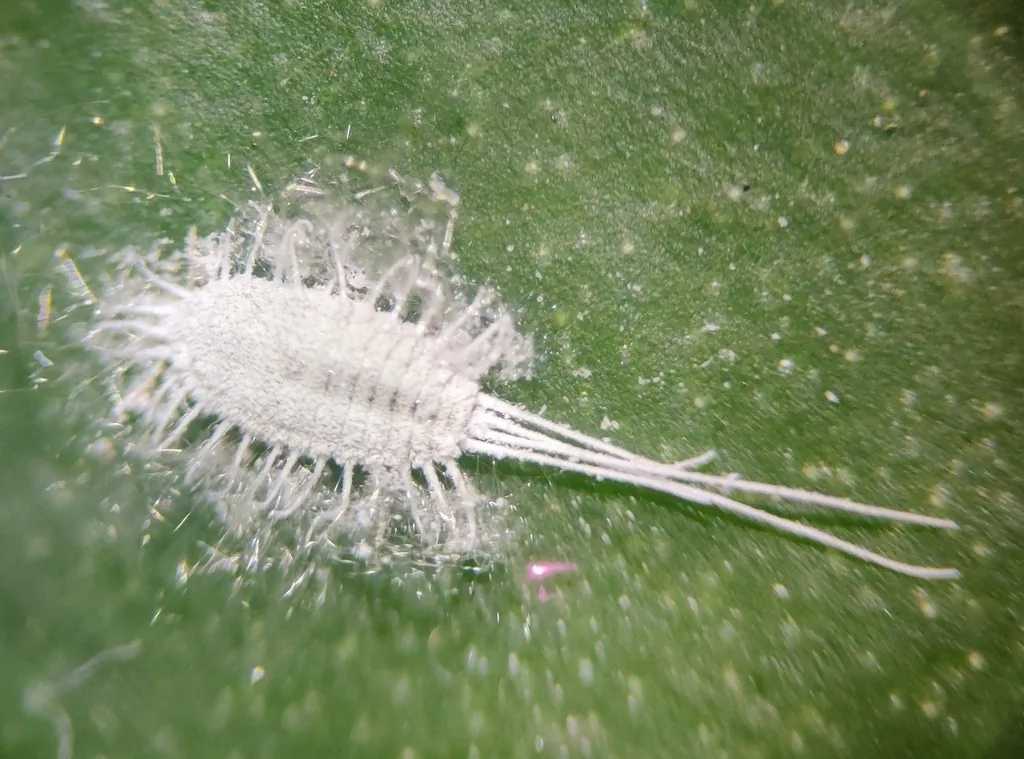
How to identify it
Look-alikes
| Look-alike | How to tell them apart |
|---|---|
| Other mealybugs | The long tail filaments distinguish it from other mealybugs on the same plants.[1] |
Where it lives
It occurs on every continent except Antarctica, mostly in greenhouses and outdoors in warm climates.[1]
Biology and life cycle
Females pass through three instars; males feed only in the first two.[1]
Damage and signs
- It feeds on sap of avocado, citrus, grapes and many tropical ornamentals and excretes honeydew.[1]
Health risk
It feeds on plants; UF/IFAS mentions no risk to people.[1]
Control
Pesticides
Target the crawler stage, which lacks protective wax; thorough coverage is essential for contact sprays.[1]
Common questions
Sources
- University of Florida IFAS Extension (Featured Creatures), “Longtailed Mealybug, Pseudococcus longispinus (EENY-666).” edis.ifas.ufl.edu/publication/IN1149 (accessed 2026-10-06)
- iNaturalist, “Pseudococcus longispinus taxon page (order and family).” www.inaturalist.org/taxa/84805 (accessed 2026-10-06)