On this page
How to identify it
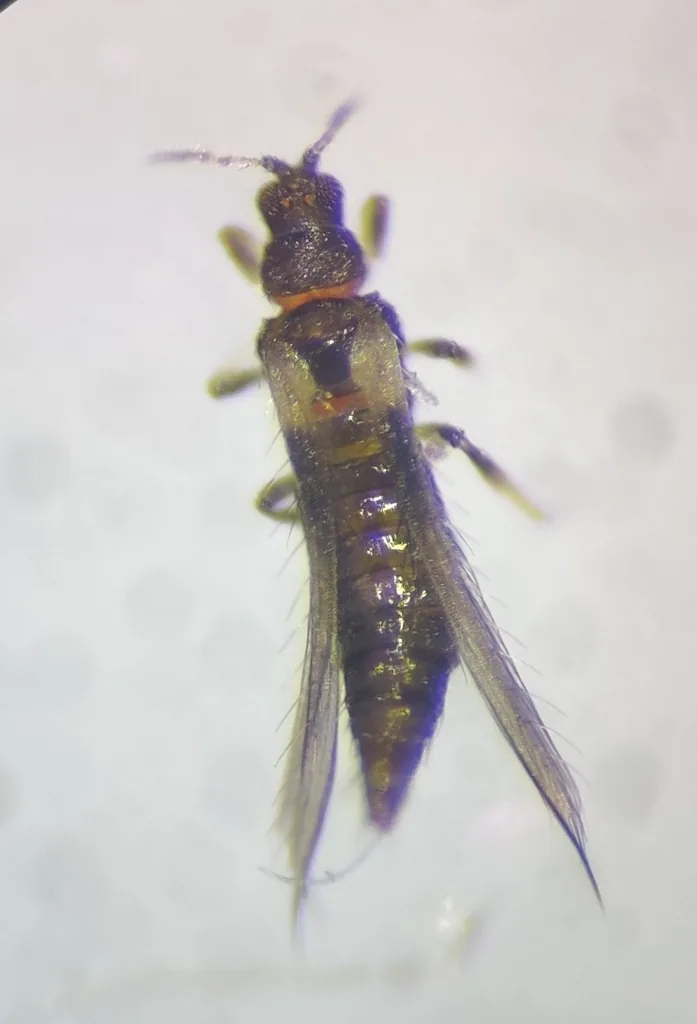
- Adults are relatively large for thrips: females about 1.6 mm and males about 1.3 mm long. They are dark brown with red bands between the segments of the abdomen.[1]
- The wings are dark, pale gray at the base. The antennae have eight segments, dark brown at the base, light brown to yellowish in the middle and brown at the tip.[1]
- Larvae are white to pale yellow: the first stage is white and almost clear, the second pale yellow.[1]
- It moves slowly compared with flower thrips and spends its whole life on the green leaves, usually on the undersides, where its black specks of excrement are often the first sign.[1]
Look-alikes
| Look-alike | How to tell them apart |
|---|---|
| Banded greenhouse thrips | Another greenhouse ornamental thrips that Ontario growers find hard to control with biological control alone.[2] |
| Western flower thrips | Flower thrips such as this one are much more active. Poinsettia thrips is slow-moving and completes its whole life on green leaves.[1] |
Where it lives
Native to eastern North America. In the United States it is found from Florida to New York and in Iowa on weedy plants, with records from states including Illinois, Missouri, Tennessee and Virginia. Outside its native range it has reached Canada, Hawaii, Puerto Rico, Mexico, 19 European countries, east Asia and northeastern Australia.[1]
Biology and life cycle
Each female inserts single, kidney-shaped eggs about 0.2 mm long into leaf tissue, mostly on the underside, and lays about 77 eggs in her lifetime. The eggs are hidden inside the leaf.[1]
Eggs take about 14 to 17 days to hatch at 23°C (73°F). The two larval stages last four to eight days, and the propupa and pupa another two to six days, resting on the plant unless disturbed.[1]
Egg to adult takes about 34 days at 20°C (68°F), 15 days at 25°C (77°F) and 11 days at 30°C (86°F). Females live about 41 days at 25°C.[1]
It can reproduce both with and without mating, and it carries Wolbachia bacteria.[1][3]
It feeds on more than 100 plant species in 48 families. In a Georgia test it fed and bred on 40 of 51 cultivated plants and 59 of 75 native plants tried. Favored hosts include impatiens, poinsettia, dieffenbachia, syngonium, hairy bittercress and Chinese hibiscus, and it also damages gerbera, rose, sweet pepper, cucumber and eggplant.[1]
Damage and signs
- Larvae and adults pierce leaf cells and suck out the contents, leaving pale spots and a shrunken look to the leaf tissue, along with black specks of excrement. They sometimes feed on flowers too.[1]
- The damage mainly lowers the appearance and sale value of greenhouse ornamentals. It is not reported to transmit plant viruses.[1]
- In Ontario greenhouse flower crops it was the most common of the less abundant pest thrips and has proved difficult or expensive to control with biological control.[2]
Health risk
UF/IFAS describes it only as a plant-feeding pest of greenhouse crops; no risk to people is mentioned.[1]
Control
Sanitation
Because every life stage stays on the plant, promptly remove weeds, plant debris and fallen leaves so the thrips can't move from them to clean plants.[1]
Traps and physical control
Sticky cards catch few poinsettia thrips because they rarely fly about. Check plants directly for adults, larvae and the pale spotting and black specks they leave on leaves.[1]
Biological control
Predatory bugs (Orius majusculus, Macrolophus pygmaeus and Dicyphus species) are effective and sold commercially. Green lacewing larvae, predatory thrips and phytoseiid predatory mites also help; the mites controlled larvae and pupae better when given pollen as extra food.[1]
Pesticides
In greenhouses it can be managed with insecticides, and Ontario growers report needing them during outbreaks. Populations on woody landscape plants are difficult to control.[1][2]
Common questions
- Why don't my sticky cards catch poinsettia thrips?
- This thrips is sedentary and stays on the leaves for its whole life, so few land on traps. Look for the insects, pale spotting and black specks on the undersides of leaves instead.[1]
- Does the poinsettia thrips only attack poinsettias?
- No. It feeds on more than 100 kinds of plants, especially impatiens and aroids such as dieffenbachia and syngonium, and also hibiscus, rose, gerbera, pepper, cucumber and eggplant.[1]
- Is the poinsettia thrips native?
- Yes. It is native to eastern North America, where it lives on weedy plants; it was first described from Quincy, Florida, in 1913.[1]
Sources
- University of Florida IFAS Extension (EDIS), “Poinsettia Thrips, Impatiens Thrips (suggested common names), Echinothrips americanus Morgan, Featured Creatures EENY-730 (B. Panthi, O. Liburd and J. Renkema, 2019).” journals.flvc.org/edis/article/view/108507 (accessed 2026-11-09)
- Insects (MDPI), “Thrips Species Composition in Ontario Greenhouse Floriculture: Innovative Identification Tools and Implications for Pest Management (Insects 2024, 15:94).” pmc.ncbi.nlm.nih.gov/articles/PMC10971553/ (accessed 2026-11-09)
- Environmental Entomology (Entomological Society of America), “First detection of Wolbachia in arrhenotokous populations of thrips species (Thysanoptera: Thripidae and Phlaeothripidae) and its role in reproduction (Kumm and Moritz 2008, Environmental Entomology 37:1422-1428), abstract.” pubmed.ncbi.nlm.nih.gov/19161685/ (accessed 2026-11-09)
- iNaturalist, “Echinothrips americanus taxon page (order and family).” www.inaturalist.org/taxa/506713 (accessed 2026-11-09)