On this page
How to identify it
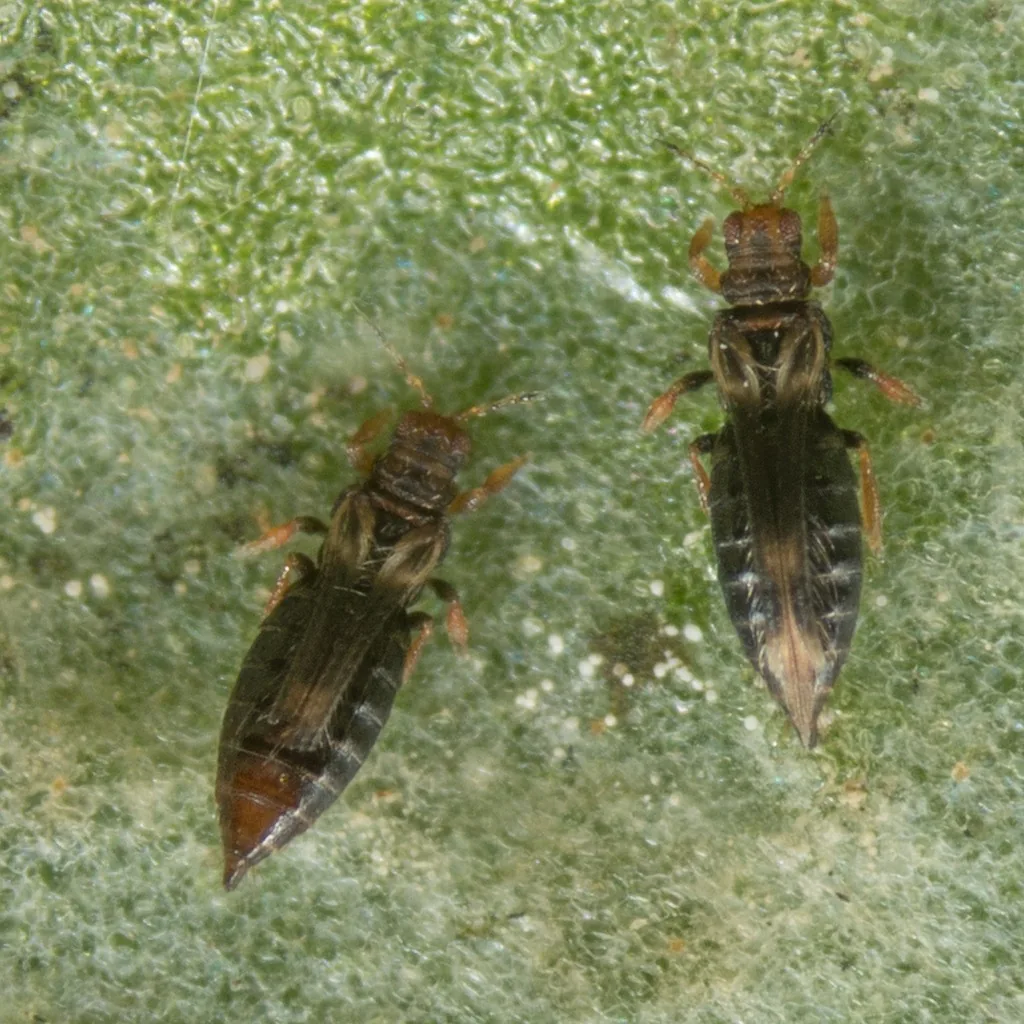
- Adult females are about 1/32 inch long. They start out mostly yellow and gradually darken to brown or black, with red eyes.[1]
- The narrow, fringed wings are gray-brown with three white bands.[1]
- Larvae are white to yellow, wingless and red-eyed. Young larvae cluster on the undersides of leaves, often each carrying a watery droplet of its own excrement; larger larvae sit along the leaf midribs or among dried-up foliage.[1]
- Males are rare, and females can reproduce without mating.[1][2]
Look-alikes
| Look-alike | How to tell them apart |
|---|---|
| Western flower thrips | The thrips most often managed in greenhouse flowers. Ontario researchers found that biological control programs built for western flower thrips do not adequately control other thrips in ornamentals, so it pays to know which species you have.[4] |
Where it lives
An introduced thrips in the United States, found outdoors on shrubs, flowers, vegetables and weeds and indoors on house plants. In Ontario it has been among the species behind thrips outbreaks in greenhouse flower crops.[1][4]
Biology and life cycle
Females lay tiny, white, elongate eggs on the undersides of leaves or along the stems. The eggs swell and turn dull before hatching about two weeks later.[1]
Larvae feed through four stages over about 18 days, growing to about 1/32 inch, then molt to a white prepupa with wing pads and a pupa with longer wing pads and the antennae folded back. Prepupae and pupae stay on the leaves, mostly underneath.[1]
Adults feed less heavily than the larvae and live 40 days or more.[1]
Researchers treat it as a species with female-only populations that reproduce without males. The females carry Wolbachia bacteria, and when researchers treated them with antibiotics they began producing males.[2]
Even when mated, females did not use sperm to fertilize their eggs, and their sperm-storage organ appears to be vestigial.[3]
Damage and signs
- The larvae do most of the damage. Feeding and egg-laying scars spoil the look of ornamental plants, and a moderate to heavy infestation causes considerable discoloration.[1]
- Hosts include many house plants and greenhouse crops: amaryllis, aralia, begonia, calla lily, cacti, chrysanthemum, croton, dracaena, gardenia, hoya, hydrangea, peperomia, philodendron, pothos, rubber tree, schefflera, screw pine and arrowhead vine, as well as banana, date palm, cotton, cucumber, tomato and grape.[1]
Health risk
NC State notes that this thrips also bites people, causing minor itching.[1]
Control
Prevention
Check the undersides of leaves, where the larvae and their droplets of excrement gather. Have the thrips identified, since control programs aimed at other thrips may not work on this one.[1][4]
Biological control
Predatory insects and mites attack banded greenhouse thrips.[1]
Pesticides
It is not reported to be resistant to insecticides. Indoors, a houseplant insect spray should give adequate control; outdoors, an insecticide labeled for residential landscape use should work. Follow the label.[1]
Common questions
- What are the tiny black insects with banded wings on my house plant?
- They may be banded greenhouse thrips. The adults are about 1/32 inch long and dark, with three white bands across their gray-brown wings, and their pale larvae cluster under the leaves.[1]
- Can banded greenhouse thrips bite?
- Yes. NC State says it bites people, causing minor itching.[1]
- How do banded greenhouse thrips reproduce without males?
- The females reproduce on their own, a process called thelytoky, and males are rare. Researchers found Wolbachia bacteria in them, and antibiotic treatment made the females produce males.[1][2]
Sources
- NC State Extension, “Banded Greenhouse Thrips, PDIC factsheet (J. R. Baker).” content.ces.ncsu.edu/banded-greenhouse-thrips (accessed 2026-11-09)
- Environmental Entomology (Entomological Society of America), “First detection of Wolbachia in arrhenotokous populations of thrips species (Thysanoptera: Thripidae and Phlaeothripidae) and its role in reproduction (Kumm and Moritz 2008, Environmental Entomology 37:1422-1428), abstract.” pubmed.ncbi.nlm.nih.gov/19161685/ (accessed 2026-11-09)
- Scientific Reports (Nature Portfolio), “Investigation of the spermathecal morphology, reproductive strategy and fate of stored spermatozoa in three important thysanopteran species (Krueger et al. 2022, Scientific Reports 12:18517), abstract.” pubmed.ncbi.nlm.nih.gov/36323867/ (accessed 2026-11-09)
- Insects (MDPI), “Thrips Species Composition in Ontario Greenhouse Floriculture: Innovative Identification Tools and Implications for Pest Management (Insects 2024, 15:94).” pmc.ncbi.nlm.nih.gov/articles/PMC10971553/ (accessed 2026-11-09)
- iNaturalist, “Hercinothrips femoralis taxon page (order and family).” www.inaturalist.org/taxa/307651 (accessed 2026-11-09)