On this page
How to identify it
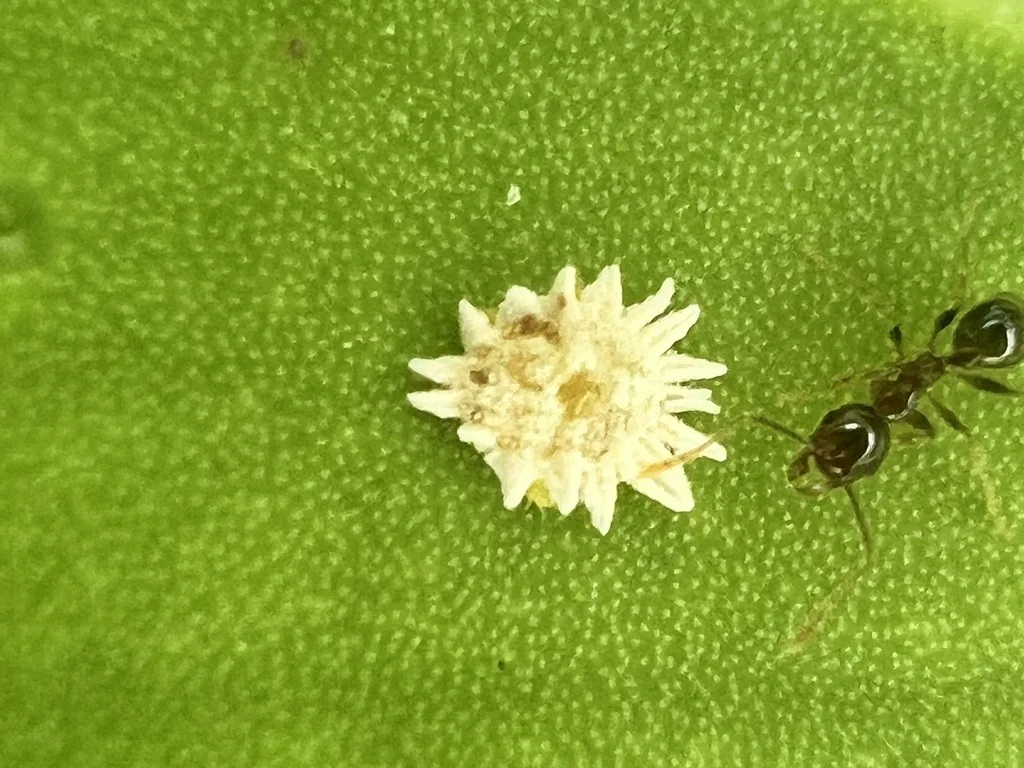
- Adult females are oval, 1.5 to 2.5 mm long and reddish-brown to orange, under a thick coat of yellowish-orange wax.[1][2]
- The wax forms 10 to 12 pairs of pyramid-shaped spikes around the edge of the body, plus 5 to 8 similar lumps along the back.[1][2]
- Unlike many mealybugs, the female does not make a cottony egg sac.[1][2]
- Males develop inside thin white cottony cocoons, about 2 mm long, which are often found in large numbers on the leaves.[1][2]
Look-alikes
| Look-alike | How to tell them apart |
|---|---|
| Other mealybugs | Mealybugs can be very small and can look like plant diseases or even parts of the plant. Coconut mealybug's thick orange-yellow wax and rows of spikes help set it apart, but a firm species identification is made from slide-mounted adult females.[1] |
Where it lives
Coconut mealybug is widely distributed, with records from North, Central and South America, Europe, Asia, Oceania and Africa. In the United States it has been recorded from Florida, California and Louisiana.[1][2]
Biology and life cycle
Young males and females look alike through the first two growth stages. In the third stage, females begin to resemble adults, while males form cocoons and change inside them before emerging as winged adults.[1]
It lives on the foliage of its hosts.[2]
Hosts span more than 40 plant families, including many palms (sago, pygmy date, California fan, parlor, queen, Kentia, lady and Washington palms), avocado, banana, citrus, coffee, grape, ginger, heliconia, dracaena, orchids and potato.[1]
DNA studies suggest that what is called coconut mealybug may be at least three closely similar species, with different forms in California and Hawaii and in Florida.[2]
Damage and signs
- Adults and nymphs suck sap. Their honeydew grows black sooty mold, which cuts down photosynthesis and can lead to leaf loss and occasionally the death of a young plant.[1]
- Heavy infestations on pygmy date palm turn the fronds yellow.[1]
- Ants feed on the honeydew and may defend the mealybugs from predators and parasites.[1]
Health risk
The sources treat it only as a plant pest; none mentions bites or any risk to people or pets.[1][2]
Control
Prevention
Inspect plants before bringing them into a landscape, nursery or collection, and check plants regularly, including leaf undersides and stems, so infestations are found before damage shows.[1]
Traps and physical control
For small infestations, prune or wash off infested plant parts; a brisk spray of water also knocks mealybugs off and reduces their numbers.[1]
Biological control
Predators, parasites and diseases attack mealybugs and help keep them down over the long term, so conserve them. A parasitic wasp, Pseudaphycus utilis, successfully controlled coconut mealybug in Hawaii and Puerto Rico.[1]
Pesticides
The wax protects mealybugs from many insecticides. Horticultural oil and insecticidal soap can give good control but, like other contact sprays, need thorough coverage and repeat applications; crawlers are the most susceptible stage.[1]
Common questions
- What are the orange, spiky mealybugs on my palm?
- Coconut mealybug has thick yellowish-orange wax with 10 to 12 pairs of pyramid-shaped spikes around its edge and is a pest of many palms, including pygmy date and Kentia palms.[1][2]
- Can I wash coconut mealybugs off?
- Yes, for small infestations a brisk spray of water helps remove them, and pruning or washing infested parts reduces their numbers.[1]
- Why don't sprays work well on mealybugs?
- Their wax shields them from many insecticides, so sprays need thorough coverage and repeat applications, and work best against crawlers.[1]
Sources
- University of Florida IFAS Extension (EDIS Featured Creatures), “Coconut mealybug, Nipaecoccus nipae (Maskell) (EENY448, 2009).” journals.flvc.org/edis/article/view/117936 (accessed 2026-11-09)
- ScaleNet (scale insect database begun at the USDA ARS Systematic Entomology Laboratory), “ScaleNet catalogue: Nipaecoccus nipae (Maskell).” scalenet.info/catalogue/Nipaecoccus%20nipae/ (accessed 2026-11-09)
- iNaturalist, “Nipaecoccus nipae taxon page (order and family).” www.inaturalist.org/taxa/330245 (accessed 2026-11-09)