The short answer
- Isolate the plant and look closely: in leaf joints, under leaves, at stem tips and, if the plant is wilting for no clear reason, on the roots.[1][4][8]
- For a light infestation, dab each mealybug and egg mass with a cotton swab dipped in rubbing alcohol. UC IPM uses 70% isopropyl alcohol or weaker and says to test it on a small part of the plant 1 to 2 days first.[1][4][8][5]
- Knock exposed mealybugs off sturdy plants with a strong spray of water, repeated every few days.[1][3][4]
- Insecticidal soap, horticultural oil or neem oil kill mostly the young crawlers they wet. Plan on two or three applications about a week apart, because new crawlers keep hatching.[1][3][5][8]
- Systemic products are less reliable on mealybugs than on aphids or whiteflies, and UC IPM advises avoiding them when possible, especially on flowering plants.[1][3]
- If a plant is heavily infested, or has root mealybugs, throwing it out is often the most practical fix.[1][4][9][8]
Mealybug profiles
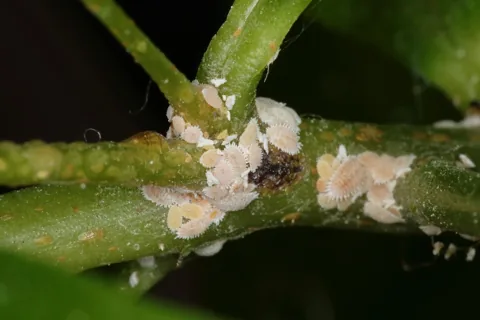 Mealybugs
Planococcus citri
Mealybugs are soft, oval insects covered in white wax that suck sap from houseplants and outdoor plants. They thrive indoors and where winters are mild, and their wax and hiding habits make them hard to reach with sprays.
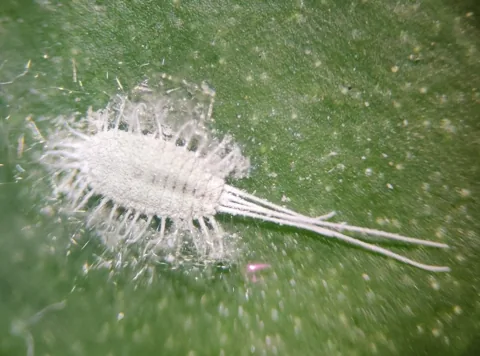 Longtailed Mealybug
Pseudococcus longispinus
The longtailed mealybug is a white, waxy mealybug named for the pair of tail filaments that are as long as or longer than the adult female's body. It is a common pest of houseplants and greenhouse plants, especially dracaena, and also turns up in some California vineyards.
No photo yet
Root mealybugs
Rhizoecus
Root mealybugs are small, bluish white mealybugs that live in the soil and feed on plant roots. They are most often a problem in potted plants such as African violets and gardenias, and because they stay underground, the first sign is often a declining plant whose roots and soil are dusted with white, waxy fluff.
No photo yet
Obscure mealybug
Pseudococcus viburni
Obscure mealybug is a powdery, white-waxed mealybug that is nearly identical to grape mealybug and attacks grapes, pears and many other plants. In California it is one of the main mealybugs in North Coast, San Joaquin Valley and Central Coast vineyards. Elsewhere it is a pest of greenhouse crops, and it has been recorded in more than two dozen U.S. states.
No photo yet
Grape mealybug
Pseudococcus maritimus
Grape mealybug is a soft, waxy insect that spends the winter under loose bark and moves onto shoots, leaves and fruit as the season goes on. In vineyards it fouls grape clusters with cottony egg sacs, honeydew and sooty mold, and it can spread grapevine leafroll virus; it also infests pears.
No photo yet
Harrisia cactus mealybug
Hypogeococcus pungens
Hypogeococcus pungens, called the Harrisia cactus mealybug, is a small pinkish mealybug from South America. In Florida it shows up mostly as cottony clusters on purslane and Alternanthera and is rarely found on cacti, but a cactus-feeding form is badly damaging native columnar cacti in Puerto Rico.
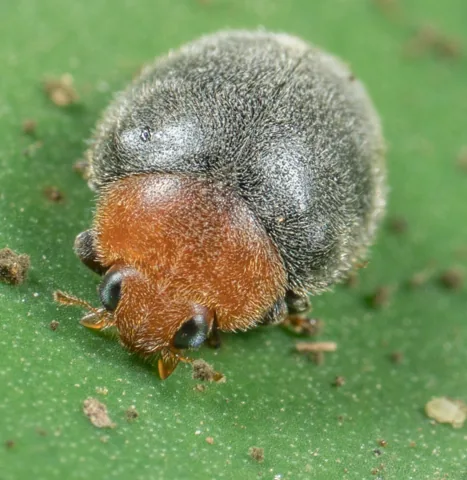 Mealybug Destroyer
Cryptolaemus montrouzieri
The mealybug destroyer is a small lady beetle introduced from Australia. Its white, waxy larvae look so much like mealybugs that they're easily mistaken for the pest.
No photo yet
Leptomastix dactylopii (mealybug parasitoid)
Leptomastix dactylopii
Leptomastix dactylopii is a tiny parasitic wasp that develops inside mealybugs and kills them. It is sold commercially for release in greenhouses, citrus groves and interiorscapes, and it has brought about large drops in mealybug numbers in Florida and other places.
Make sure it's mealybugs
Adult female mealybugs are wingless, oval and segmented, covered with white powdery or cottony wax, and often fringed with wax filaments. Unlike most scale insects, they keep their legs and can creep around slowly. Females lay eggs in white, cottony egg sacs, so an infested plant usually shows clumps of white fluff, sticky honeydew, black sooty mold on the honeydew, or ants. Sizes vary with species and source: Wisconsin gives about 1/16 inch for females, Clemson 1/8 to 1/4 inch, and Kansas State 2 to 5 mm for full-grown females.[1][4][8][3]
- Where to look: leaf joints where the leaf stalk meets the stem, leaf undersides, stem tips, branch crotches, the crown of the plant, and under the leaf sheaths of plants such as orchids and prayer plants.[1][3][8]
- Look-alikes: cottony cushion scale, woolly aphids, some soft scales and whiteflies also make wax and honeydew. UC IPM says to look at the insect under the wax to be sure. Our scale insect guide covers the scale side of that line.[1]
- Not every white, waxy larva is a pest. Larvae of the mealybug destroyer, a lady beetle that eats mealybugs, are covered with white wax filaments and can grow to 1/2 inch, more than twice the size of an adult female mealybug. They move faster, and brushing the wax away shows legs and an alligator-like body.[2][1]
- Damage: mealybugs weaken plants by sucking sap. Heavy populations slow growth and cause yellowing, leaf drop and wilting, and some species inject saliva that stunts or deforms growth. Healthy plants can tolerate low numbers.[1][4][3][5]
Which mealybug do you have?
A handful of species cause most problems. The one you have changes what works, especially if it lives on roots or gives birth to live young.[1][3]
- Citrus mealybug: the most common mealybug on indoor plants. Short, even wax filaments around the body and sometimes a faint dark stripe down the back. It favors soft-stemmed and succulent plants such as coleus, croton, jade, poinsettia and cactus, plus rosemary, citrus and bird of paradise. See the mealybugs profile.[1][4][5]
- Longtailed mealybug: two tail filaments as long as or longer than the body. It produces live young instead of egg sacs and often hides in leaf whorls; NC State says dracaena appears to be its favored host. See the longtailed mealybug profile.[1][6][4]
- Root (ground) mealybugs: small, bluish-white mealybugs without obvious filaments that live in the potting soil and feed on roots. They're reported most often on African violets and gardenias. See the root mealybugs profile and the section below.[1][7][4]
- Outdoor species: in California, obscure and grape mealybugs are common on grapes, pears and other fruit trees, and vine mealybug attacks grape roots as well as the vine above ground. Among fruit trees, citrus has the most mealybug problems.[1][11]
First steps on an infested houseplant
Move the plant away from your other plants right away. Wisconsin says mealybugs crawl easily from plant to plant where leaves or branches overlap, and Kansas State adds that crawlers also spread on air currents, hands, watering equipment and ants. Clemson says to keep an infested plant separate until the pest is completely gone, which may take several weeks or more. Our houseplant pests guide covers the general routine for indoor plants.[4][3][8]
- Decide whether it's worth saving. Kentucky says easily replaced plants that are severely infested should be discarded, since keeping them risks spreading the pests to more valuable plants. UC IPM also suggests tossing old "grandmother" plants that keep reinfesting new ones.[9][1][3]
- Prune out the worst stems if that won't ruin the plant's shape, and bag them right away: Wisconsin notes mealybugs can survive on cut pieces as long as the pieces stay moist.[4][1]
- Check the pot, saucer, stakes and anything else that touched the plant for mealybugs and egg sacs, and dispose of infested items.[1]
- Hold back on nitrogen. Heavy nitrogen fertilizer with regular watering spurs the soft new growth mealybugs prefer, and Kansas State says females on heavily fertilized plants may lay more eggs.[1][3][4]
Rubbing alcohol: swabs and sprays
Alcohol is the standard spot treatment for houseplants, and a swab also pulls the insect off. Kansas State notes that very few insecticides get through mealybug wax, but products containing alcohol may. UC IPM and Wisconsin both say to test it first, because some plants are burned by it.[1][4][8][5][3]
- Swabbing: dip a cotton swab in rubbing alcohol and touch it to each mealybug and egg mass. UC IPM gives 70% isopropyl alcohol or weaker, and says a much more diluted solution is sometimes better.[1][8][4]
- Test first: dab a small part of the plant and wait. UC IPM says 1 to 2 days; Wisconsin says leaf damage may take a day or two to show. Wisconsin finds swabbing works best on large-leaved plants.[1][4]
- Spraying: for widespread infestations UC IPM suggests a 10 to 25% solution of isopropyl alcohol in a spray bottle, repeated every week until the mealybugs are gone.[1]
- Follow-up wash: NC State suggests washing the plant afterward with mild soapy water (about 2% soap, not detergent) to remove leftover wax, then watching it closely for a few weeks and removing new mealybugs as they appear.[5][6]
Water sprays and washing
A forceful spray of water removes many exposed mealybugs from sturdy plants. UC IPM says to repeat it at several-day intervals; Kansas State, writing for greenhouses, says spraying regularly (for example twice a week) dislodges eggs, crawlers and adults. Wisconsin suggests a moderately strong spray of warm water.[1][3][4]
- Washing leaves: Kentucky says broadleaved plants can be washed with soapy water and a soft brush or cloth, using one teaspoon of mild detergent or soap in a gallon of water. It's slow, but may be the best option for plants that sprays could injure.[9]
- Limits: water doesn't reach mealybugs wedged into stem crotches and leaf folds, so Wisconsin says washing rarely gets them all. Check again and repeat.[4]
Insecticidal soap, horticultural oil and neem
These kill mostly by contact, so they work best on crawlers, the newly hatched, wax-free young. Older mealybugs are protected by their wax. UC IPM says soaps, horticultural oils and neem oil applied directly on mealybugs give some suppression, especially of younger nymphs, and to test them for plant injury first.[1][3][8]
- Repeat: most insecticides don't kill the eggs inside egg sacs, which keep hatching over a long period. Kansas State says at least two to three weekly applications are usually needed; NC State says to treat at least twice and probably three times at weekly intervals. The longtailed mealybug has no egg sacs but NC State still re-treats it two or more times.[3][5][6]
- Coverage: spray the base of leaf stalks, leaf sheaths and leaf undersides, where mealybugs gather. Soap does nothing once it has dried.[3][8]
- Label and plant: Kentucky notes that even houseplant insecticide products can injure some plants, sometimes when the sprayer is held too close. Read the label before buying.[9]
- Our insecticidal soap, horticultural oil and neem oil pages cover each active ingredient in more detail.[1]
Succulents, cacti and jade
Citrus mealybug especially likes soft-stemmed and succulent plants, and Wisconsin names jade and cactus among its favorites. UC IPM lists cactus and jade among houseplants that often have mealybug problems, and cactus among the outdoor plants most commonly infested.[4][1]
- Swab rather than spray where you can, and test first. UC IPM's phytotoxicity test for alcohol, soaps and oils applies to every plant type, and Wisconsin says to wait a day or two for symptoms.[1][4]
- Check under the plant as well as on it. White cottony masses at the drainage holes, or yellowing and wilting with no other cause, can mean mealybugs on the roots; Wisconsin says pulling the root ball from the pot is often the only way to confirm.[4]
- Wisconsin notes that a separate cactus mealybug occasionally turns up on specific host plants. Our Harrisia cactus mealybug profile covers one cactus-feeding species.[4]
Root mealybugs
Root mealybugs live in potting soil on the roots, so you usually don't find them until a plant declines and you look. Signs include yellowed leaves, wilting, stunting and fewer blooms. NC State says the fluffy wax they secrete can give soil a bluish tint, and that they sometimes crawl out of drainage holes when a pot is watered and infest plants nearby.[4][7][1]
- Discard is the usual advice: UC IPM says ground mealybugs are even harder to control than aboveground ones and to get rid of infested plants quickly, before the pests move to clean plants. Wisconsin agrees that discarding is often the most practical fix.[1][4]
- Save a cutting: if you want to keep the plant, Clemson suggests taking a cutting from a clean part and starting a new plant in a clean pot with sterile potting soil.[8]
- Systemics: NC State takes a different view, recommending imidacloprid or another systemic insecticide labeled for residential use; landscape-only products mean moving the plant outdoors (in shade for tender houseplants) for treatment. Kansas State says root mealybugs are extremely difficult to detect and manage with available insecticides.[7][3]
- Prevention: use commercially prepared potting soil, not garden soil, and keep pots off the ground outdoors where pests can crawl in through drainage holes.[9][8]
Systemic insecticides: cautions
Systemic insecticides are taken up by the plant, so they can reach mealybugs that sprays miss. Sources disagree on how well they work against mealybugs. Clemson says imidacloprid granules applied to the soil control mealybugs, and NC State lists imidacloprid and acephate as systemics homeowners can use. UC IPM and Kansas State are more cautious.[8][5][1][3]
- Less reliable on mealybugs: UC IPM says neonicotinoids such as imidacloprid (houseplant spikes or granules) and dinotefuran (some landscape plants) may reduce mealybug numbers but are less reliable against mealybugs than against other sap-sucking insects. Kansas State suggests mealybugs may not take in a lethal dose because they feed in leaf tissue or on stems.[1][3]
- Bees and natural enemies: UC IPM says to avoid them when possible, especially on flowering plants, because of harm to natural enemies and pollinators. Clemson says to avoid soil-applied systemic insecticides outdoors unless absolutely necessary. Our guide to protecting pollinators covers timing and label rules.[1][8]
- Use: Kansas State says systemics work best applied early, before plants are put on display, and that the soil shouldn't be overwatered afterward so roots can absorb the active ingredient. Acephate has a strong odor, so NC State suggests treating plants outdoors.[3][5]
- Broad-spectrum sprays: UC IPM says pyrethroids and other insecticides labeled for mealybugs may be little more effective than soaps and oils and can devastate natural enemies.[1]
Mealybugs on outdoor plants
Outdoors, UC IPM says natural enemies usually keep mealybugs below damaging levels and that nonchemical methods are usually enough. Mealybugs thrive where winters are mild; NC State says citrus mealybugs don't survive North Carolina winters outdoors.[1][5]
- Handpick or prune out colonies, and use a strong water spray on exposed ones.[1]
- Protect natural enemies: parasitic wasps, lady beetles, lacewings, minute pirate bugs, predatory midge larvae and spiders all feed on mealybugs. Avoid broad-spectrum insecticides for any pest in the area. Look for parasite pupae in colonies and mummified mealybugs with emergence holes.[1][11]
- Control the ants: ants tend mealybugs for their honeydew and protect them from natural enemies. Kansas State adds that mealybugs tended by ants feed more and do more damage. UC IPM suggests sticky bands on trunks (over a protective wrap on young trees), trimming branches that touch buildings or other plants, and ant bait stations. Our ant guides cover baits.[1][10][3][11]
- Grapes: grape and obscure mealybugs overwinter under loose bark on the trunk and cordons, and UC IPM's grape guidelines say ant control may be enough to let parasites and predators handle them.[11]
- If a planting keeps having serious problems, UC IPM suggests replacing it with plants that aren't prone to mealybugs for a year or two.[1]
Mealybug destroyer and other beneficials
The mealybug destroyer (Cryptolaemus montrouzieri) is a small lady beetle from Australia, black in the middle with a reddish-brown head and hind end. UC IPM calls it the most important mealybug predator in many areas. It's sold for release, mostly in greenhouses, interiorscapes and citrus groves, and Wisconsin says most commercial natural enemies of mealybugs aren't suited to the typical home.[2][1][4]
- Release only when egg sacs are plentiful: females need to eat mealybug eggs before they lay their own, so UC IPM says there's little point releasing them when mealybug numbers are low.[1][2][4]
- Rates: Wisconsin gives 2 to 8 adults per plant; UC IPM gives several beetles per square foot of growing area or per plant where egg masses are present. Wisconsin says the beetles take time and may not wipe out the mealybugs.[4][2]
- Warmth: they breed fastest at 72 to 77°F; below 68°F and with short days reproduction slows sharply, so they often can't keep up in winter unless the space is heated and lit.[2]
- Check what arrives: UC IPM says a healthy shipment is about half females. Females have black to dark brown front legs, males orange.[2]
- Parasitic wasps: Leptomastix dactylopii is sold for release but kills only the citrus mealybug. Kansas State (2011) says no parasitoids were sold for the longtailed mealybug. See our beneficial insects guide and our guide to releasing beneficial insects.[1][3]
Keeping mealybugs out
Most mealybug problems start with a new plant, pot or tool. Adult females can't fly and don't crawl fast, so they don't spread quickly on their own.[1][6][3]
- Inspect before you buy or bring a plant in. If you can't remove every mealybug, UC IPM says to discard the plant or take it back to the seller.[1][4]
- Quarantine new plants. Sources give different times: Wisconsin says a week or so, Kentucky 30 days, and Clemson six weeks, checking about once a week with a 10X hand lens.[4][9][8]
- Keep checking mealybug-prone plants after an infestation. Kansas State says early infestations are almost invisible and then seem to explode.[1][3]
- Don't overfeed with nitrogen.[1][4][3]
Common questions
- What kills mealybugs instantly?
- A cotton swab dipped in rubbing alcohol (70% isopropyl or weaker) kills or removes the mealybugs it touches. Test it on a small part of the plant first, and expect to repeat, because eggs and hidden mealybugs survive.[1][4][8]
- Can I spray rubbing alcohol on my plants?
- UC IPM suggests a 10 to 25% isopropyl alcohol solution in a spray bottle for widespread infestations, repeated weekly, after testing on a small part of the plant.[1]
- Why do mealybugs keep coming back?
- Egg sacs shield eggs from sprays, mealybugs hide in crevices and on roots, and a plant left untreated nearby reinfests the others. Treat at weekly intervals two or three times and keep checking.[3][5][4]
- Does neem oil kill mealybugs?
- Neem oil, like insecticidal soap and horticultural oil, gives some suppression, mostly of young nymphs with little wax. It has to wet the insects directly.[1][3]
- Should I throw out a plant with mealybugs?
- If it's heavily infested, easily replaced, or has root mealybugs, extension sources say discarding it is often the best choice.[1][4][9]
Photo credits
- Mealybugs: (c) Carlos Alexandre Mattos Raposo, some rights reserved (CC BY) — via iNaturalist, CC BY 4.0
- Longtailed Mealybug: (c) Svavar Martin Andreasen, some rights reserved (CC BY) — via iNaturalist, CC BY 4.0
- Mealybug Destroyer: Jesse Rorabaugh, public domain (CC0), via iNaturalist
Sources
- University of California Statewide IPM Program, “Pest Notes: Mealybugs, Publication 74174 (M. L. Flint).” ipm.ucanr.edu/home-and-landscape/mealybugs/ (accessed 2026-11-10)
- University of California Statewide IPM Program, “Mealybug Destroyer (Natural Enemies Gallery).” ipm.ucanr.edu/natural-enemies/mealybug-destroyer/ (accessed 2026-11-10)
- Kansas State University Research and Extension, “Mealybug Management in Greenhouses and Interiorscapes, MF3001 (R. A. Cloyd, 2011).” bookstore.ksre.ksu.edu/pubs/MF3001.pdf (accessed 2026-11-10)
- University of Wisconsin-Madison Extension, Wisconsin Horticulture, “Mealybugs (S. Mahr).” hort.extension.wisc.edu/articles/mealybugs-2/ (accessed 2026-11-10)
- NC State Extension, “Citrus Mealybug.” content.ces.ncsu.edu/citrus-mealybug (accessed 2026-11-10)
- NC State Extension, “Longtailed Mealybug.” content.ces.ncsu.edu/longtailed-mealybug-2 (accessed 2026-11-10)
- NC State Extension, “Root Mealybugs.” content.ces.ncsu.edu/root-mealybugs (accessed 2026-11-10)
- Clemson Cooperative Extension, “Common Houseplant Insects & Related Pests, HGIC.” hgic.clemson.edu/factsheet/common-houseplant-insects-related-pests/ (accessed 2026-11-10)
- University of Kentucky Entomology, “Houseplant Insect Control, ENTFACT-406.” entomology.mgcafe.uky.edu/ef406 (accessed 2026-11-10)
- University of California Statewide IPM Program, “Pest Notes: Ants.” ipm.ucanr.edu/home-and-landscape/ants/ (accessed 2026-11-10)
- University of California Statewide IPM Program, “Mealybugs (Pseudococcus), Grape Pest Management Guidelines.” ipm.ucanr.edu/agriculture/grape/mealybugs-pseudococcus/ (accessed 2026-11-10)