The short answer
- They kill on contact only. Clemson Extension says soaps and oils must directly cover the pests, and that thorough coverage of upper leaf surfaces, lower leaf surfaces and stems is essential. Once the spray dries, Cornell says a moving insect walking over the residue won't be harmed.[2][3]
- Spray when it's cool and the plant is watered. Clemson, Cornell and UC IPM all say not to spray above 90°F, in full sun or on water-stressed plants. Early morning or late in the day is best, because slower drying keeps the spray working longer.[1][2][3][8]
- Test sensitive plants first. Japanese maple, horse chestnut, mountain ash, sweet pea, bleeding heart, lantana and gardenia are on Clemson's and Cornell's soap-sensitive lists; Colorado State lists black walnut, junipers and cedars, redbud, Japanese and red maple and dwarf Alberta spruce as oil-sensitive.[1][3][4]
- Expect to repeat. Soaps and oils kill only the insects present on the day they're sprayed, so Clemson says soap may need repeating every 4 to 7 days, following the label, until the pests are gone.[5][1]
- Mix to the label, not stronger. Clemson gives 1 to 2% as the usual strength for both and warns that a higher concentration may be very harmful to plants. Rates for specific products are on the insecticidal soap and horticultural oil pages.[1][2]
Pests these sprays control
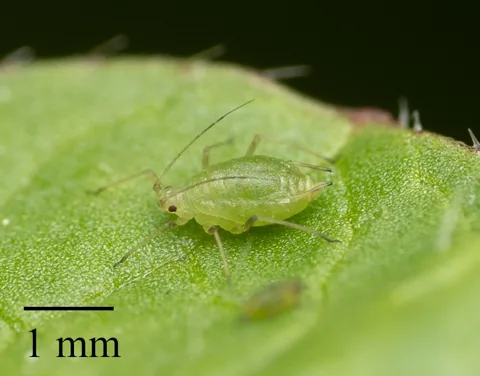 Aphids
Myzus persicae
Aphids are small, soft-bodied insects that pierce tender stems and leaves and suck out plant sap. Almost every plant hosts at least one aphid species, but established plants usually tolerate them, treating aphids for the plant's health is usually unnecessary, and natural enemies often bring numbers down.
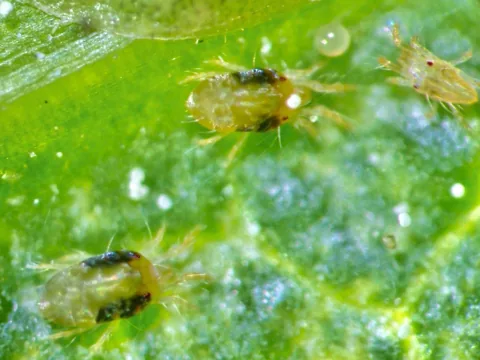 Spider Mites
Tetranychus urticae
Spider mites are tiny arachnids, relatives of spiders and ticks, that live in colonies on leaf undersides and suck out plant cells. The twospotted spider mite is the most important species in yards and gardens and on house plants, and Minnesota says it can infest over 200 species of plants.
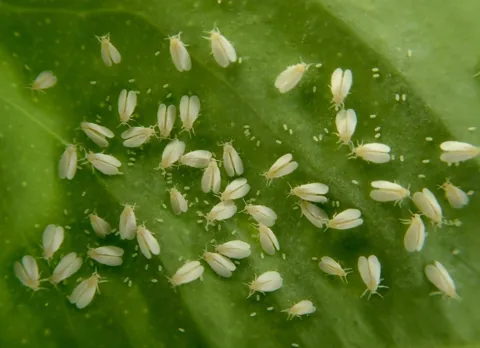 Whiteflies
Trialeurodes vaporariorum
Whiteflies are tiny sap-sucking insects that build large colonies on leaf undersides, especially in warm weather. Outbreaks usually follow disruption of their natural enemies, and heavy infestations are hard to control, so prevention matters most.
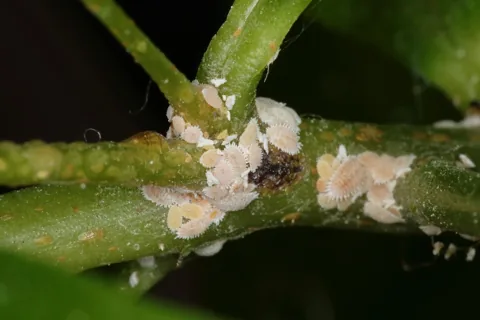 Mealybugs
Planococcus citri
Mealybugs are soft, oval insects covered in white wax that suck sap from houseplants and outdoor plants. They thrive indoors and where winters are mild, and their wax and hiding habits make them hard to reach with sprays.
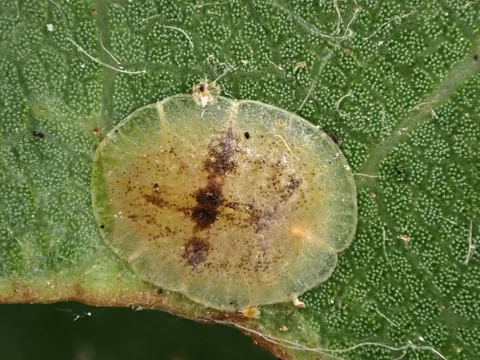 Scale Insects
Superfamily Coccoidea (representative: brown soft scale, Coccus hesperidum)
Scales are small sap-sucking insects that settle on the bark, leaves or fruit of trees, shrubs and houseplants and rarely look like insects at all. Most plants tolerate low to moderate numbers, but heavy infestations cause yellowing, leaf drop and dieback, and the soft scales drip sticky honeydew.
What soap and oil sprays are
Insecticidal soaps are potassium salts of fatty acids. Clemson describes commercial insecticidal soap as a highly refined version of liquid dish soap, and Cornell Cooperative Extension says household soap or dish soap is not insecticidal soap. Both say the commercial products are formulated and tested for use on plants.[1][3][2]
Horticultural oils are, according to Colorado State, usually highly refined petroleum (mineral) oils combined with an emulsifier so they mix with water. Refining removes the impurities linked to plant injury. Labels and fact sheets call them superior, supreme or narrow-range oils. Plant-based oils such as neem, canola and cottonseed oil are sold too, and UC IPM accepts both petroleum and plant oils for spider mites.[4][10][8]
Neem oil is a plant oil with its own pesticide page on this site; much of the advice below on coverage applies to it as well, since UC IPM groups soaps, neem oil and horticultural oil together as sprays that kill only what they hit.[5][9]
What they kill
Clemson says small, soft-bodied insects such as aphids, mealybugs, thrips, scale crawlers and spider mites are most susceptible to soap. Cornell adds adelgids and whiteflies. UC IPM's list for oils covers aphids, whiteflies, mealybugs, scale insects, spider mites, psyllids and thrips, and Colorado State adds eriophyid mites and leafhoppers for summer oil and overwintering caterpillar eggs such as leafrollers and tent caterpillars for dormant oil.[1][3][10][4]
Oil is the stronger choice for scale. UC IPM says complete coverage with horticultural oil at the right time gives good control of most scales, and that armored scales and oak pit scales need especially thorough coverage because they are less susceptible to pesticides than soft scales. For mealybugs, UC IPM says soaps and oils work best on younger nymphs with less wax.[6][9]
- Aphids: soap, oil or both. UC IPM says they work by smothering aphids, so apply them thoroughly. See the aphid guide.[5]
- Spider mites: UC IPM recommends insecticidal soap or oil, or a combination, with excellent coverage of leaf undersides and repeat sprays as needed. See the spider mite guide.[8]
- Whiteflies: UC IPM says soaps and oils may reduce but not eliminate them, and control only the whiteflies directly sprayed. See the whitefly guide.[7]
- Mealybugs: UC IPM says soaps, horticultural oil or neem oil applied directly can give some suppression. See the mealybug guide.[9]
- Scale: horticultural oil in the dormant season or when crawlers are active (UC IPM). See the scale insect guide.[6]
Why coverage is everything
Clemson says soaps kill by suffocation, by disrupting the insect's cell membranes and by stripping the protective waxes off the insect so it dries out. Colorado State says oils mainly block the spiracles insects breathe through, and may also act as poisons or disrupt feeding.[1][4]
Neither leaves a useful residue. Clemson says soap has no residual effectiveness once it dries or washes away, and Cornell says it works only while wet. That's why the spray has to land on the insect itself. Cornell's example: spraying only the upper leaf surface leaves whiteflies alive and healthy, because they feed under the leaves, and the immature stages barely move, so they never walk into wet spray.[1][3]
Wet the upper and lower leaf surfaces and the stems (Clemson). For scale on woody plants, UC IPM says to thoroughly wet twig terminals and the undersides of leaves; in winter, the bark of terminal shoots.[2][6]
Heat, drought and humidity: avoiding leaf burn
Plant injury (phytotoxicity) is the main drawback of both sprays. Cornell describes soap injury as yellow or brown spotting, burned tips and yellow or brown scorching on leaf edges, and says soap can mark some apple, pear and stone fruit varieties. Colorado State calls oil's risk of injury small but real, and adds that oil can stain some surfaces, particularly dark house paint.[3][4]
- Temperature: Clemson, Cornell and UC IPM say not to spray soap or oil above 90°F. Colorado State gives a higher cutoff for oil, 100 degrees F, and says the heat limit is mainly about drought stress: plants that aren't stressed are much less likely to be damaged.[1][2][3][6][4]
- Cold: Clemson says not to spray horticultural oil below 45°F. UC IPM and Colorado State set the limit at freezing (32°F for UC IPM), and Colorado State says freezing can break the emulsion and leave uneven coverage.[2][6][4]
- Sun and time of day: avoid full sun (Clemson, Cornell). Spray early in the morning or late in the day so the spray dries slowly.[1][3][2]
- Drought stress: water first. Cornell says stressed plants may be especially intolerant of soap and that conifers are more susceptible under drought; UC IPM says to make sure plants are well irrigated before spraying foliage in hot weather.[3][6]
- Humidity and rain: UC IPM says not to spray oil when it's foggy, when relative humidity is above 90% or when rain is expected within 24 hours. Clemson says the same about rain in the next 24 hours.[6][2]
- New growth: Cornell says to let tender new growth harden off and to wait until newly planted ornamentals, transplants and cuttings are established. Colorado State says not to spray oil while shoots are growing, or in fall before plants have hardened for winter.[3][4]
- Repeated sprays: Clemson warns that leaf damage can build up with repeated soap applications, so don't spray more often than the label allows.[1]
Plants that are sensitive to soap or oil
Read the label first; it may list plants not to spray. Then test. Clemson says to spray a small area and wait 24 hours; Cornell says symptoms should show within 48 hours if a plant is sensitive. If a sprayed plant wilts or its leaf edges brown within a few hours, both say to rinse it with clean water.[1][3][6]
- Soap-sensitive (Clemson and Cornell): Japanese maple, horse chestnut, mountain ash, sweet pea, bleeding heart, maidenhair fern, crown of thorns, lantana, nasturtium, gardenia and Easter lily. Clemson adds portulaca, hawthorn, cherry and plum; Cornell adds jade plant.[1][3]
- Somewhat sensitive to soap: certain azaleas, begonias, fuchsias, geraniums and impatiens (Clemson, Cornell); Cornell adds camellias. Cornell suggests a small test before treating palms, delicate ferns, ornamental ivies and succulents.[1][3]
- Oil-sensitive (Colorado State): black walnut, cryptomeria, Douglas-fir, hickories, junipers and cedars, maples (particularly Japanese and red maple), redbud, smoke tree and spruce (particularly dwarf Alberta spruce).[4]
- Blue foliage: both sprays can wash off the waxy coating that makes plants look blue. UC IPM says oil removes the bluish tinge from blue spruce without harming the tree, and Clemson says the same color loss can happen with soap.[6][1]
Dormant oil vs. summer oil
Colorado State says dormant oil now describes when the oil is applied, on woody plants before buds swell and break, rather than a different kind of oil; the heavier, less refined oils of the past have been replaced by lighter, more refined ones. Clemson's less-toxic insecticides fact sheet still describes dormant oils as heavier, less refined oils that may damage foliage if sprayed during the growing season. Check the label: it will say whether a product can go on leafed-out plants.[4][2]
Dormant season: UC IPM says to thoroughly spray the bark of terminal shoots in winter for most scales overwintering on deciduous woody plants, and to wait for the delayed-dormant period (buds swollen but not open) for oak pit scale, sycamore scale and other harder species. It says not to spray oystershell or olive scale in the dormant season, because the susceptible stages aren't present then. Superior or supreme oils applied delayed-dormant, as aphid eggs begin to hatch, kill overwintering aphid eggs on fruit trees.[6][5]
Growing season: UC IPM says oil works on deciduous plants in spring or summer when sprayed soon after most scale crawlers have emerged, and that late spring and summer are the times to spray broadleaf evergreens such as citrus. More than one spray a season may be needed when a scale has more than one generation a year.[6]
Strength differs by season. Clemson's less-toxic fact sheet gives a 1 to 2% solution (2½ to 5 tablespoons of oil per gallon of water) for actively growing plants and 4%, about 10 tablespoons per gallon, as a dormant spray on woody bark. The product label is the legal limit; follow it where it differs.[2]
Mixing and spraying
Use a commercial product and follow its label. Clemson says homemade soap mixtures carry a much higher risk of plant injury, and that dry dish detergent and laundry detergents are far too harsh for plants. Clemson gives 1 to 2% (2½ to 5 tablespoons per gallon) as the usual strength for insecticidal soap concentrates and says to mix in a clean sprayer. Ready-to-use bottles avoid mixing for small jobs.[1][2]
Hard water weakens soap. Clemson and Cornell say calcium, magnesium and iron make the fatty acids drop out of solution. To check your water, mix the label rate in a glass jar, shake it and let it stand for 15 minutes. A uniform milky mix is fine; scum on top means you need different water (Clemson suggests distilled or bottled) or, per Cornell, a water conditioner.[1][3]
- Don't mix oil with sulfur. Colorado State says not to combine oils with sulfur or sulfur-containing pesticides. UC IPM says not to mix oil with chlorothalonil, sulfur or certain other fungicides, and not to spray oil within 3 weeks of a sulfur application; its spider mite page says not to apply sulfur within 30 days of an oil spray.[4][6][8]
- Don't mix soap with copper fungicides, lime sulfur or concentrated fertilizers. Cornell lists copper sulfate, Bordeaux mixture, lime sulfur, rotenone products and certain fungicides as incompatible with insecticidal soap, and says not to combine it with concentrated mineral fertilizers for foliar spraying.[3]
- Spray only where the pests are. Cornell says to treat only the plants or spots with the problem, and to spray when an infestation appears rather than as a preventive.[3]
- Avoid drift onto oil-sensitive plants nearby (Colorado State) and keep oil off dark painted siding.[4]
- Don't spray fruit and nut trees in bloom with soap (Cornell).[3]
How safe they are
UC IPM says insecticidal soap, horticultural oil and neem oil have low toxicity to people and pets and relatively little effect on pollinators and natural enemies. Clemson says most beneficial insects aren't harmed by soap sprays and that pests rarely develop resistance to soaps and oils. Because they don't persist, UC IPM steers gardeners to soaps and oils over broad-spectrum insecticides that kill the natural enemies keeping aphids, mites and whiteflies in check.[6][1][2][5][7]
They are still pesticides. Clemson notes that every product carries a signal word (caution, warning or danger) and suggests choosing products labeled caution. Read the whole label for protective equipment and plants not to treat, and follow it exactly.[2][1]
Common questions
- Can I use dish soap instead of insecticidal soap?
- Extension services advise against it. Cornell says household or dish soap is not insecticidal soap, and Clemson says homemade mixes carry a substantially higher risk of plant injury, and that laundry and dry dish detergents are far too harsh for plants.[3][1]
- How often should I spray insecticidal soap?
- Clemson says repeat applications may be needed every 4 to 7 days, following the label, until the pests are gone, but warns that leaf damage can accumulate with repeated sprays.[1]
- What's the hottest temperature I can spray soap or oil?
- Clemson, Cornell and UC IPM say not above 90°F. Colorado State gives 100 degrees F for oil and ties the risk mainly to drought stress. Spray in the cool early morning or late in the day either way.[1][3][6][4]
- Will soap or oil hurt bees and ladybugs?
- UC IPM says these sprays have relatively little adverse impact on pollinators and natural enemies, and Clemson says most beneficial insects are not harmed by soap sprays. Clemson's less-toxic insecticides fact sheet is more careful: used as directed, soaps and oils are generally less harmful to many beneficial insects.[6][1][2]
- Does horticultural oil work on scale insects?
- Yes, when timed right. UC IPM says complete coverage with horticultural oil at the proper time gives good control of most scales: in the dormant season for many overwintering scales, or soon after crawlers emerge in spring and summer.[6]
Photo credits
- Aphids: Jesse Rorabaugh, public domain (CC0), via iNaturalist
- Spider Mites: (c) Mike Bowie, some rights reserved (CC BY) — via iNaturalist, CC BY 4.0
- Whiteflies: (c) Mike Bowie, some rights reserved (CC BY) — via iNaturalist, CC BY 4.0
- Mealybugs: (c) Carlos Alexandre Mattos Raposo, some rights reserved (CC BY) — via iNaturalist, CC BY 4.0
- Scale Insects: (c) Grey Smith, some rights reserved (CC BY) — via iNaturalist, CC BY 4.0
Sources
- Clemson Cooperative Extension Home and Garden Information Center, “Insecticidal Soaps for Garden Pest Control (HGIC 2771).” hgic.clemson.edu/factsheet/insecticidal-soaps-for-garden-pest-control/ (accessed 2026-11-10)
- Clemson Cooperative Extension Home and Garden Information Center, “Less Toxic Insecticides for Garden and Landscape Pest Control in South Carolina.” hgic.clemson.edu/factsheet/less-toxic-insecticides/ (accessed 2026-11-10)
- Cornell Cooperative Extension of Nassau County, “Using Insecticidal Soap in Your Home Garden or Landscape.” ccenassau.org/resources/-insecticidal-soap (accessed 2026-11-10)
- Colorado State University Extension, “Insect Control: Horticultural Oils (Fact Sheet 5.569).” extension.colostate.edu/resource/insect-control-horticultural-oils/ (accessed 2026-11-10)
- University of California Statewide IPM Program, “Pest Notes: Aphids.” ipm.ucanr.edu/home-and-landscape/aphids/ (accessed 2026-11-10)
- University of California Statewide IPM Program, “Pest Notes: Scales.” ipm.ucanr.edu/home-and-landscape/scales/ (accessed 2026-11-10)
- University of California Statewide IPM Program, “Pest Notes: Whiteflies.” ipm.ucanr.edu/home-and-landscape/whiteflies/ (accessed 2026-11-10)
- University of California Statewide IPM Program, “Pest Notes: Spider Mites.” ipm.ucanr.edu/home-and-landscape/spider-mites/ (accessed 2026-11-10)
- University of California Statewide IPM Program, “Pest Notes: Mealybugs.” ipm.ucanr.edu/home-and-landscape/mealybugs/ (accessed 2026-11-10)
- University of California Statewide IPM Program, “Less Toxic Insecticides.” ipm.ucanr.edu/home-and-landscape/less-toxic-insecticides/ (accessed 2026-11-10)