The short answer
- Organic pest control starts with prevention and physical methods, not sprays. The USDA organic rules list crop rotation, sanitation, resistant varieties, natural enemies, traps and barriers first, and allow approved pesticides only when those aren't enough.[1][6]
- When you do need a spray, the organic-allowed products with good extension support are Bt for young caterpillars, spinosad for caterpillars, thrips and leafminers, insecticidal soap and horticultural oil for aphids, mites, whiteflies and other soft-bodied pests, neem for short-term feeding deterrence, and kaolin clay as a coating that keeps insects off. Natural doesn't mean harmless: read the label, and keep spinosad, soaps and oils off insects you want to keep.[5][6][7][8][10][12][9][14]
Garden pests these methods target
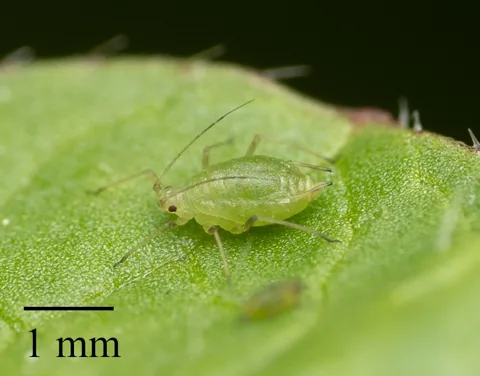 Aphids
Myzus persicae
Aphids are small, soft-bodied insects that pierce tender stems and leaves and suck out plant sap. Almost every plant hosts at least one aphid species, but established plants usually tolerate them, treating aphids for the plant's health is usually unnecessary, and natural enemies often bring numbers down.
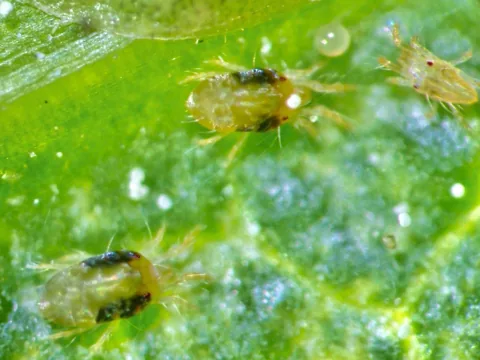 Spider Mites
Tetranychus urticae
Spider mites are tiny arachnids, relatives of spiders and ticks, that live in colonies on leaf undersides and suck out plant cells. The twospotted spider mite is the most important species in yards and gardens and on house plants, and Minnesota says it can infest over 200 species of plants.
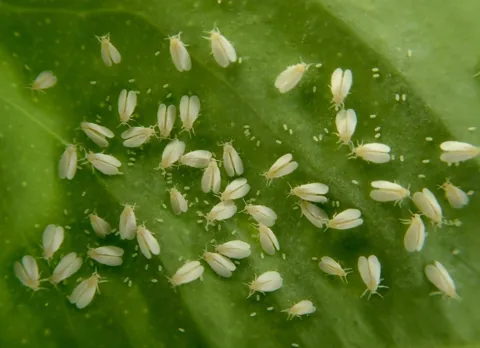 Whiteflies
Trialeurodes vaporariorum
Whiteflies are tiny sap-sucking insects that build large colonies on leaf undersides, especially in warm weather. Outbreaks usually follow disruption of their natural enemies, and heavy infestations are hard to control, so prevention matters most.
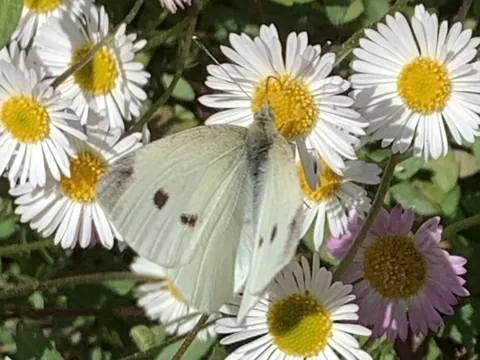 Imported Cabbageworm
Pieris rapae
The imported cabbageworm is the caterpillar of the familiar small white butterfly, the cabbage white. It chews ragged holes in cabbage, broccoli, cauliflower, kale and other cole crops, and it bores into heads as it grows.
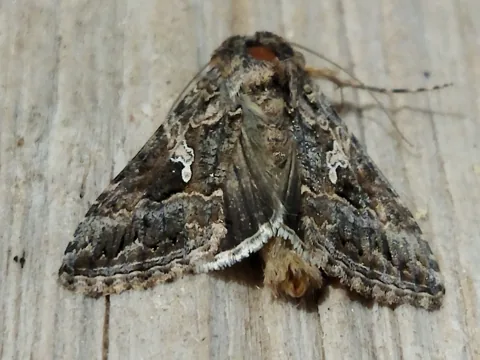 Cabbage Looper
Trichoplusia ni
The cabbage looper is the caterpillar of a gray-brown moth that flies mainly at night. It chews ragged holes in cabbage-family crops and many other vegetables and flowers, and it crawls by looping its body like an inchworm.
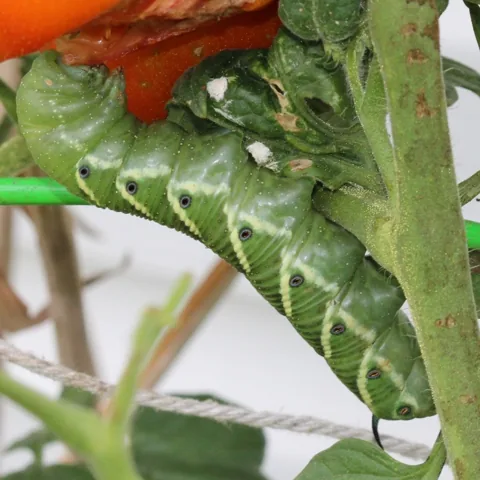 Tomato Hornworm
Manduca quinquemaculata
The tomato hornworm is one of the largest caterpillars in the vegetable garden, up to about 4 inches long, with a horn at its rear end. It chews leaves and fruit of tomato and related plants and can defoliate them quickly.
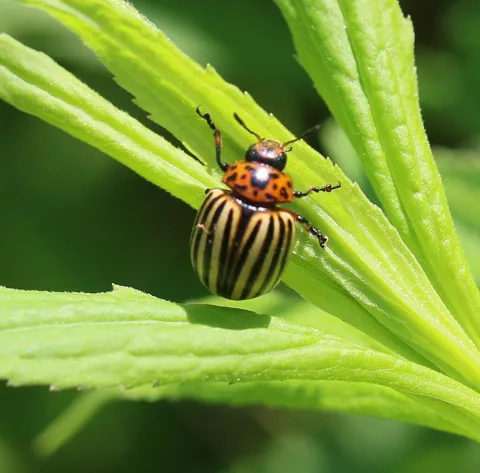 Colorado Potato Beetle
Leptinotarsa decemlineata
The Colorado potato beetle, the black and yellow-striped 'potato bug' of home gardens, is the most serious insect pest of potatoes. Adults and larvae eat the leaves of potatoes, eggplant and tomatoes and can strip plants completely.
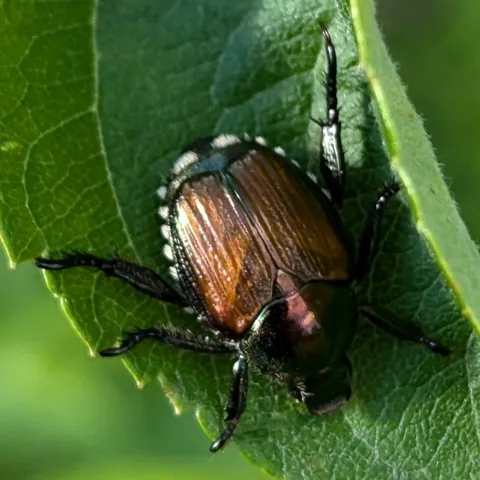 Japanese Beetle
Popillia japonica
The Japanese beetle damages landscapes twice: metallic green adults chew the leaves, flowers and fruit of hundreds of plants in early summer, and their white grubs feed on grass roots underground. A review of its biology calls it the most widespread and destructive insect pest of turf, landscapes and nursery crops in the eastern United States.
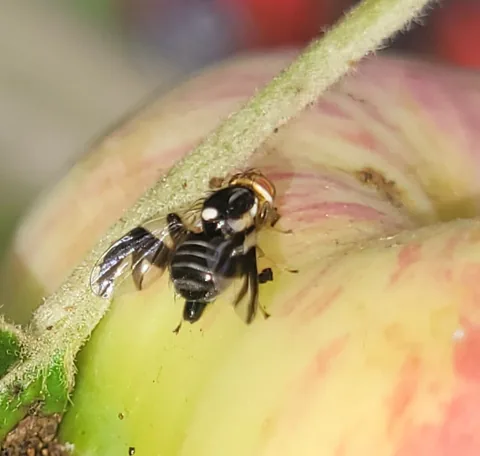 Apple Maggot
Rhagoletis pomonella
The apple maggot is a small fruit fly whose larvae tunnel through apples and leave brown, rotting trails. Minnesota Extension calls it the most important insect pest of Minnesota-grown apples, and Wisconsin's fruit specialists say few pests are as damaging to home apple growing.
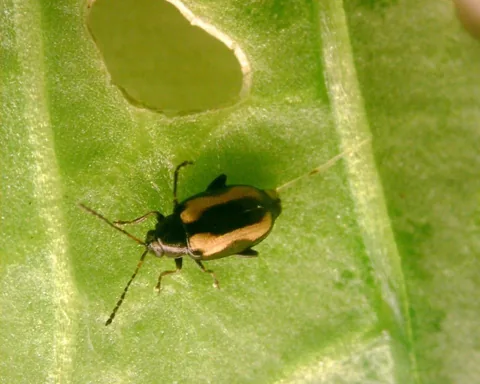 Flea Beetles
Phyllotreta striolata
Flea beetles are tiny, shiny beetles with enlarged hind legs that jump like fleas when disturbed. Adults chew small holes and pits in the leaves of radishes, cabbage and other crucifers, eggplant, potatoes, tomatoes and many other vegetables, and they do the most harm to seedlings in spring.
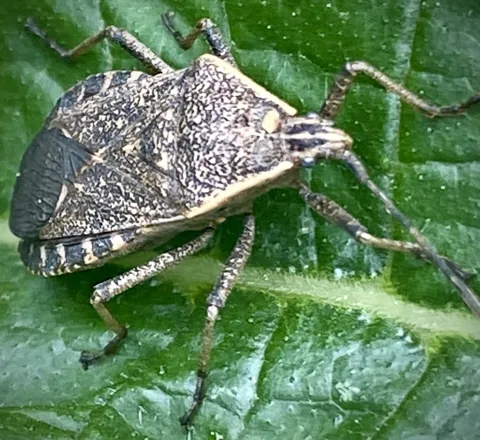 Squash Bug
Anasa tristis
The squash bug is a common vegetable garden pest that sucks sap from squash, pumpkins, melons and other cucurbits. Heavy feeding makes plants wilt and can kill young plants outright.
What "organic" means for pest control
In the U.S., "organic" for growing food is defined by the USDA National Organic Program. Its rules don't ban pesticides; they set an order. Growers must first use practices that prevent pests: crop rotation and soil management, sanitation that removes pest habitat, and plant species and varieties suited to the site and resistant to local pests. Pest problems may then be handled with natural enemies (released, or encouraged with habitat) and with lures, traps and repellents. Only when those are insufficient may a biological or botanical substance, or a synthetic substance on the National List, be applied.[1][5]
The National List of synthetic substances allowed as insecticides in organic crops includes insecticidal soaps and narrow-range horticultural oils (dormant, suffocating and summer oils), and the rule says those synthetics may only be used when the preventive and biological steps prove insufficient.[2]
- Organic food isn't necessarily pesticide-free. Pesticides allowed in organic farming are mostly made from natural substances such as minerals and plant extracts, but there are exceptions, and not every natural substance is allowed: arsenic, strychnine and tobacco dust (nicotine sulfate) are prohibited.[3]
- Organic doesn't automatically mean less toxic. Illinois Extension notes that some organic-approved products, such as kaolin clay or Bt, are very benign, while others have toxicity similar to synthetic insecticides; Arizona Extension reminds gardeners that insecticides derived from plants can harm people and non-target organisms, and that home remedies and do-it-yourself pesticides carry hazards too.[5][6]
- For a home garden the same order of operations is a good plan. It matches the integrated pest management (IPM) approach Arizona Extension describes, with chemical controls used after other methods have proven ineffective or damage continues.[6][1]
Start without a sprayer
These steps prevent damage or remove pests without any spray. Several of them have their own guides on this site; the short version is here.[1][6]
- Barriers and row covers. Floating row covers keep moths from laying eggs on cabbage-family crops, and Minnesota Extension uses them over potato rows to stop Colorado potato beetles feeding and laying eggs. Minnesota says to put them on before you see any beetles and to rotate the crop. Clemson notes screens or fine mesh netting also keep moths off small plantings. See the row cover guide for fabrics and pollination.[16][18][22]
- Handpicking. Clemson, Penn State, UC IPM and Minnesota Extension all list handpicking as effective in home gardens, especially for large, slow-moving pests such as hornworms, Colorado potato beetles, loopers and other caterpillars. Drop them in a bottle or pail of soapy water or crush them. Clemson suggests checking plants every few days so caterpillars are removed soon after they hatch.[21][23][16][17][18][22]
- Japanese beetles. Kentucky and Minnesota Extension say picking or shaking the beetles into a bucket of soapy water can protect small plantings, especially when numbers are low. For fruit crops, Minnesota suggests handpicking until the plant has finished blooming and started to set fruit, then covering it.[20][19]
- Pruning. UC IPM suggests pruning off rolled or webbed leaves along with handpicking leaf-feeding caterpillars; it says handpicking and natural enemies often provide enough control.[17]
- Natural enemies. The organic rule names releasing predators and parasites and creating habitat for natural enemies as ways to control pests, and Clemson notes beneficial insects help control aphids, leafminers and hornworms, so use insecticides only when necessary. Lady beetles, lacewings, parasitic wasps and the rest have their own guides here, including when buying and releasing them is worth it.[1][21]
- Traps and repellents. The organic rule also lists lures, traps and repellents. Trap crops and companion plants have their own guide on this site, which sorts out which claims research supports.[1]
Organic sprays with evidence behind them
Each of these is allowed in organic gardening in at least some formulations (check the label of the product you buy). None of them works on every pest, and most have to touch or be eaten by the insect. Each has a full page on this site with label details.[2][3][7][8]
- Bt (Bacillus thuringiensis). A soil bacterium whose crystal proteins kill only insects that eat them. Bt kurstaki (and aizawai) kills caterpillars of moths and butterflies such as cabbageworms, loopers, tent caterpillars and hornworms; Bt israelensis kills larvae of mosquitoes, black flies and fungus gnats; Bt tenebrionis and san diego strains target certain leaf beetle larvae such as Colorado potato beetle. It has to be eaten, young larvae are most affected, and death takes 1 to 5 days. Sunlight breaks it down quickly, so time sprays to when caterpillars are small and feeding, and expect to reapply. Because it is so selective, it doesn't harm many beneficial insects.[7][6][5][16][17]
- Spinosad. A mixture of spinosyns made by a soil bacterium, active on contact or when eaten. It controls caterpillars, thrips, leafminers, spider mites, fruit flies and others, and insects die within 1 to 2 days. Sunlight breaks it down on leaves, with half-lives of 2 to 16 days, so it lasts longer than Bt. It is broader than Bt: Illinois Extension says it spares many common beneficial insects, while UC IPM says it can have negative impacts on some beneficials. It is very highly toxic to bees while wet (see the bee section below).[8][5][17][16][6]
- Insecticidal soap. Potassium salts of fatty acids that kill soft-bodied pests (aphids, young scales, whiteflies, psyllids, mealybugs, thrips and mites) by disrupting cell membranes and stripping protective wax. The spray must wet the insect and has no effect once dry, so cover leaf undersides and repeat every 4 to 7 days if needed, as the label allows. Caterpillars, sawflies, beetle larvae and hard-bodied adults such as lady beetles and bees are generally not affected, though beneficial mites are. Clemson says to use a 1 to 2% solution or the label rate, avoid full sun and temperatures above 90°F, test a small area 24 hours ahead, and skip water-stressed plants; hard water can make the soap precipitate and stop working.[10][11][6]
- Horticultural oil. Highly refined oils (mostly petroleum-based, some plant-based) that kill mainly by blocking the breathing pores of aphids, mites, whiteflies, young scales, psyllids, leafhoppers, adelgids and some insect eggs. Dormant-season sprays on fruit and shade trees target overwintering scales, aphid eggs and mites; lighter summer oils can be used on foliage, including some flowers and vegetables. Oils leave little residue and pose few risks to beneficials not hit by the spray. Sources give slightly different temperature limits: UC Master Gardeners say between 40 and 90°F, Colorado State says not above 100°F or below freezing, adding that heat risk depends mostly on drought stress. Don't spray stressed plants or oil-sensitive species (Colorado State lists maples, especially Japanese and red, junipers, dwarf Alberta spruce, black walnut and redbud, among others), and don't combine oils with sulfur.[12][13][2]
- Neem oil and azadirachtin. Neem seed oil contains azadirachtin, which reduces feeding, repels and interferes with insect growth hormones; clarified neem oil without azadirachtin acts like other oils by smothering. Insects have to eat treated leaves to be affected, so NPIC says bees are not likely to be harmed. It breaks down fast: on leaves the half-life of azadirachtin is 1 to 2.5 days. Against Japanese beetles, Kentucky Extension says neem products deter feeding for about 3 to 4 days, and Minnesota says it works for several days but needs repeating and is less effective when beetles are numerous. Neem oil also helps against powdery mildew and rust.[9][6][20][19][12]
- Kaolin clay. A fine white clay sprayed on as a film that insects avoid: it is a physical barrier, masks the plant's color, and particles cling to insects and irritate them. Penn State reports it deters striped cucumber beetles if sprayed twice a week early in the season and describes an organic orchard where weekly sprays kept trees almost free of Japanese beetles; eXtension reports it controls apple maggot, white apple leafhopper and pear psylla and gives at least fair control of plum curculio and several fruit caterpillars. It leaves a chalky residue on produce that has to be washed or brushed off, and heavy use can harm beneficials and lead to flare-ups of European red mites or San Jose scale.[14][15][5]
Protecting bees and beneficial insects
Organic-allowed doesn't mean safe for pollinators and natural enemies. The products differ a lot.[5][6]
- Spinosad: very highly toxic to bees while wet, with little or no effect on honey bees and other beneficials once sprays have dried. Spray when bees aren't foraging; Illinois Extension suggests nighttime.[8][5][6]
- Soaps and oils: they kill any insect they wet, good or bad, but leave no active residue once dry. Spray only the plants that need it.[13][11][12]
- Bt: EPA concluded that the kurstaki, israelensis and tenebrionis strains are low in toxicity to bees. Some studies found effects on bumblebees and honey bees from Bt aizawai products, possibly caused by other ingredients in the products.[7]
- Pyrethrins, another botanical allowed in organic farming, kill a broad range of insects quickly, harm beneficial insects and are toxic to bees, so Arizona Extension advises applying them where and when bees and other non-target insects won't be exposed.[5][6]
- Kaolin is mild, but eXtension notes that heavy use in orchards harmed beneficial species and led to mite and scale outbreaks.[15]
Organic labels, OMRI lists and homemade sprays
Whether a product is allowed in organic growing depends on every ingredient, not only the active one. NPIC gives the example of a product with an approved active ingredient that would still not qualify because it contains a synthetic "other ingredient" such as petroleum distillates. So two products with the same active ingredient on the front can differ.[3]
- Label wording. EPA lets a registrant add language and a logo stating that all ingredients and uses meet the National Organic Program rule; the recommended logo reads "for organic production" and may carry the words "For Organic Gardening." The wording is voluntary, so a product without it may still be allowed.[4][3]
- Product lists. NPIC points to the Organic Materials Review Institute (OMRI) product lists as one place to check whether a product is allowed. Certified organic farms rely on their certifier; home gardeners can use the lists and the label.[3][4]
- Not a guarantee. Arizona Extension reports that a few neem products certified for organic farming were found to be contaminated with synthetic active ingredients, and the Oregon Department of Agriculture has issued stop-sale orders on 5 products containing azadirachtin since July 2017.[6]
- Homemade sprays. Colorado State Extension advises against using household dish soap or cleaning products as pesticides: they aren't formulated or tested for pests, the detergents can injure plants, and their use as pesticides is of questionable legality. Clemson says you could mix your own, but with a substantially increased risk of plant injury, and that laundry and dry dish detergents are far too harsh. The home remedies guide covers vinegar, garlic, pepper and other kitchen sprays.[11][10]
- Follow the label regardless: Arizona Extension advises protective gear and spraying when bees and other beneficials aren't present, even for home remedies and natural products, and notes that children may be especially sensitive to pesticides.[6]
Common questions
- Is organic pest control less toxic than regular insecticides?
- Not always. Some organic-approved products, such as kaolin clay and Bt, are very low in toxicity, while others are about as toxic as synthetic products. Pyrethrins and wet spinosad are toxic to bees. Read and follow the label for every product.[5][6][8]
- What is the best organic spray for caterpillars?
- Bt kurstaki, which kills only caterpillars that eat it and works best on small ones. Spinosad also works on caterpillars but affects more kinds of insects, including bees while wet. Handpicking is often enough in a small garden.[7][17][16][8]
- What organic spray works on aphids and spider mites?
- Insecticidal soap or horticultural oil, sprayed so it wets the pests, including leaf undersides. Both have to be repeated because they don't leave an active residue, and both can injure sensitive plants in heat.[10][11][12][13]
- Does neem oil hurt bees?
- NPIC says neem oil is practically non-toxic to bees, and because insects must eat treated plants to be affected, pollinators aren't likely to be harmed.[9]
- Can I use a product in my garden if it doesn't say organic?
- Yes, if it is labeled for your plant and pest. The organic wording on labels is voluntary, so a product without it may still meet the organic rules; NPIC points to the OMRI product lists as one way to check.[4][3]
- Does homemade soap spray work?
- Extension services disagree on how far to go. Colorado State says not to use household soaps or detergents as pesticides at all; Clemson says homemade mixes carry a substantially higher risk of plant injury than commercial insecticidal soap.[11][10]
Photo credits
- Aphids: Jesse Rorabaugh, public domain (CC0), via iNaturalist
- Spider Mites: (c) Mike Bowie, some rights reserved (CC BY) — via iNaturalist, CC BY 4.0
- Whiteflies: (c) Mike Bowie, some rights reserved (CC BY) — via iNaturalist, CC BY 4.0
- Imported Cabbageworm: (c) eebee, some rights reserved (CC BY) — via iNaturalist, CC BY 4.0
- Cabbage Looper: (c) SteveM4560, some rights reserved (CC BY) — via iNaturalist, CC BY 4.0
- Tomato Hornworm: (c) adam1420, some rights reserved (CC BY) — via iNaturalist, CC BY 4.0
- Colorado Potato Beetle: (c) Barry Cottam, some rights reserved (CC BY) — via iNaturalist, CC BY 4.0
- Japanese Beetle: (c) Emmett Collins-Sussman, some rights reserved (CC BY) — via iNaturalist, CC BY 4.0
- Apple Maggot: (c) Bex Goreham, some rights reserved (CC BY) — via iNaturalist, CC BY 4.0
- Flea Beetles: 螯蝦, public domain (CC0), via iNaturalist
- Squash Bug: Anne P, public domain (CC0), via iNaturalist
Sources
- U.S. Government Publishing Office (govinfo), “7 CFR 205.206: Crop pest, weed, and disease management practice standard (USDA National Organic Program; CFR 2025 edition).” www.govinfo.gov/content/pkg/CFR-2025-title7-vol3/xml/CFR-2025-title7-vol3-sec205-206.xml (accessed 2026-11-10)
- U.S. Government Publishing Office (govinfo), “7 CFR 205.601: Synthetic substances allowed for use in organic crop production (USDA National Organic Program; CFR 2025 edition).” www.govinfo.gov/content/pkg/CFR-2025-title7-vol3/xml/CFR-2025-title7-vol3-sec205-601.xml (accessed 2026-11-10)
- National Pesticide Information Center, “Pesticide Ingredients Used in Organic Agriculture (updated July 13, 2026).” npic.orst.edu/ingred/organic.html (accessed 2026-11-10)
- U.S. Environmental Protection Agency, “Labeling of Pesticide Products under the National Organic Program (PR Notice 2003-1).” www.epa.gov/pesticide-labels/labeling-pesticide-products-under-national-organic-program (accessed 2026-11-10)
- University of Illinois Extension, “Organic Pest Control (Ryan Pankau, The Garden Scoop, July 26, 2018).” extension.illinois.edu/blogs/garden-scoop/2018-07-26-organic-pest-control (accessed 2026-11-10)
- University of Arizona Cooperative Extension, “AZ1765: Alternative Pesticide Options for the Home Gardener (May 2018).” extension.arizona.edu/sites/default/files/2024-08/az1765-2018.pdf (accessed 2026-11-10)
- National Pesticide Information Center, “Bacillus thuringiensis (Bt) General Fact Sheet.” npic.orst.edu/factsheets/btgen.html (accessed 2026-11-10)
- National Pesticide Information Center, “Spinosad General Fact Sheet.” npic.orst.edu/factsheets/spinosadgen.html (accessed 2026-11-10)
- National Pesticide Information Center, “Neem Oil General Fact Sheet.” npic.orst.edu/factsheets/neemgen.html (accessed 2026-11-10)
- Clemson Cooperative Extension Home & Garden Information Center, “Insecticidal Soaps for Garden Pest Control (HGIC 2771, updated July 30, 2021).” hgic.clemson.edu/factsheet/insecticidal-soaps-for-garden-pest-control/ (accessed 2026-11-10)
- Colorado State University Extension, “Insect Control: Insecticidal Soap (Fact Sheet 5.547).” extension.colostate.edu/resource/insect-control-insecticidal-soap/ (accessed 2026-11-10)
- Colorado State University Extension, “Insect Control: Horticultural Oils.” extension.colostate.edu/resource/insect-control-horticultural-oils/ (accessed 2026-11-10)
- University of California Cooperative Extension, “Horticultural Oils for Insect Control (Contra Costa Master Gardener Program).” ucanr.edu/media/231948 (accessed 2026-11-10)
- Penn State Extension, “Particle Films as a Deterrent for Insect Pests (Thomas Ford, updated June 12, 2024).” extension.psu.edu/particle-films-as-a-deterrent-for-insect-pests (accessed 2026-11-10)
- eXtension Apples community of practice, “Can kaolin clay sprays reduce insect damage to apple fruit? (adapted from Cornell's Resource Guide for Organic Insect and Disease Management).” apples.extension.org/can-kaolin-clay-sprays-reduce-insect-damage-to-apple-fruit/ (accessed 2026-11-10)
- University of California Statewide IPM Program, “Loopers (Home and Landscape).” ipm.ucanr.edu/PMG/GARDEN/VEGES/PESTS/loopers.html (accessed 2026-11-10)
- University of California Statewide IPM Program, “Leaf-Feeding Caterpillars (Home and Landscape).” ipm.ucanr.edu/home-and-landscape/leaf-feeding-caterpillars/ (accessed 2026-11-10)
- University of Minnesota Extension, “Colorado potato beetle (reviewed 2026).” extension.umn.edu/garden-and-home/yard-and-garden/yard-and-garden-insects/colorado-potato-beetle (accessed 2026-11-10)
- University of Minnesota Extension, “Japanese beetles in yards and gardens.” extension.umn.edu/yard-and-garden-insects/japanese-beetles (accessed 2026-11-10)
- University of Kentucky Entomology, “ENTFACT-451: Japanese Beetles in the Urban Landscape (revised March 2026).” entomology.mgcafe.uky.edu/ef451 (accessed 2026-11-10)
- Clemson Cooperative Extension Home & Garden Information Center, “Tomato Insect Pests (HGIC 2218, updated May 23, 2025).” hgic.clemson.edu/factsheet/tomato-insect-pests/ (accessed 2026-11-10)
- Clemson Cooperative Extension Home & Garden Information Center, “Cabbage, Broccoli & Other Cole Crop Insect Pests (HGIC 2203).” hgic.clemson.edu/factsheet/cabbage-broccoli-other-cole-crop-insect-pests/ (accessed 2026-11-10)
- Penn State Extension, “Tomato Insect Pests in the Home Garden.” extension.psu.edu/tomato-insect-pests-in-the-home-garden (accessed 2026-11-10)