How to identify it
- Caterpillars are green and covered in fine hairs that give them a velvety look, often with a faint yellow-orange stripe down the back.[1][3]
- Full-grown caterpillars reach about 1 to 1 1/2 inches long and move slowly; they are sluggish compared with other cabbage caterpillars.[1][3][2]
- Wet green or greenish-brown droppings on leaves and inside heads are a telltale sign.[2][1]
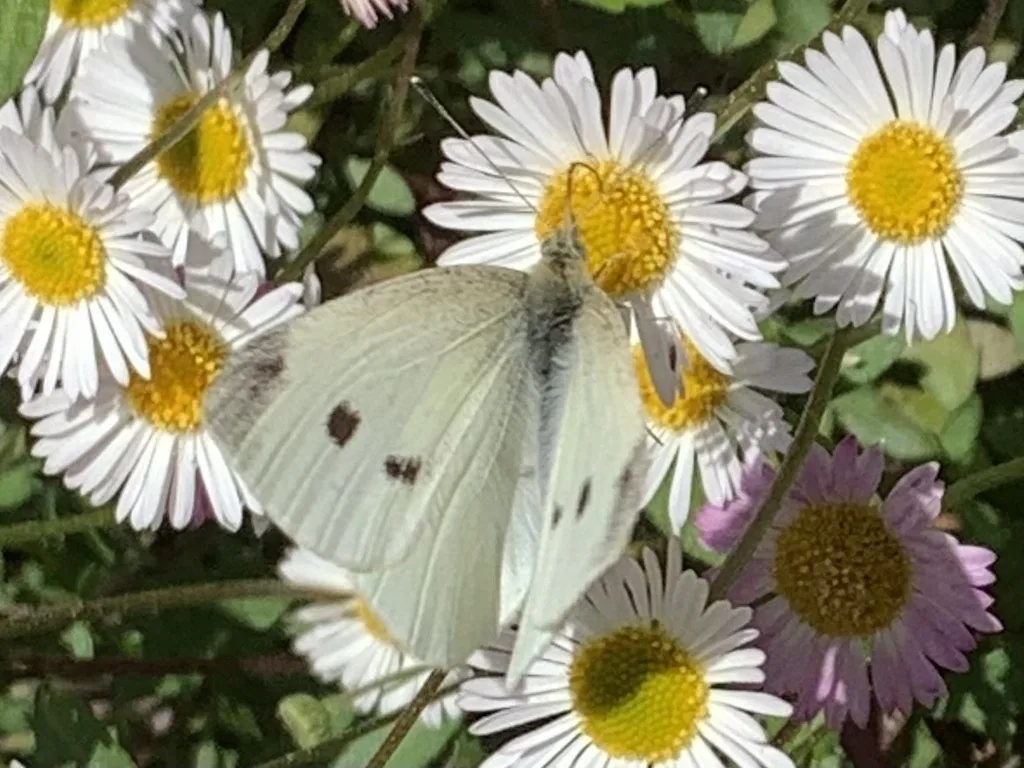
- The adult is a white butterfly, about 1 1/2 inches across, with dark forewing tips, one to four black spots on each forewing and yellowish wing undersides.[3][2][1]
- Eggs are tiny, pale and bullet-shaped, standing upright one at a time on leaves, usually on the underside.[2][1][3]
Look-alikes
| Look-alike | How to tell them apart |
|---|---|
| Cabbage looper | Cabbage loopers are smooth rather than fuzzy, grow to 1 1/2 to 2 inches, and arch their backs like an inchworm as they crawl.[2] |
| Diamondback moth caterpillar | Diamondback moth caterpillars stay under about half an inch, taper at both ends, and wriggle hard when touched instead of moving sluggishly.[2] |
Where it lives
A common pest of cole crops from New England and Maine to California, with several generations a year; in mild areas it can be active year-round where hosts grow.[2][3][1]
Biology and life cycle
Females fly by day and lay single eggs on host leaves, and the eggs hatch in about 5 to 7 days.[3][1]
Caterpillars feed for about 2 to 3 weeks, then form a green to brownish chrysalis attached to a leaf or other sheltered spot by a few silk threads.[1][3][2]
About ten days later a new generation of butterflies emerges; New England sees three to four generations, and Maine two or three.[3][2]
The insect passes the winter as a pupa, so garden debris left in fall can carry it into the next season.[3]
Damage and signs
- Caterpillars chew large, irregular holes in leaves, feed along the midrib and bore into cabbage heads, often from the bottom.[1][3]
- Seedlings can be badly damaged quickly, and heavy summer populations can leave plants unusable or kill them.[1][3]
- Droppings left in heads and florets soil the harvest and can stain cauliflower.[3][1]
- Before heads form, plants tolerate a fair amount of leaf feeding; once heading starts, even a few caterpillars matter.[1][2]
Health risk
Imported cabbageworms are plant feeders: the caterpillars eat cabbage, broccoli, cauliflower, kale, turnips, radishes, celery, parsley and mustard-family weeds, and the harm is to the crop.[2][3]
Control
Prevention
Cabbage varieties such as Early Globe, Red Acre and Round Dutch have shown some resistance to cabbageworm.[3]
Sanitation
Pull mustard-family weeds around the garden, and remove crop remains and till in fall to reduce overwintering pupae.[3][1]
Traps and physical control
Check leaf undersides and the center of each plant, especially as heads form; handpicking caterpillars takes effort but can cut numbers sharply.[2][3]
Biological control
Parasitic wasps, tachinid flies, egg parasites and natural viral infections all attack cabbageworms; avoid broad-spectrum sprays that kill these allies.[1][2]
Pesticides
Bacillus thuringiensis (Bt) works very well on young caterpillars and spares natural enemies; it is less effective in cool weather.[1][3]
Spinosad and insecticidal soap are other options named by extension; small caterpillars are the easiest to kill.[3][1]
Spray in late afternoon or early evening to limit exposure for bees, and follow the label for the crop.[3]
Common questions
- Are the white butterflies in my garden a problem?
- Yes, if you grow cabbage family crops. The white butterflies lay the eggs that become cabbageworms, so check plants for eggs and small caterpillars a few days after they appear.[1][3]
- What is the green slime and holes in my broccoli?
- Ragged holes plus wet green droppings point to imported cabbageworm; look for slow, velvety green caterpillars near the leaf midribs and center of the plant.[2][1]
- Is Bt safe to use on cabbageworms?
- Bt is the extension-preferred spray for cabbageworm because it targets caterpillars and avoids harming natural enemies; apply it while larvae are small.[1][3]
Sources
- University of California Statewide IPM Program, “Cole Crops Pest Management Guidelines: Imported Cabbageworm.” ipm.ucanr.edu/agriculture/cole-crops/imported-cabbageworm/ (accessed 2026-10-06)
- UMass Amherst Center for Agriculture, Food, and the Environment, “Imported Cabbageworm (vegetable fact sheet).” www.umass.edu/agriculture-food-environment/vegetable/fact-sheets/imported-cabbageworm (accessed 2026-10-06)
- University of Maine Cooperative Extension, “Pest Management Fact Sheet #5006: Imported Cabbageworm.” extension.umaine.edu/ipm/ipddl/publications/5006e/ (accessed 2026-10-06)
- iNaturalist, “Pieris rapae taxon page (order and family).” www.inaturalist.org/taxa/55626 (accessed 2026-10-06)