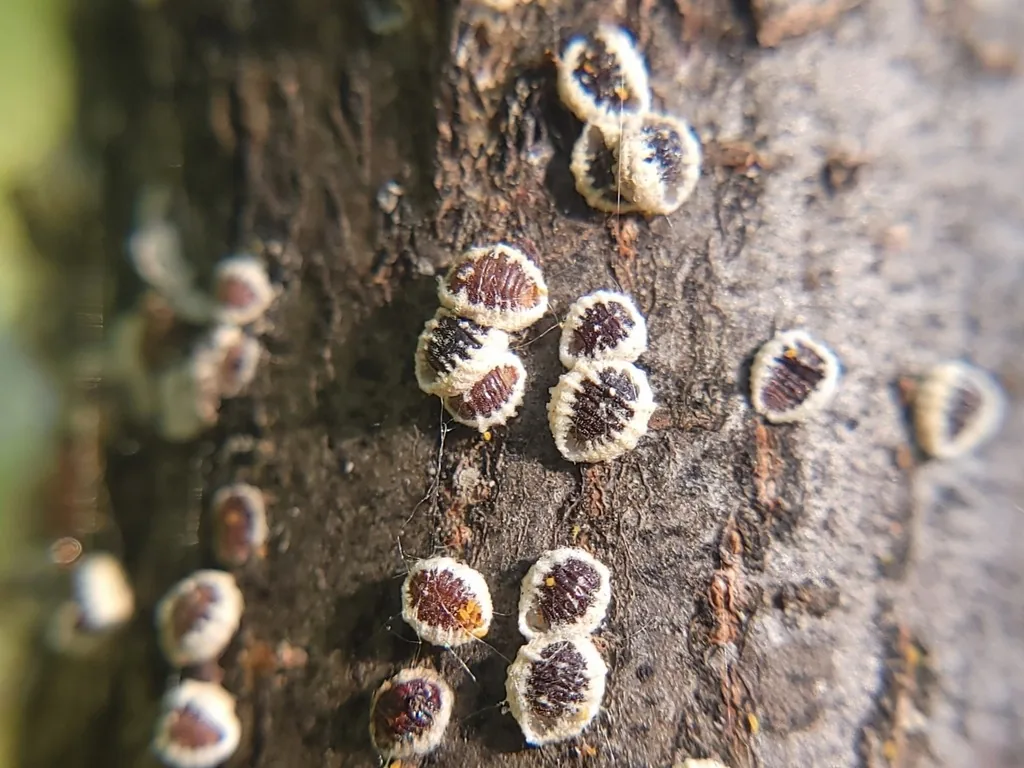
How to identify it
Look-alikes
Where it lives
The PNW Insect Management Handbook covers it on elms in the Pacific Northwest.[1]
Biology and life cycle
It overwinters as immature crawlers in bark crevices of small branches and in branch axils.[1]
Females lay eggs in spring; crawlers are active by June and move to leaf undersides for the summer, often dying when the leaves drop.[1]
There's one generation a year.[1]
Damage and signs
Health risk
It feeds on plants; the PNW Insect Management Handbook mentions no risk to people.[1]
Control
Prevention
Chinese elm and other Asiatic elms aren't infested, and Siberian elm resists it, though it's a poor shade tree.[1]
Keep trees healthy and avoid excess nitrogen fertilizer, which favors scale buildup.[1]
Traps and physical control
Prune out isolated infestations, and wrap tape near adult scales, sticky side out, to catch crawlers.[1]
Biological control
Lady beetles, green lacewings and parasitic wasps help control it; avoid broad-spectrum insecticides that kill them.[1]
Pesticides
Dormant-season sprays need enough water to cover the whole tree; growing-season sprays target crawlers, usually late spring to early summer.[1]
Common questions
Sources
- Pacific Northwest Pest Management Handbooks (OSU, WSU, University of Idaho), “Elm (Ulmus): European elm scale (Insect Management Handbook).” pnwhandbooks.org/insect/hort/landscape/hosts-pests-landscape-plants/elm-ulmus-european-elm-scale (accessed 2026-10-06)
- iNaturalist, “Gossyparia spuria taxon page (order and family).” www.inaturalist.org/taxa/1514433 (accessed 2026-10-06)