On this page
How to identify it
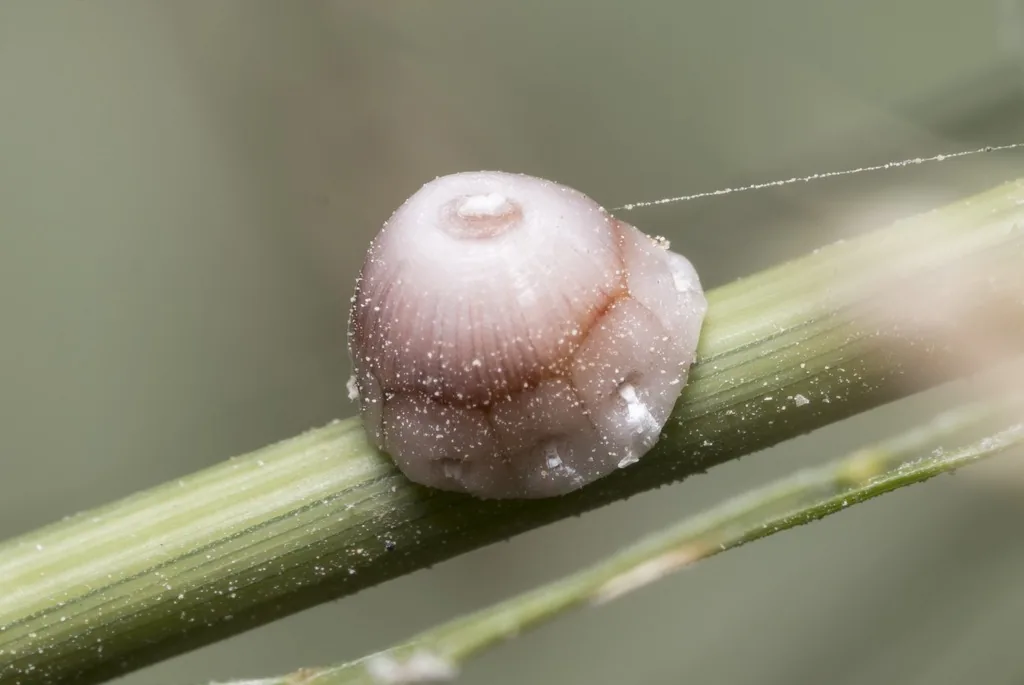
- The adult female is deeply encased in a hard, domed, broadly oval wax covering that is pinkish-gray to pale pink and sometimes almost pure white.[1][2]
- The wax is divided into plates: one large plate on top with a small dark center, three plates down each side, and more at the front and rear ends.[1][2]
- Thin dark red lines, the color of the scale's body showing through, separate the plates, and streaks of bright white wax run from the breathing pores on the sides.[1][2]
Look-alikes
| Look-alike | How to tell them apart |
|---|---|
| Red wax scale (Ceroplastes rubens) | Another introduced wax scale in Florida; its wax is pinkish to red and longer than wide, with two conspicuous pairs of white bands rather than a pattern of plates outlined in dark red.[6][1] |
Where it lives
It occurs across the Mediterranean region and has been recorded in parts of Africa, Asia, the Caribbean and South America, about 60 countries in all. In the United States it is known from Florida, where it has been identified in Broward, Dade, Manatee, Palm Beach, Pasco and Pinellas counties, and from a fig orchard in Fallbrook, California, found in 2024. An older Texas record was a quarantine interception, not an established population.[1][3][2]
Biology and life cycle
Its life cycle has not been studied in Florida. On fig trees in Israel, adult females spend the winter on twigs and lay eggs very early in spring, and the crawlers that hatch settle to feed on the leaves.[1]
After about a month the young scales molt and move to leaf stalks or new shoots, mature in summer and produce a second generation of crawlers, which mature late in fall and overwinter on the twigs.[1]
The number of generations varies by place: two a year have been recorded in Greece and one a year on figs in southern France.[2]
It feeds on plants in more than 90 genera. In Florida it has been found on ixora, sugar apple, mimusops and pygmy date palm; elsewhere its hosts include fig, citrus, mango, avocado, guava, banana, mulberry, oleander, pittosporum, English ivy and grape.[1][3]
Damage and signs
- It is a pest of figs in the Mediterranean region and of citrus in Italy, where infrequent but major local outbreaks have occurred; in Israel it is usually a minor citrus pest but occasionally a serious one.[1][2]
- The California infestation was considerable but was not causing significant damage to the fig trees.[2]
- In experiments it carried two grapevine leafroll viruses from infected to healthy vines, though far less efficiently than a mealybug tested alongside it.[4]
Health risk
The sources treat it only as a plant pest; none mentions bites or any risk to people or pets.[1][2]
Control
Prevention
Inspect plants now and then for scales, honeydew, sooty mold and ants. Before spraying, check whether many of the scales are already dead or parasitized; if they are, hold off and look again later.[5]
Traps and physical control
On small plants, prune off heavily infested twigs if the scales are limited to a few parts of the plant.[5]
Biological control
Parasitic wasps, including Coccophagus lycimnia and Scutellista cyanea, help keep fig wax scale in check, and lady beetle and syrphid fly larvae were attacking the California infestation.[1][2]
Ants that feed on scale honeydew protect scales from their natural enemies, so keep ants out of infested plants with sticky barriers on trunks or with insecticide baits.[5]
Pesticides
Outbreaks on citrus in Italy and Greece have been controlled with refined petroleum oils applied in summer. For garden plants, a thorough horticultural oil spray timed to when crawlers are active controls most scales.[1][5]
Common questions
- What are the pink, plated wax bumps on my ixora?
- In Florida, fig wax scale has been a pest mainly of ixora. Look for a hard, domed pinkish to white wax covering divided into plates by thin dark red lines.[1][2]
- Is fig wax scale in the United States?
- Yes. It has been in Florida since at least 1994 and was found outdoors in a fig orchard in San Diego County, California, in 2024.[1][2]
- Does fig wax scale hurt grapevines?
- It feeds on grape, and in laboratory tests it spread two grapevine leafroll viruses between vines, though only at low rates.[1][4]
Sources
- University of Florida IFAS Extension (EDIS Featured Creatures), “Fig Wax Scale, Ceroplastes rusci (L.) (EENY-187, 2001).” journals.flvc.org/edis/article/view/110437 (accessed 2026-11-09)
- ScaleNet (scale insect database begun at the USDA ARS Systematic Entomology Laboratory), “ScaleNet catalogue: Ceroplastes rusci (Linnaeus).” scalenet.info/catalogue/Ceroplastes%20rusci/ (accessed 2026-11-09)
- Society of Chemical Industry (Pest Management Science), “Current and future potential distribution of the invasive scale Ceroplastes rusci (Shan et al. 2023, Pest Management Science 79: 1184-1192; PubMed abstract).” doi.org/10.1002/ps.7290 (accessed 2026-11-09)
- American Phytopathological Society (Plant Disease), “Transmission of Grapevine Leafroll Viruses by Planococcus ficus and Ceroplastes rusci (Mahfoudhi et al. 2009, Plant Disease 93: 999-1002; PubMed abstract).” doi.org/10.1094/PDIS-93-10-0999 (accessed 2026-11-09)
- University of California Statewide IPM Program, “Pest Notes: Scales (UC ANR Publication 7408).” ipm.ucanr.edu/home-and-landscape/scales/ (accessed 2026-11-09)
- University of Florida IFAS Extension (EDIS Featured Creatures), “Red Wax Scale, Ceroplastes rubens Maskell (EENY-237, 2001).” journals.flvc.org/edis/article/view/108573 (accessed 2026-11-09)
- iNaturalist, “Ceroplastes rusci taxon page (order and family).” www.inaturalist.org/taxa/330198 (accessed 2026-11-09)