On this page
How to identify it
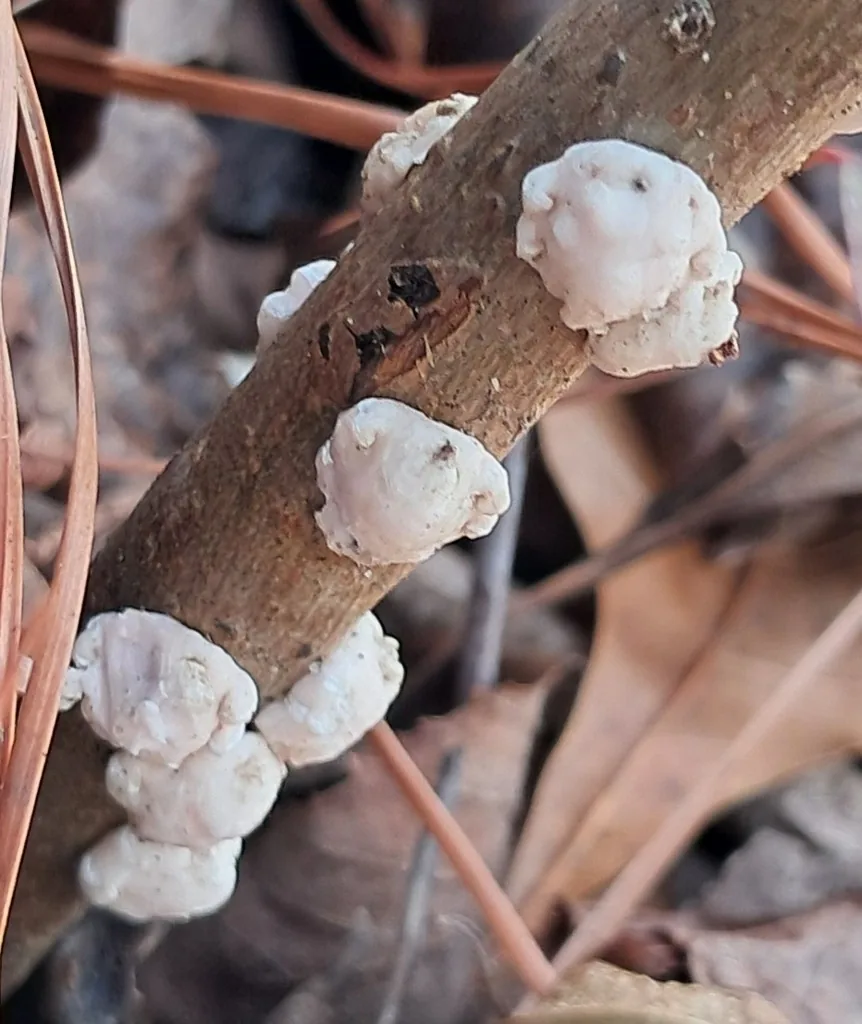
- Mature females are rounded to hemispherical white wax covers up to 1/4 inch (6 mm) across, reddish underneath; there are no males.[1][2]
- Young scales look like cameos, with white wax only partly covering the reddish body; crawlers are rusty red.[1][2]
- Bees, wasps, hornets and ants foraging in dense shrubs are often a clue, because they are drawn to the scale's honeydew.[1][2]
Look-alikes
| Look-alike | How to tell them apart |
|---|---|
| Florida wax scale | A related wax scale in the same genus with similar habits.[2] |
| Other soft scales | Lecanium and other soft scales lack the thick white wax dome.[1] |
Where it lives
A non-native pest found in Maryland, Georgia and the Southeast on landscape shrubs.[1][2]
Biology and life cycle
There is one generation a year; adult females overwinter on the bark.[1][2]
Crawlers hatch in early summer, around June in Maryland, about 1,145 degree days, when bottlebrush buckeye blooms and before mimosa flowers.[1][2]
All life stages are found mainly on twigs and small branches.[1][2]
Damage and signs
- It feeds on plants in 62 families, especially Chinese and Japanese holly, boxwood, euonymus, firethorn, camellia, spirea, flowering quince, barberry and beautyberry.[1][2]
- Light infestations produce honeydew and sooty mold; heavy or long-lasting ones cause yellowing, leaf drop, lost vigor and branch dieback.[1][2]
Health risk
None to people or pets.[1]
Control
Prevention
From May, check females every one to two weeks to find when eggs hatch, because the crawler window is short.[1][2]
Traps and physical control
Prune out heavily infested twigs and branches.[2]
Pesticides
Spray infested twigs thoroughly with horticultural oil, insecticidal soap or a contact or systemic insecticide while crawlers are present; dormant oil plus systemic or growth-regulating insecticides works best, and large populations may take more than a year.[1][2]
Common questions
Sources
- University of Maryland Extension (Home & Garden Information Center), “Indian Wax Scale (updated September 22, 2026).” extension.umd.edu/resource/indian-wax-scale (accessed 2026-10-16)
- University of Georgia Cooperative Extension, “Wax Scales (Japanese, Florida, or Indian wax scale) Ceroplastes spp. (Landscape Pest Management).” extension.uga.edu/programs-services/landscape-pest-management/pests-ornamental/wax-scales-japanese-florida-indian-wax-scale-ceroplastes.html (accessed 2026-10-16)
- iNaturalist, “Ceroplastes ceriferus taxon page (order and family).” www.inaturalist.org/taxa/387379 (accessed 2026-10-06)