On this page
How to identify it
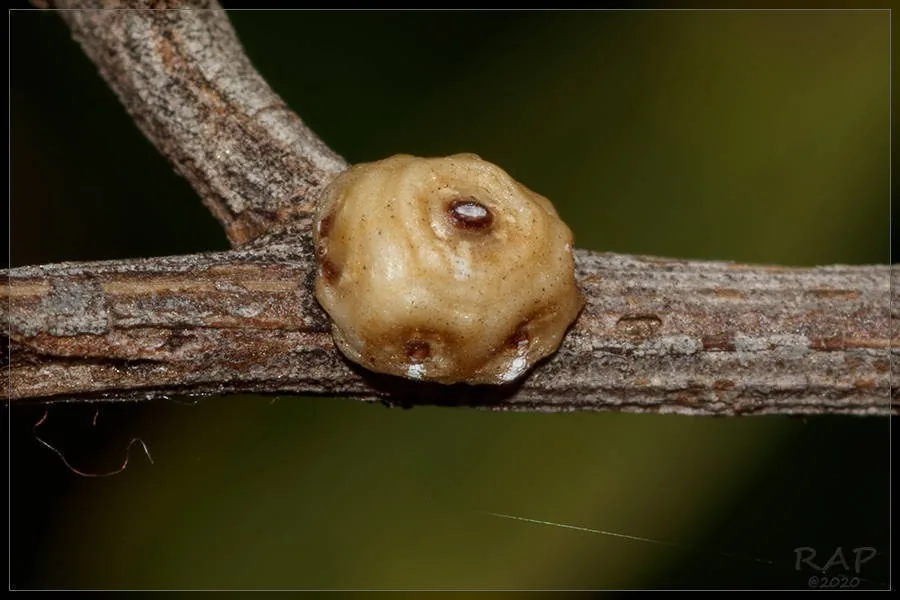
- Mature females are about 1/4 inch long, rounded and covered in thick, pearly-gray wax divided by shallow grooves into plates, each with a darker spot around a small wax button; the large rear plate has three buttons.[1][2]
- Nymphs are reddish and partly covered with pure white, star-shaped or conical wax plates; they feed on top of leaf veins before moving to the stems.[1][2]
Where it lives
It is a landscape pest from the Southeast, where gardenia is its most common host in North Carolina, to southern California, where it is mainly a pest of gardenia.[1][2]
Biology and life cycle
Adults are present on stems and twigs from late July through winter; each female lays hundreds of eggs under her wax.[1][2]
Crawlers probably emerge in late May to early June and settle on the tops of leaves, then move to stems after their second molt; there is one generation a year.[1][2]
It has been recorded on citrus, gardenia, guava, passion flower and plants in 119 genera and 63 families.[1]
Damage and signs
Health risk
It feeds only on plants; NC State and UC IPM mention no risk to people.[1][2]
Control
Biological control
Control ants on infested plants, since ants attack the natural enemies of scale insects.[2]
Pesticides
Time any spray for when crawlers are out on the tops of leaves in late May to early June; once settled under wax, scales are hard to reach. NC State notes related wax scale crawlers are highly susceptible to carbaryl (Sevin) and pyrethroid sprays.[1]
Common questions
- What are the gray, waxy bumps on my gardenia stems?
- Likely barnacle scales, soft scale insects under a thick, pearly-gray wax cover; gardenia is their most common host in North Carolina.[1]
- When should I spray for barnacle scale?
- When the crawlers hatch and move onto the leaves, around late May to early June; sprays do little once the scales are settled under their wax.[1]
Sources
- NC State Extension, “Barnacle Scale.” content.ces.ncsu.edu/barnacle-scale (accessed 2026-10-19)
- University of California Statewide IPM Program, “Wax scales (Home and Landscape).” ipm.ucanr.edu/home-and-landscape/wax-scales/ (accessed 2026-10-19)
- iNaturalist, “Ceroplastes cirripediformis taxon page (order and family).” www.inaturalist.org/taxa/120449 (accessed 2026-10-06)