On this page
How to identify it
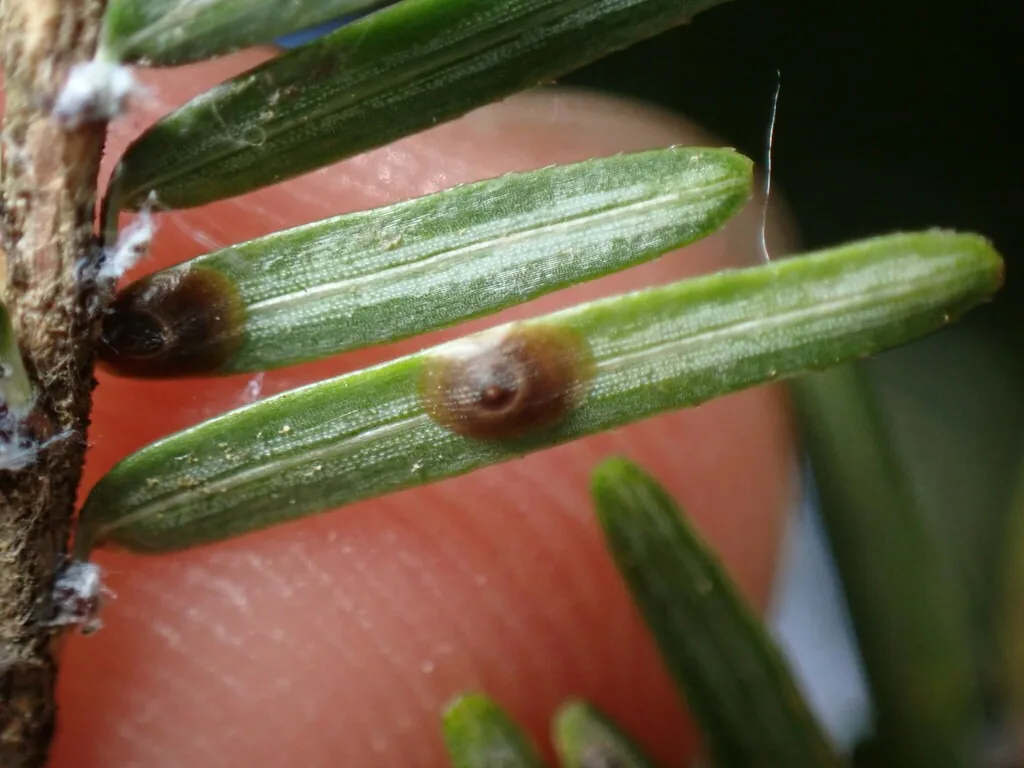
- The female's cover is circular, only 1 to 1.3 mm across, strongly convex and dark brown, with a pointed or nippled center usually hidden by secretion; rubbed, it shows a light resinous yellow. The male cover is the usual oval shape, much smaller, with an ashen central spot.[2]
- Scales sit on the underside of the needle, and when numbers are high the needles may be nearly coated. Infestations often go unnoticed until needles yellow and drop.[1]
- Look first at the young needles of the lower crown, which the scale tends to colonize first, and use magnification on the lower needle surface.[1]
- Easily confused with the native hemlock scale (Hemiberlesia ithacae); the hemlock scale's female cover is larger, about 2 mm, dark brown-gray and circular to oval.[1][3]
Look-alikes
| Look-alike | How to tell them apart |
|---|---|
| Hemlock scale | A native armored scale on the same hosts with a circular to oval, dark brown-gray female cover about 2 mm across. The shortneedle evergreen scale is smaller (1 to 1.3 mm), strongly convex and dark brown with a nippled center.[3][2] |
| Elongate hemlock scale | Another armored scale of hemlock needles; UMass warns against confusing the two, and on native hemlock the elongate hemlock scale may outcompete the shortneedle evergreen scale.[3][1] |
Where it lives
Native to Japan, with records from Japan, Russia's Far East and South Korea. In the United States it is recorded from Connecticut, Maryland, New Jersey and Rhode Island, with New York reported by UMass and a 2017 confirmation from Barnstable County, Massachusetts.[2][1]
Biology and life cycle
Hosts include eastern hemlock and the Japanese hemlocks, firs, spruces (including white spruce), Korean pine, Japanese yew, cedar and false cypress.[1][2]
Two generations a year are reported in Connecticut. Second-instar nymphs overwinter; adults are reported in April and first-generation eggs lie under the female's cover by early May. Crawlers are out from late May to early July, and a second generation of eggs in early August produces crawlers from early August to early November.[1]
Females have three developmental stages and males five. Natural enemies include the aphelinid wasp Encarsia citrina (long known as Aspidiotiphagus citrinus), another Encarsia and several encyrtid wasps, but on ornamentals the parasitoids are rarely numerous enough to hold the scale down.[1][2]
Nitrogen fertilization of infested hemlocks increased scale populations in Connecticut research, and in Japan trees stressed by poor growing conditions are most affected.[1]
Damage and signs
- Feeding through piercing-sucking mouthparts drains needle fluids. Needles yellow and drop early, and heavy infestations can kill trees; it has historically been a severe pest of native hemlock in Connecticut and a serious pest of eastern hemlock in the Northeast, and damage to spruce has been reported in Rhode Island.[1][2]
- Japanese hemlock species tend to carry higher populations than native hemlock.[1]
Health risk
Neither source mentions any effect on people or pets; this is a plant pest fixed to conifer needles.[1][2]
Control
Prevention
Avoid nitrogen fertilizer on infested hosts, since it increased scale numbers on hemlock in Connecticut trials. Inspect the lower crown of hemlocks, spruces, firs and yews with a hand lens before symptoms appear.[1]
Traps and physical control
A strong stream of water will not dislodge these tightly attached scales. If the infestation is caught early on one or a few branches, cut them out and burn them where that is allowed; do not pile them in compost or yard waste near susceptible hosts.[1]
Biological control
Parasitic wasps attack the scale but rarely in numbers that keep it low on ornamentals. Choose treatments that spare them; broad-spectrum insecticides kill natural enemies too.[1]
Pesticides
The waxy cover shields the scale from contact sprays, so treatments target the crawlers; late June to early July has been the best window in Connecticut, though crawlers are out for weeks and peak timing varies by site. A single April dormant oil application reduced populations in Connecticut research, with mixed reports since. Massachusetts lists horticultural oil, insecticidal soap, neem oil, azadirachtin, buprofezin, pyriproxyfen and systemics such as dinotefuran, imidacloprid and acetamiprid among the options; apply after bloom to protect pollinators, and note that neonicotinoids are state-restricted for trees and shrubs in Massachusetts.[1]
Common questions
- My hemlock's lower needles are yellowing and dropping, and the undersides are crusted with tiny dark bumps. Which scale is it?
- Tiny (1 to 1.3 mm), strongly convex, dark brown covers with a nippled center point to the shortneedle evergreen scale, which colonizes the lower crown first. The native hemlock scale is larger, about 2 mm, and dark brown-gray.[2][1][3]
- When should I spray?
- Aim at the crawlers, which cannot be reached once they settle and build a cover. In Connecticut the best window has been late June to early July, with a second crawler run from early August into fall; an April dormant oil treatment has also reduced populations.[1]
- Can I just hose the needles off?
- No. These armored scales adhere tightly and cannot be washed off. Prune and destroy infested branches if the problem is still local, and avoid nitrogen fertilizer, which favors the scale.[1]
Sources
- UMass Extension Landscape, Nursery and Urban Forestry Program, “Dynaspidiotus (formerly Nuculaspis) tsugae, shortneedle evergreen scale, Professional Insect & Mite Management Guide for Woody Plants.” www.umass.edu/agriculture-food-environment/landscape/publications-resources/insect-mite-guide/dynaspidiotus-tsugae (accessed 2026-11-10)
- ScaleNet (scale insect database begun at the USDA ARS Systematic Entomology Laboratory), “ScaleNet catalogue: Dynaspidiotus tsugae (Marlatt, 1911).” scalenet.info/catalogue/Dynaspidiotus%20tsugae/ (accessed 2026-11-10)
- UMass Extension Landscape, Nursery and Urban Forestry Program, “Hemiberlesia (formerly Abgrallaspis) ithacae, hemlock scale, Professional Insect & Mite Management Guide for Woody Plants.” www.umass.edu/agriculture-food-environment/landscape/publications-resources/insect-mite-guide/hemiberlesia-formerly-abgrallaspis-ithacae (accessed 2026-11-10)
- iNaturalist, “Dynaspidiotus tsugae taxon page (order and family).” www.inaturalist.org/taxa/994356 (accessed 2026-11-10)