On this page
How to identify it
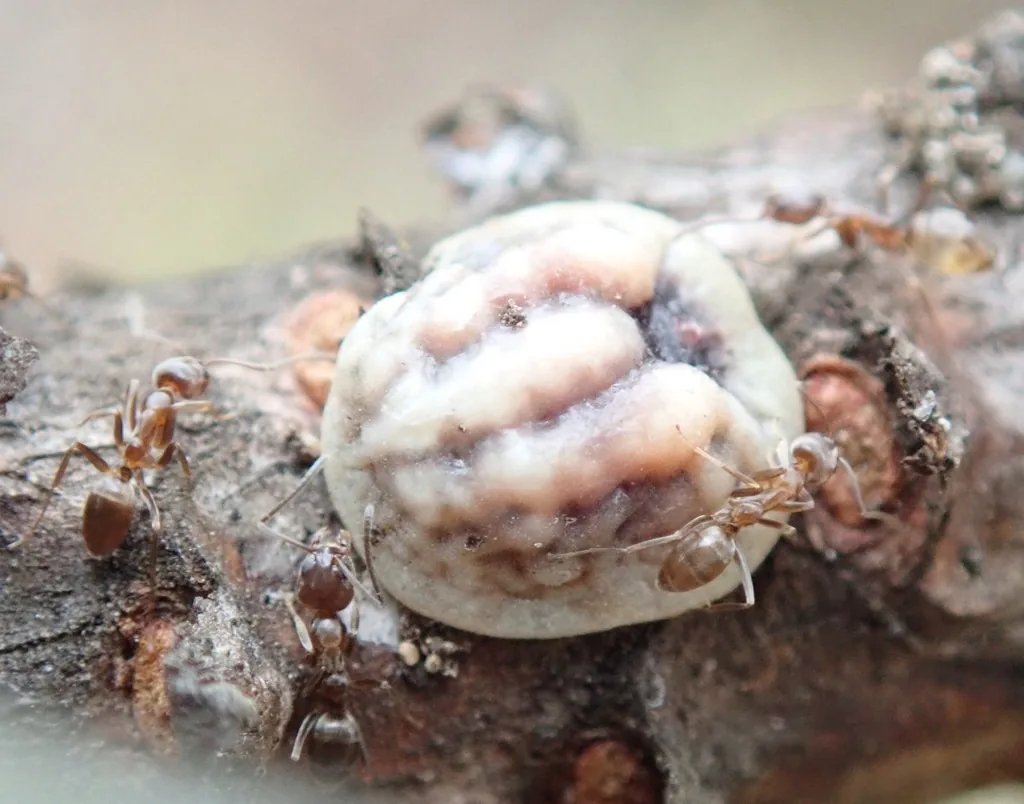
- Adult females are about 1/4 inch long, irregularly dome-shaped with a rough, wrinkled surface, and have no obvious legs.[1][2]
- They are yellowish-white mottled with brown and gray, sometimes pink, but often look black under a coat of sooty mold.[1]
- Male cocoons, often in large numbers on the needles, look like grains of rice: elongate, somewhat flattened, with a raised ridge from end to end.[1]
- Crawlers are flat, oval and orange to yellow, and show up on needles from late winter through spring.[1]
Look-alikes
| Look-alike | How to tell them apart |
|---|---|
| Monterey pine scale (Physokermes insignicola) | Also on pines and found mostly in the San Francisco Bay Area, it is darker, less irregular and more spherical than irregular pine scale, and does little or no damage.[1] |
| Pine tortoise scale | A related Toumeyella soft scale that also infests pines and resembles irregular pine scale; irregular pine scale is known only from California.[1][2] |
| Pine needle scale | This armored scale looks like the male cocoons of irregular pine scale, but it never forms the dark, rounded females found on the twigs.[1] |
Where it lives
Irregular pine scale is known only from California. Its crawlers hatch from February through May in Southern California and from late April through June in the San Francisco Bay Area.[2][1]
Biology and life cycle
It has one generation a year. Immature females spend the winter on 1- or 2-year-old shoots, usually in colonies blackened by sooty mold and crusted with honeydew.[1]
Females mature and start producing eggs in late winter, and each can lay up to 1,000 eggs over her life.[1]
Crawlers that will become males mostly settle on the needles, while future females settle and feed on young shoots.[1]
Pines are its hosts, Monterey pine above all. Ants come to the honeydew and attack the parasitic wasps and predators that would otherwise help control the scale; one parasitic wasp recorded from it is Coccophagus lycimnia.[1][2]
Damage and signs
- The scales suck sap from needles and small twigs and excrete large amounts of honeydew, and the sooty mold that grows on it can completely cover the female scales.[1]
- Prolonged feeding by heavy populations can all but stop a pine from producing new shoots. Large infestations turn needles yellow or brown and make them drop early, which can seriously weaken trees and sometimes kill young pines.[1]
Health risk
The sources treat it only as a plant pest; none mentions bites or other risk to people or pets.[1][2]
Control
Traps and physical control
Where the scale has been abundant and damaging, time sprays by watching for crawlers: wrap several infested twigs with double-sided sticky tape and check and replace it weekly, or inspect foliage weekly with a hand lens, starting in February in Southern California or April in Northern California.[1]
Biological control
Parasitic wasps and predators help control the scale, but ants that come to feed on the honeydew attack them.[1]
Pesticides
Thoroughly spray the shoot tips with horticultural oil when crawlers first become abundant, and again about 3 weeks later.[1]
For large trees, or where spray drift would be a problem, a systemic insecticide such as imidacloprid can be applied in late winter, preferably as a soil drench around the base of the trunk as the label directs. Read the label and wear the protective equipment it requires.[1]
Common questions
- What are the rice-like white specks all over my pine needles?
- Masses of small, elongate white cocoons with a ridge down the middle are the male cocoons of irregular pine scale; look for the lumpy females on the nearby twigs.[1]
- Can irregular pine scale kill my pine?
- Heavy, long-lasting infestations can nearly stop new shoot growth and cause heavy needle drop, which seriously weakens trees and sometimes kills young pines.[1]
- When is the best time to spray?
- When crawlers first become abundant, which is February through May in Southern California and late April through June in the Bay Area; use horticultural oil and repeat about 3 weeks later.[1]
Sources
- University of California Statewide IPM Program, “Irregular Pine Scale (Home and Landscape).” ipm.ucanr.edu/home-and-landscape/irregular-pine-scale/ (accessed 2026-11-09)
- ScaleNet (scale insect database begun at the USDA ARS Systematic Entomology Laboratory), “ScaleNet catalogue: Toumeyella pinicola Ferris.” scalenet.info/catalogue/Toumeyella%20pinicola/ (accessed 2026-11-09)
- iNaturalist, “Toumeyella pinicola taxon page (order and family).” www.inaturalist.org/taxa/1448625 (accessed 2026-11-09)