The short answer
- Confirm it first. HWA leaves round, white, cottony masses at the base of the needles on the undersides of branches, easiest to see from late fall through spring. If you find none, don't treat; check the trees again a few times a year.[1][4][7]
- If a hemlock you value is infested, treat it. Without treatment, Michigan DNR says infested trees are likely to die within four to 10 years; UMass says stressed trees may die in 3 to 5 years, while healthy trees on good sites may last 7 to 10 years before showing decline.[1][12]
- Imidacloprid is the long-lasting choice: slow to reach the canopy but protective for years. Dinotefuran works within weeks but lasts only about one to two years, so it is used for heavily infested or declining trees, sometimes mixed with imidacloprid.[1][4][5][16]
- Apply systemics in spring or fall when the soil is moist, not frozen, waterlogged or in drought. Check your state's rules first: in New York, homeowners may no longer apply these insecticides themselves and must hire a licensed applicator.[4][5][1][10]
- Check for elongate hemlock scale too. It often shares the tree, and imidacloprid does not control it; dinotefuran does.[14][11]
- Biological control is being released on public land, not sold for yards, and it is not yet enough to save individual trees. Remove trees that are dead or close to it, especially where they could fall on buildings, paths or roads.[7][3][1][8]
Hemlock pests
 Hemlock Woolly Adelgid
Adelges tsugae
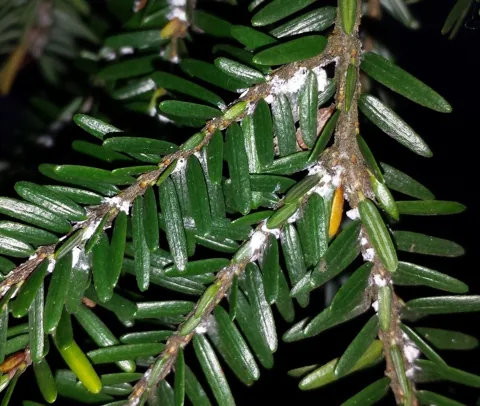
The hemlock woolly adelgid is a tiny, sap-feeding relative of aphids from Asia that lives on hemlock twigs at the base of the needles. It has killed millions of eastern and Carolina hemlocks, but landscape trees can be saved when it is found early and treated.
 Elongate Hemlock Scale
Fiorinia externa
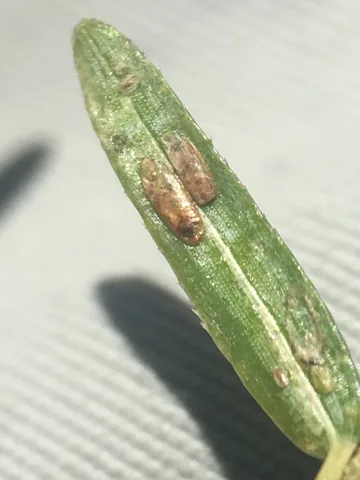
Elongate hemlock scale is an invasive armored scale from Japan that yellows evergreen needles, causes needle loss and dieback, and can kill heavily infested trees. Penn State calls it a serious pest of ornamental and forest hemlocks.
No photo yet
Hemlock scale
Hemiberlesia ithacae
The hemlock scale is a native armored scale with a round, dark cover about 2 mm across. It feeds on the undersides of needles, hemlock first of all but also spruce, fir, Douglas-fir and pine, and the first sign is often a small yellow spot on the upper side of the needle. Four to six scales on a needle are enough to yellow it and make it drop. It is easy to confuse with the elongate hemlock scale and the introduced shortneedle evergreen scale, which share its hosts.
No photo yet
Hemlock Rust Mite
Nalepella tsugifoliae
The hemlock rust mite is a microscopic, four-legged eriophyid mite that feeds on hemlock needles in spring, turning heavily infested foliage grayish or bluish, then yellow, before needles drop.
 Hemlock Looper
Lambdina fiscellaria
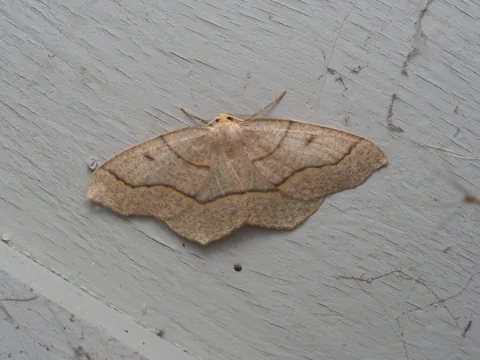
The hemlock looper is a native inchworm that defoliates hemlock and balsam fir, and in an outbreak it can kill hemlock after a single year of defoliation.
No photo yet
Hemlock sawfly
Neodiprion tsugae
The hemlock sawfly is a native defoliator of western hemlock in the Pacific coastal forests of Oregon, Washington, British Columbia and southeast Alaska, with interior populations in British Columbia, northeast Washington, Idaho and Montana. Its larvae feed in groups on older needles, and in outbreak years, such as the 2018 to 2019 outbreak in southeast Alaska, they can strip the old foliage from whole hillsides of hemlock.
 Balsam Woolly Adelgid
Adelges piceae
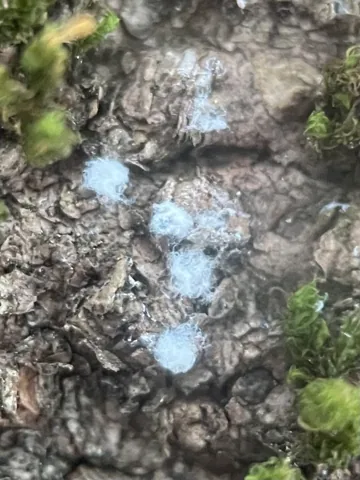
The balsam woolly adelgid is a tiny, all-female insect that feeds on the bark of true firs; infested trees swell at nodes and branch tips, thin out and can die.
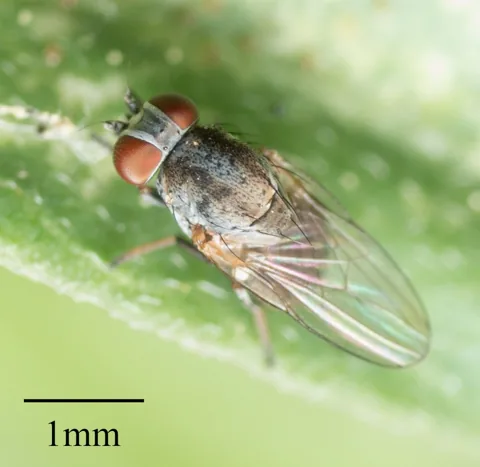 Aphid Flies (Silver Flies)
Chamaemyiidae (e.g., Leucopis, Leucotaraxis)
Aphid flies (family Chamaemyiidae) are tiny, often silvery-gray flies whose larvae eat aphids, adelgids, mealybugs and scale insects. They are beneficial predators in gardens and forests. Two western species, the silver flies Leucotaraxis argenticollis and L. piniperda, have been approved for release in the eastern United States to fight hemlock woolly adelgid.
Step 1: Is it really hemlock woolly adelgid?
Look on the underside of the outer twigs, at the point where each needle attaches. The adelgid itself is tiny: Kentucky and NC State Extension describe it as a 1/32-inch, reddish-purple insect, and Penn State says the overwintering females are black, oval and about 2 mm long. What you actually notice is the white wax it makes. NC State says infested branches become covered with 1/8-inch round, fluffy white masses that look like small cotton balls lined up along the twig.[10][16][13][12]
Timing matters. The wool is easiest to see from late fall through spring. From midsummer until mid-autumn the young adelgids are dormant, smaller than a sesame seed and almost impossible to see, so a summer inspection can miss an infestation. Penn State notes the white masses can persist into the following year even after the insects are dead, so wool alone does not prove a current, live infestation on a tree that was treated.[7][13]
Check several twigs on all sides of each tree, and every hemlock in a group. Vermont's forest health program notes that light infestations are hard to detect and may be concentrated at the tops of a few trees or on scattered branches.[4][2]
- Damage signs: HWA feeding reduces new shoot growth and causes grayish-green foliage, early needle drop, thin crowns, branch tip dieback and eventually death.[10][16][13]
- Hosts: eastern (Canada) hemlock and Carolina hemlock are the trees at risk in the East. UMass says western and mountain hemlock are highly resistant, though stressed trees can still succumb.[12][10]
- Don't mail or move branch samples. Michigan asks people to report a suspected find with photos and the tree's location instead of clipping and shipping branches, which could spread the insect. Your state forestry agency or extension office can confirm an ID.[1]
Step 2: Check for elongate hemlock scale as well
Elongate hemlock scale is a separate invasive pest, an armored scale insect, and Penn State says it is frequently found on the same hemlock as HWA. It matters for the treatment decision because the two pests respond to different insecticides.[14][11]
Look on the underside of the needles rather than at the needle base. Female scales are flat, elongate and light yellow-brown to brownish orange, about 1.5 mm long according to Penn State (University of Kentucky gives about 1/20 inch); males are smaller with white covers. Infested needles develop yellow spots or bands on the upper surface, then drop, and the crown thins.[14][11]
Penn State warns that waxy strands from settled scale crawlers can be thick enough to make the underside of the needles look white, which leads people to misdiagnose it as HWA. HWA wool sits as round tufts at the needle base on the twig; scale covers sit flat along the needle.[14][1]
- Imidacloprid will not control elongate hemlock scale, according to University of Kentucky. Dinotefuran, applied to the foliage or as a basal trunk spray from May into the fall, does.[11]
- Crawler sprays are the other option. Penn State says crawlers are most abundant from late May through early June, with a second spray in early July if needed; repeat applications may be needed until mid-September because all life stages overlap. University of Kentucky lists horticultural oil and contact insecticides for crawlers from June into September, and buprofezin, an insect growth regulator, when crawlers peak from May into July.[14][11]
- For more on scale biology and crawler timing, see the elongate hemlock scale profile and the scale insect guide linked below.[14][11]
Step 3: Is the tree healthy enough to save?
Systemic insecticides only work if the tree can still move water and sap up into the crown. Vermont's forest health program says systemic treatments are well suited to trees still healthy enough for good water movement, and UMass warns that on a tree infested for several years, imidacloprid may not work well because the tree's vascular system may be too damaged to carry it where it is needed.[2][12]
Trees that are thinning are not necessarily lost. The New York State Hemlock Initiative says that in many cases trees with thinned canopies can be brought back to full health. University of Kentucky cites residential research in which treated trees with little new growth but no dieback recovered most quickly, and trees in the poorest condition also recovered, but more slowly.[4][10]
- Best candidate: some new shoot growth and no branch dieback. These trees recovered fastest after treatment in the research Kentucky cites.[10][2][4]
- Declining tree you want to keep: thin crown, grayish foliage, little new growth. Cornell says dinotefuran is most useful for older trees or trees with severe crown decline that may not survive another season of HWA, and Michigan DNR calls it ideal for heavily infested trees because it moves quickly.[4][1]
- Poor candidate: a tree infested for years with heavy dieback. UMass says imidacloprid may not move through a badly damaged tree, and Michigan DNR warns weakened trees become a hazard in storms; see the removal section below.[12][1]
- Help any tree you keep: water during drought, mulch properly and avoid mower and string-trimmer wounds. Don't fertilize infested hemlocks; Vermont and Kentucky both say extra nitrogen favors the adelgid.[2][10]
Step 4: Decide which trees to treat
You may not be able to treat every hemlock. Product labels often limit how much imidacloprid can go on an acre per year, so Michigan DNR and Penn State Extension both point out that protecting a whole wooded lot at once is often impossible. Some owners stage treatments over several years or hire a professional.[1][15][2]
Start with the trees that matter most to you: high-value yard trees, trees that keep a stream cool and shaded, and trees that would become a hazard near a building or trail as they die. The New York State Hemlock Initiative publishes a landowner prioritization toolkit built around those kinds of values.[8][15][2]
Plan for all the hemlocks on the property over the next few years. Michigan DNR says that once HWA is on a site, hemlocks without symptoms are very likely to become infested, including the neighbors' trees, so it is worth talking to neighbors about treating together.[1]
Step 5: Treatment options by active ingredient
Two systemic insecticides are the standard tools for HWA: imidacloprid and dinotefuran. They are sold under many trade names, so read the label for the active ingredient and for hemlock woolly adelgid as a listed pest. Both are neonicotinoids; see the imidacloprid and dinotefuran pages for toxicity and environmental details.[1][5][15]
- Imidacloprid: slow to act but long-lasting. Cornell says it can take up to a year to become fully effective in the canopy, and Michigan DNR says at least a year to reach the top of a large tree. Smaller trees respond sooner: UMass says a soil application may take 8 to 12 weeks to reach the adelgids, and University of Kentucky says at least 30 days. Once active, adelgids die as they feed and new ones cannot recolonize the tree.[6][1][12][10]
- Dinotefuran: fast but short-lived. Cornell says it reaches the canopy within two to three weeks and lasts about a year; Michigan DNR says one to two years. It also controls elongate hemlock scale. In New York it may only be applied by certified applicators, as a basal bark spray.[4][1][11][5]
- Both together: Cornell describes a tank mix of imidacloprid and dinotefuran applied as a basal bark spray, giving fast knockdown plus long protection. This is a professional application.[5]
- Horticultural oil and insecticidal soap: contact sprays that kill the adelgids they wet, with no lasting residue. They suit small trees and hedges a homeowner can reach and cover completely; tall trees need high-pressure equipment. Vermont and Kentucky say they have low toxicity to people and non-target organisms.[10][2][12]
- Other insecticides such as bifenthrin and permethrin can also be applied as foliar sprays, but Vermont's forest health program warns they kill beneficial insects and lead to more spider mites and hemlock rust mites.[2]
How systemics are applied, and who can do it
Rules differ by state, so check before you buy. Michigan DNR says many landowners can apply garden-store imidacloprid or dinotefuran products to the soil themselves. Cornell's New York State Hemlock Initiative says that as of July 2025, New York homeowners are no longer permitted to apply these insecticides and must hire a licensed applicator. In a Penn State Extension video, a forester says forest owners can buy both and do not need a license to apply them. Your state extension office or department of agriculture can tell you what applies to you.[1][5][7][15]
- Soil drench: the product, mixed at the label rate for the tree's size, is poured onto the soil close to the trunk. Vermont and Kentucky say to rake away leaf litter and apply 6 to 12 inches from the base, on moist soil. Vermont says not to drench near water or in rocky, porous soil.[2][10][5]
- Basal bark spray: a low-pressure spray on the lower trunk. Cornell calls it the best management practice for HWA, applied to the bottom four to five feet of the trunk until it just begins to drip. It does not wound the tree and can be used near water.[5][2]
- Soil injection, slow-release soil tablets and trunk injection are professional methods. Trunk injection works near water and in rocky soil, but University of Kentucky notes it wounds the tree and gave a shorter period of protection than soil treatment.[5][10][2]
- Near water or flowers: Michigan DNR says trees within 75 feet of a body of water or an area with a high water table, or with flowering plants growing underneath, may need a trunk injection or bark treatment instead of a soil application. Keep any product out of storm drains, ditches and surface water.[1]
- Bees: Cornell notes that hemlocks are wind-pollinated and bees do not rely on them, which makes HWA treatment a lower-risk use of imidacloprid. Bee-visited flowers under the tree are a different matter; see protecting pollinators when you spray.[6][1]
When to treat
Systemic insecticides move best while the tree is actively growing and the soil is moist. Cornell says spring, after the ground thaws, is the best time, with fall as the second window. University of Kentucky gives mid-March to early June and mid-September to mid-November; Michigan DNR gives early April to late October, whenever soil moisture is moderate. Avoid frozen, waterlogged or drought-dry soil.[5][10][1]
Oil and soap sprays target the stages without a protective wool covering. University of Kentucky gives two windows, March through April and September through October; Vermont says April to May and August to mid-October. Penn State recommends late September through October, aimed at the overwintering females. For dormant oil, UMass says to spray before buds open, at 45 degrees F or warmer, with no freezing weather for 24 to 48 hours afterward.[10][2][13][12]
Don't wait a season once you find it. Michigan DNR says the sooner you treat, the more successful treatment will be.[1]
How long protection lasts and when to retreat
Sources give different figures for imidacloprid. Cornell's New York State Hemlock Initiative says it is effective for up to seven years, Penn State Extension says five to seven years, and Michigan DNR says at least four years, with retreatment every four to seven years. University of Kentucky's older fact sheet says it kills adelgids for about 24 months. Dinotefuran protects for about one year (Cornell, Penn State) to two years (Michigan DNR).[6][15][1][10][4]
Judge results by new growth, not by the old wool. Michigan DNR says the white ovisacs linger for a while after treatment; check new growth in late fall or winter after a spring dinotefuran treatment, and wait a year after imidacloprid. Cornell says healthy trees put out bright lime-green shoot tips in May and June, and that recovery starts at the top of the crown, so check the upper branches.[1][4]
Check treated trees every year. Retreat with dinotefuran after one to two years if adelgids return, or with imidacloprid every four to seven years, according to Michigan DNR.[1]
Biological control: releases on public land, not for sale
HWA arrived without the predators that keep it in check in its native range. State and federal programs, the USDA Forest Service and universities have been releasing specialist predators: Laricobius beetles (L. nigrinus from the Pacific Northwest and L. osakensis from Japan) and, more recently, Leucotaraxis silver flies. Cornell says L. nigrinus has 38 established populations in New York, and the Forest Service reports silver flies recovered in Virginia two years after 435 adults were released in March 2021.[10][3][7][9]
These releases are made on public land such as parks, preserves and state forests, not on private property, and Cornell says it will take time for predator populations to build to the point where they can save trees. The Forest Service says the Laricobius beetles have so far not been enough on their own to halt hemlock damage, and Penn State Extension describes the beetle releases as not very successful so far.[4][7][3][15]
Buying beetles for your yard is not recommended. Cornell says more than 3 million Sasajiscymnus tsugae lady beetles have been released, few have ever been recovered, and there is no clear evidence they reduce adelgids or improve tree health. For now, chemical treatment is the reliable way to protect a particular tree.[7]
Slowing the spread on your property
Crawlers are the only mobile stage, and they ride on birds, wind, animals and people. Cornell says to prune hemlocks at any time except spring and early summer; Vermont says to do any cutting from August to February. Leave or compost hemlock debris on site where possible, since Vermont and other states regulate moving hemlock material out of infested areas.[7][2][12]
Vermont also suggests taking down bird feeders and birdbaths from April to the end of August, or moving them at least 100 feet from hemlocks, and knocking the white ovisacs off with a strong stream of water from a hose or pruning out infested branches to reduce numbers.[2][10]
When removal makes sense
Remove a hemlock when it is dead or so far gone that treatment will not bring it back, and especially when it stands where it could fall on a building or trail. Michigan DNR warns that weakened trees can spell disaster in high winds and storms and will eventually have to be removed.[1][8]
Vermont's forest health program says untreated trees that become infested should be removed and disposed of properly so they don't act as a reservoir for the trees you are protecting, and that it may not be feasible to protect every tree.[2]
In woodlots, don't rush. Vermont discourages premature salvage cuts because infested trees take years to die, still provide habitat, and may include resistant trees that researchers are looking for. If you do cut, it recommends doing it between August and March, when the insect is not moving.[2]
If you replace hemlocks, plant other conifers or a mix of species. Penn State Extension suggests forest owners think about what their woods will look like without hemlock while protecting the trees that matter most.[2][15]
Common questions
- Can I treat a hemlock before it gets hemlock woolly adelgid?
- Sources differ. Vermont's forest health program says trees that are not yet infested can be protected with a systemic insecticide, and University of Kentucky says there is no preemptive treatment and suggests soil treatment for infested trees once HWA has been reported in your county. Cornell says there is no need to treat trees without HWA but to keep checking them a few times a year, and UMass notes oil sprays give no preventive benefit.[2][10][4][12]
- How fast does imidacloprid work on hemlock woolly adelgid?
- Slowly. UMass says a soil application can take 8 to 12 weeks to reach the adelgids (3 to 5 weeks for a professional trunk injection), and Cornell and Michigan DNR say it can take up to, or at least, a year to reach the top of a large tree. Use dinotefuran when a tree needs faster help.[12][6][1]
- Why is my treated hemlock still covered in white wool?
- The wool masses persist after the insects die. Penn State says they can last into the following year, and Michigan DNR says they linger after treatment. Look for new adelgids on new growth and for healthy new shoots instead.[13][1]
- Will imidacloprid also control elongate hemlock scale?
- No. University of Kentucky says imidacloprid is not effective against elongate hemlock scale. Dinotefuran is, and Penn State notes the scale is often on the same tree as HWA.[11][14]
- Can I just spray my hemlock with oil?
- For a small tree or hedge you can cover completely, yes. Horticultural oil and insecticidal soap kill the adelgids they contact, but they leave no residue, so repeat sprays may be needed, and large trees need professional spray equipment.[10][12][2]
- Can I buy predator beetles for my hemlocks?
- It isn't recommended. Cornell says purchased Sasajiscymnus beetles have rarely been recovered and haven't been shown to help trees, and current releases of Laricobius beetles and silver flies go to public land through state and federal programs.[7]
Photo credits
- Hemlock Woolly Adelgid: (c) Even Dankowicz, some rights reserved (CC BY) — via iNaturalist, CC BY 4.0
- Elongate Hemlock Scale: (c) Sean Grasing, some rights reserved (CC BY) — via iNaturalist, CC BY 4.0
- Hemlock Looper: Brighton Lee, public domain (CC0), via iNaturalist
- Balsam Woolly Adelgid: (c) Archer Jones, some rights reserved (CC BY) — via iNaturalist, CC BY 4.0
- Aphid Flies (Silver Flies): Jesse Rorabaugh, public domain (CC0), via iNaturalist
Sources
- Michigan Department of Natural Resources (Michigan Invasive Species Program), “Plan now for spring treatment of hemlock woolly adelgid (news release, March 25, 2025).” content.govdelivery.com/accounts/MIDNR/bulletins/3d898fd (accessed 2026-11-10)
- Vermont Department of Forests, Parks and Recreation (hosted by vtinvasives.org), “Hemlock Woolly Adelgid in Vermont: Recommendations for Landowner Response (August 2012).” vtinvasives.org/sites/default/files/documents/pests/VTFPR_HWAinVT_RecommendationsforLandownerResponse.pdf (accessed 2026-11-10)
- USDA Forest Service, “Predatory flies offer new hope for hemlock forests (November 3, 2023).” www.fs.usda.gov/inside-fs/delivering-mission/sustain/predatory-flies-offer-new-hope-hemlock-forests (accessed 2026-11-10)
- New York State Hemlock Initiative, Cornell University, “HWA Management for Landowners.” blogs.cornell.edu/nyshemlockinitiative/hwa-management/hwa-management-for-landowners/ (accessed 2026-11-10)
- New York State Hemlock Initiative, Cornell University, “HWA Treatment Options.” blogs.cornell.edu/nyshemlockinitiative/hwa-management/hwa-treatment-options/ (accessed 2026-11-10)
- New York State Hemlock Initiative, Cornell University, “Imidacloprid Information.” blogs.cornell.edu/nyshemlockinitiative/hwa-management/imidacloprid-info/ (accessed 2026-11-10)
- New York State Hemlock Initiative, Cornell University, “Frequently Asked Questions.” blogs.cornell.edu/nyshemlockinitiative/frequently-asked-questions/ (accessed 2026-11-10)
- New York State Hemlock Initiative, Cornell University, “Hemlock Prioritization.” blogs.cornell.edu/nyshemlockinitiative/hwa-management/hemlock-prioritization/ (accessed 2026-11-10)
- New York State Hemlock Initiative, Cornell University, “Laricobius Beetles.” blogs.cornell.edu/nyshemlockinitiative/biocontrol-program/laricobius-beetles/ (accessed 2026-11-10)
- University of Kentucky Entomology, “ENTFACT-452: Meeting the Threat of the Hemlock Woolly Adelgid.” entomology.mgcafe.uky.edu/ef452 (accessed 2026-11-10)
- University of Kentucky Entomology, “ENTFACT-471: Dealing with Elongate Hemlock Scale.” entomology.mgcafe.uky.edu/ef471 (accessed 2026-11-10)
- UMass Amherst Center for Agriculture, Food, and the Environment, “Hemlock Woolly Adelgid Frequently Asked Questions.” www.umass.edu/agriculture-food-environment/landscape/fact-sheets/hemlock-woolly-adelgid-frequently-asked-questions (accessed 2026-11-10)
- Penn State Extension, “Hemlock Woolly Adelgid.” extension.psu.edu/hemlock-woolly-adelgid (accessed 2026-11-10)
- Penn State Extension, “Elongate Hemlock Scale.” extension.psu.edu/elongate-hemlock-scale (accessed 2026-11-10)
- Penn State Extension, “Eastern Hemlock Health Update (video transcript).” extension.psu.edu/eastern-hemlock-health-update (accessed 2026-11-10)
- NC State Extension, “Hemlock Woolly Adelgid (Entomology Insect Notes).” content.ces.ncsu.edu/hemlock-woolly-adelgid (accessed 2026-11-10)