On this page
How to identify it
- Grown caterpillars are about 1 to 1.2 inches long and range from nearly black to light green or straw yellow, with a broad, usually paler band down the back carrying paired dark spots.[1][2]
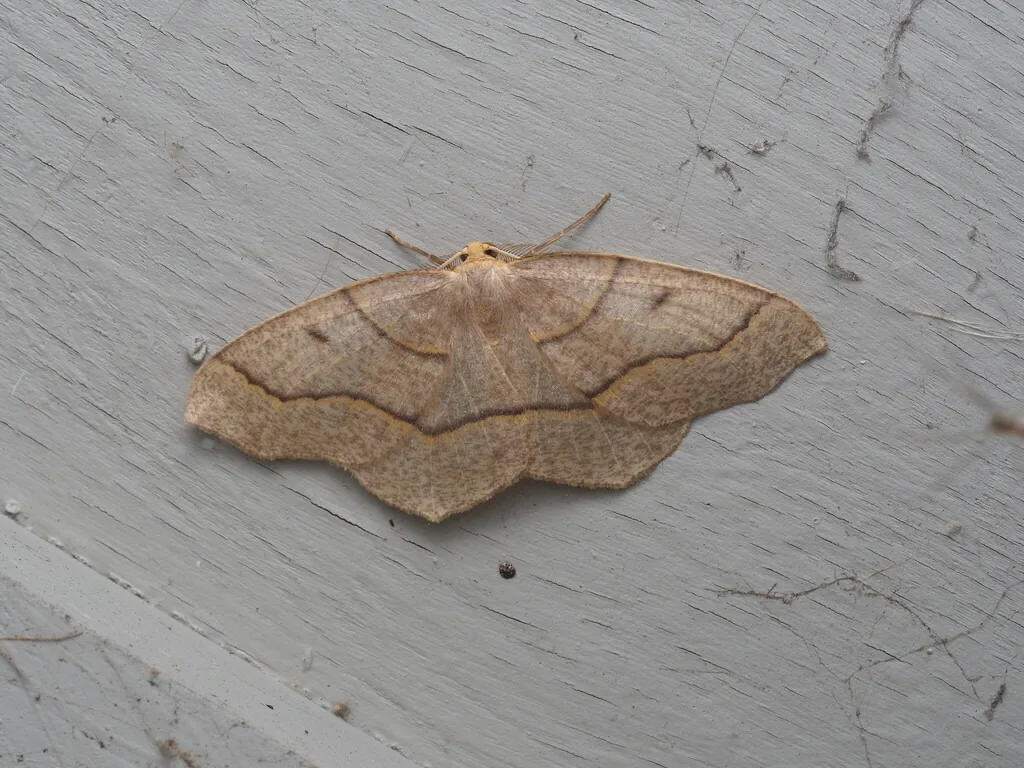
- Moths are frail and tan to gray-brown, with a wingspan of about 1.25 inches; each forewing has a band edged by two narrow dark lines, and they rest flat on tree trunks.[1][2]
- Feeding is wasteful: caterpillars nip needles that then die and turn brown, and a mat of clipped needles can collect under the tree.[1][2]
Where it lives
Native across much of the eastern half of North America; in Maine it became a serious problem in 1989, and heavy defoliation reached 225,000 acres in 1991.[1][2]
Biology and life cycle
Tiny eggs laid singly on bark, twigs and debris spend the winter and hatch from late May into July; UMass gives late May or early June, Maine mid-June through July.[1][2]
Young caterpillars feed on new needles, then move to older foliage, dropping on silk threads when disturbed.[1][2]
From late July they pupate without a cocoon in bark cracks or litter, and the moths fly from mid-August into October.[1][2]
Damage and signs
- Hemlock and balsam fir are preferred, followed by white spruce; Maine has recorded it on every native conifer and on many hardwoods and shrubs.[1][2]
- Heavy populations can strip 30 to 60 percent of the new needles and nearly all the old ones in a season; hemlock can die after one such year, fir and spruce after two or more.[1][2]
- Hardwoods are rarely harmed and recover quickly, and yard trees are mainly at risk when they border infested forest.[1][2]
Health risk
Control
Biological control
Many parasitoid wasps and flies, fungi and a virus attack it; outbreaks typically last 2 to 3 years and then collapse.[1]
Pesticides
Bacillus thuringiensis works only on young caterpillars and must be applied before they reach about 1/2 inch, so early detection matters.[2]
Common questions
- Why are my hemlock's needles browning and piling up under the tree?
- Hemlock looper caterpillars nip needles wastefully, leaving browned foliage and a mat of clipped needles below.[1][2]
- How do I check my hemlocks for loopers?
- From June 1 to July 1, tap branches weekly over a light-colored sheet; the small loopers play dead for a minute or two before moving.[1][2]
Sources
- UMass Extension Landscape, Nursery and Urban Forestry Program (Landscape Insect & Mite Guide), “Lambdina fiscellaria and L. athasaria (Hemlock Looper).” www.umass.edu/agriculture-food-environment/landscape/publications-resources/insect-mite-guide/lambdina-fiscellaria-lambdina-athasaria (accessed 2026-10-16)
- Maine Forest Service (Maine Department of Agriculture, Conservation and Forestry), “Hemlock Looper (fact sheet, Jan. 2001).” www.maine.gov/DACF/mfs/forest_health/documents/hemlock_looper.pdf (accessed 2026-10-16)
- iNaturalist, “Lambdina fiscellaria taxon page (order and family).” www.inaturalist.org/taxa/154446 (accessed 2026-10-06)